




Walking Poles as a Navigation Tool?
When we think of navigation in the wilderness, our minds typically turn to maps, compasses, and GPS devices. However, a tool already in your hands—your trekking poles—can serve as a surprisingly effective and immediate aid for navigation and route-finding. While they cannot replace traditional tools, they excel as practical, real-time assistants that complement your primary navigation system, helping you maintain your course and make safer decisions on the trail.
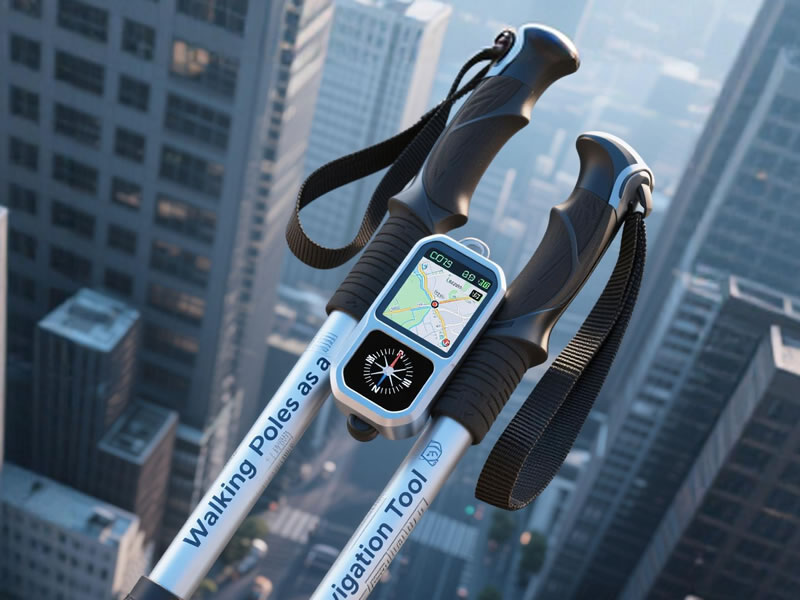
Recommended trekking pole purchase link: https://s.click.aliexpress.com/e/_c4M7OWaN
Maintaining a Straight Line in Featureless Terrain
One of the most challenging navigation scenarios is traversing featureless landscapes, such as thick fog, whiteout conditions in snow, or vast, uniform meadows where distinct landmarks are absent. In these situations, it's remarkably easy to walk in circles without realizing it. Your trekking poles provide a simple solution:
- The Straight-Line Technique: As you walk, plant your poles firmly. Before moving, turn around and visually align the imprints or holes left by your poles. Ensuring they form a straight line behind you confirms you are moving in a consistent direction. You can also align the shafts of your poles with a distant object you're aiming for, creating a physical reference line to keep you on track until you reach it.
Terrain Probing and Route-Finding
Your poles act as an extension of your senses, providing critical tactile information about the path ahead.
- Testing Ground Stability: Before committing your weight, use a pole to probe muddy sections, snowfields, or what appears to be solid ground. A sudden, deep sink can warn you of a hidden water hole or unstable terrain, allowing you to choose a safer route.
- Measuring Depth: When approaching a stream or a patch of snow, your pole is a perfect depth gauge. This information is crucial for deciding whether to cross, find a bridge, or don waterproof gear.
- Parting Vegetation: In dense brush or thick ferns, gently use your poles to push aside vegetation to scout for the actual trail, which can often become obscured. This helps you avoid veering off the designated path.
Creating a Makeshift Directional Reference
While not a precision instrument, a trekking pole can provide a basic sense of direction.
- Shadow Method: On a sunny day, plant your pole vertically in the ground. Mark the tip of its shadow with a small stone or a twig. Wait 15-20 minutes, and mark the tip of the new shadow. The line connecting the first and second points will run approximately east-west. This can help you reorient yourself if you become momentarily disoriented.
- Using the Pole as a Sight: By laying a pole on the ground and sighting along its length, you can create a temporary bearing to a nearby object, helping you walk a straight line over a short distance as you consult your map.
The "Hand-Railing" Technique
In navigation, a "handrail" is a linear feature—like a river, ridge, or road—that you can follow. Your trekking poles can help you maintain contact with this feature. For instance, if you are using a stream as a handrail, you can use your poles to consistently check your distance from the bank without having to look down constantly, allowing you to focus on your forward progress.
A Crucial Caveat: The Supporting Role
It is vital to emphasize that trekking poles are a supplementary navigation aid. They should never replace a map, compass, and the knowledge to use them. A GPS device can fail, batteries can die, but a compass will always point north. Your poles are for immediate, micro-level decisions, while your compass and map are for macro-level, strategic navigation.
In conclusion, by viewing your trekking poles as multi-functional tools that include navigation support, you elevate them from simple stability aids to integral components of your backcountry skill set. They bridge the gap between the large-scale direction on your map and the immediate, physical world under your feet, making you a more observant, safer, and more confident navigator.




