




Lightest Trekking Poles on the Market
In the relentless pursuit of ultralight backpacking, where every gram is scrutinized, trekking poles represent one of the final frontiers for significant weight savings. The quest for the absolute lightest poles has led to revolutionary designs that push the boundaries of material science and minimalist engineering. These are not merely hiking aids; they are masterpieces of efficiency, designed for the gram-counting enthusiast who values minimal weight above all else.
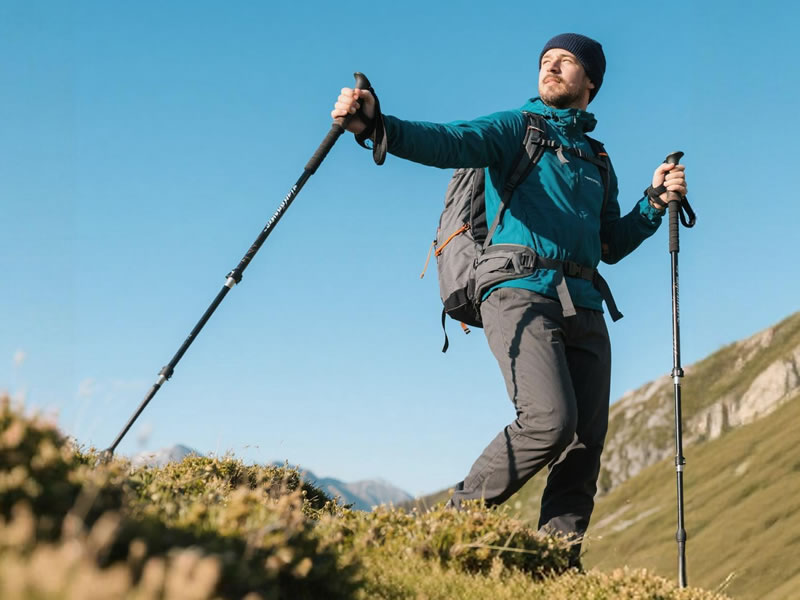
Recommended trekking pole purchase link: https://s.click.aliexpress.com/e/_c4M7OWaN
The current champions in the weight-saving arena are poles that dip below the remarkable threshold of 150 grams per pole. Reaching these ethereal weights requires an uncompromising approach that prioritizes weight savings over features, comfort, and sometimes, even durability.
The Reigning Champions of Minimal Weight
- Gossamer Gear LT5™: Often cited as the undisputed titleholder, the LT5s set a staggering benchmark at approximately 135 grams (4.75 ounces) per pole. This incredible weight is achieved through the use of premium, high-modulus carbon fiber and an aggressively minimalist design. The grips are slim, the baskets are tiny, and every single component has been pared down to its absolute functional limit.
- Zpacks Carbon Fiber Trekking Pole: A very close contender, the Zpacks pole weighs in at a formidable 170 grams (6 ounces) per pole. Like the LT5, it is a folding Z-pole constructed entirely from carbon fiber. Its design philosophy is identical: eliminate everything non-essential to create the most efficient weight-bearing structure possible.
The Engineering Behind the Featherweight
Achieving such low weights isn't accidental; it's the result of deliberate and radical design choices:
- Premium Carbon Fiber: These poles use the highest-grade, high-modulus carbon fiber available. This material offers an unparalleled strength-to-weight ratio, allowing for incredibly thin yet strong shaft walls.
- Folding Z-Pole Design: The folding "Z-pole" design is integral to this weight class. By eliminating the heavy internal locking mechanisms of telescopic poles, designers save crucial grams. The internal tension cord system is the lightest way to create a deployable pole.
- Radical Minimalism: Every single feature is scrutinized. Grips are slimmed down to mere nubs, straps are reduced to thin webbing or removed entirely, and baskets become token gestures. There are no shock absorbers, no extended foam grips, and no comfort-focused ergonomics.
The Inevitable Trade-Offs: Performance vs. Weight
Choosing one of the lightest poles on the market requires a clear-eyed acceptance of their limitations. The pursuit of the final few grams comes with significant compromises.
- Durability: This is the primary trade-off. While strong under vertical load, these ultra-light carbon fiber poles are more vulnerable to sharp, lateral impacts against rocks. A pole weighing 135 grams simply does not have the material mass to absorb a major shock that a 250-gram aluminum pole might withstand.
- Comfort: The minimalist grips offer very little padding and can become uncomfortable on long, jarring descents. The lack of a substantial strap system also means more grip strength is required, potentially leading to hand fatigue.
- Limited Adjustability: As folding Z-poles, their length is fixed once assembled. You lose the on-the-fly adjustability of telescopic poles, which is a valuable feature for optimizing ergonomics on varying terrain.
Who Are These Poles For?
The lightest trekking poles are highly specialized tools designed for a specific user:
- Experienced Ultralight Purists: Hikers whose base weight is already below 5 kg (10 pounds) and for whom every single gram is part of a larger system.
- Fastpackers and Trail Runners: Athletes who value speed and minimum carried weight above all else, often on established trails where severe pole abuse is less likely.
- The Weight-Conscious Thru-Hiker: A hiker willing to trade some durability and comfort for the immense cumulative energy savings over thousands of miles.
Conclusion: The Pinnacle of Specialization
The lightest trekking poles on the market, like the Gossamer Gear LT5 and Zpacks Carbon Fiber models, represent the pinnacle of weight-focused engineering. They are remarkable achievements that offer unparalleled weight savings. However, they are not for everyone. They demand a user who is technically skilled, hikes mindfully, and accepts that ultimate performance in one area (weight) necessitates compromises in others (durability and comfort). For the right hiker, they are not just poles; they are the ultimate expression of a lightweight philosophy, transforming every step into a more efficient motion.




