




Difference Between a Carabiner and a Quick Link? A Guide to Choosing the Right Connector
At first glance, carabiners and quick links might appear to serve a similar purpose: connecting two things together. However, their design, operation, and intended use are fundamentally different. Choosing the wrong one can compromise safety, efficiency, and the integrity of your system. This article will clarify the key distinctions, helping you select the correct connector for your specific need, whether for climbing, rigging, or everyday tasks.
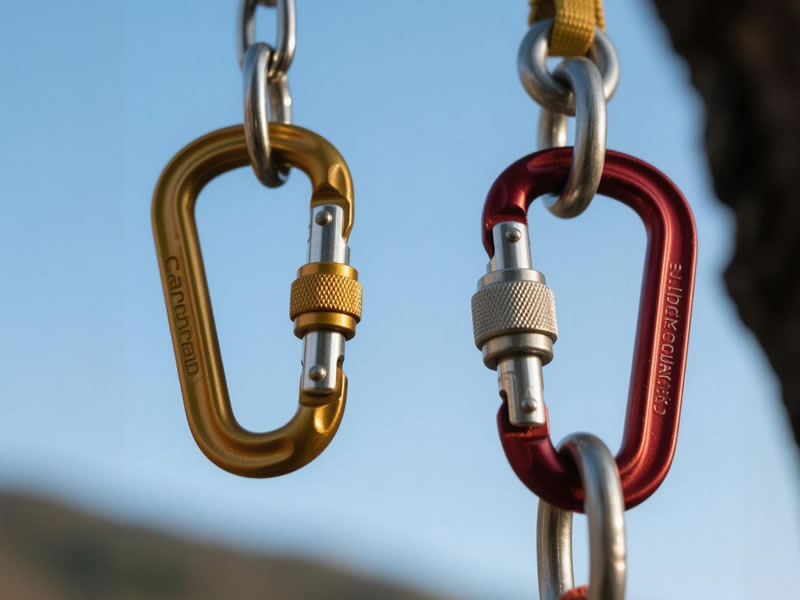
Core Design and Mechanism: The Gate vs. The Screw
This is the most apparent difference and defines their primary function.
- Carabiner: Characterized by a spring-loaded, gated opening on one side. This gate allows for quick, one-handed, and reversible attachment and detachment without dismantling the entire connection. The gate mechanisms vary (e.g., wire gate, solid gate, locking screw-gate, auto-locking) but all prioritize convenience and speed.
- Quick Link (also called a Screw Gate Link or Maillon Rapide): A solid, closed oval or D-shaped ring made from steel or aluminum. One side features a threaded collar that screws onto a matching threaded section to close the link. It forms a semi-permanent, non-gated connection that must be manually screwed shut and open.
Intended Use and Applications: When to Use Which
Their designs dictate their ideal environments.
Carabiner Use Cases:
- Life Support & Climbing: The primary domain. Used for clipping ropes into harnesses, anchors, and protection. Locking carabiners are essential for belaying and rappelling.
- Dynamic & Frequent Clipping: Any scenario requiring frequent, quick changes. Examples: attaching a dog's leash, organizing gear on a backpack, clipping a water bottle, or temporarily hanging a tool.
- Where a Gate is Necessary: Applications where you cannot thread the connector through an attachment point and must rely on a gate to clip in.
Quick Link Use Cases:
- Permanent or Semi-Permanent Anchors: Ideal for creating fixed anchor points in climbing, arborist rigging, or theater rigging. Once screwed shut, it won't open accidentally.
- High-Load, Static Connections: Used in industrial rigging, lifting, and towing where a gate is considered a potential point of failure. They are often stronger in relation to their size than non-locking carabiners.
- Connecting Looped Ends: Perfect for joining two chain ends, creating a permanent loop in a sling, or connecting hardware where both ends can be threaded through before screwing closed.
Key Comparison Table
| Feature | Carabiner | Quick Link |
|---|---|---|
| Opening Mechanism | Spring-loaded gate (locking or non-locking) | Threaded screw collar |
| Primary Advantage | Speed, convenience, reversibility | Security, strength, no gate failure risk |
| Ease of Use | Very easy, often one-handed | Requires two hands to screw/unscrew |
| Risk of Accidental Opening | Possible with non-lockers; mitigated with lockers | Virtually zero when properly tightened |
| Common Materials | Aluminum alloy, Steel | Steel, Stainless Steel, Aluminum |
| Typical Strength | Varies widely; climbing gear is kN-rated. | Often high; rated by Working Load Limit (WLL) in tons/kN. |
| Best For | Dynamic systems, frequent clipping, life support | Static systems, permanent anchors, rigging |
Critical Safety Considerations: Why You Can't Just Swap Them
- Gate Failure is Not an Option: In a critical, life-support static anchor (e.g., a top-rope anchor), a locking carabiner is acceptable but a quick link is often preferred. Why? A quick link eliminates the gate—the carabiner's most vulnerable component to cross-loading and accidental opening. For permanent installations, the security of a screw-together link is superior.
- The Convenience Trap: Never replace a locking carabiner on a climbing belay device with a quick link for convenience. The repeated unscrewing and screwing to manage the rope is impractical, slow, and increases the risk of it being left partially unscrewed.
- Strength is Contextual: While a steel quick link may have a high breaking strength, it is not a direct substitute for a climbing-rated carabiner in a dynamic system. Climbing gear is engineered for specific types of impact loads. Always use equipment with the correct certification (UIAA/CE for climbing; WLL markings for rigging) for its intended purpose.
Conclusion: Choosing Based on Function
The choice boils down to a simple question: Do you need a quick-release mechanism or a permanent, closed loop?
- Choose a carabiner when you need to clip and unclip regularly, require one-handed operation, or are engaged in dynamic activities like climbing where certified life-support hardware is mandatory.
- Choose a quick link when creating a secure, static point where a gate would be a liability, for long-term installations, or in heavy-duty rigging where its solid construction is advantageous.
Understanding this fundamental difference—the gated connector versus the screw-closed ring—ensures you use the right tool for the job, optimizing both safety and performance. Never compromise; select the hardware designed for your specific application.




