




Can Hiking Poles Be Repaired If Bent?
The sight of a bent hiking pole can be disheartening, especially if it's a trusted and expensive piece of gear. The immediate question is whether it can be salvaged. The answer is nuanced and hinges on two critical factors: the material of the pole and the severity of the bend. More importantly, it involves a fundamental consideration: safety versus economy.
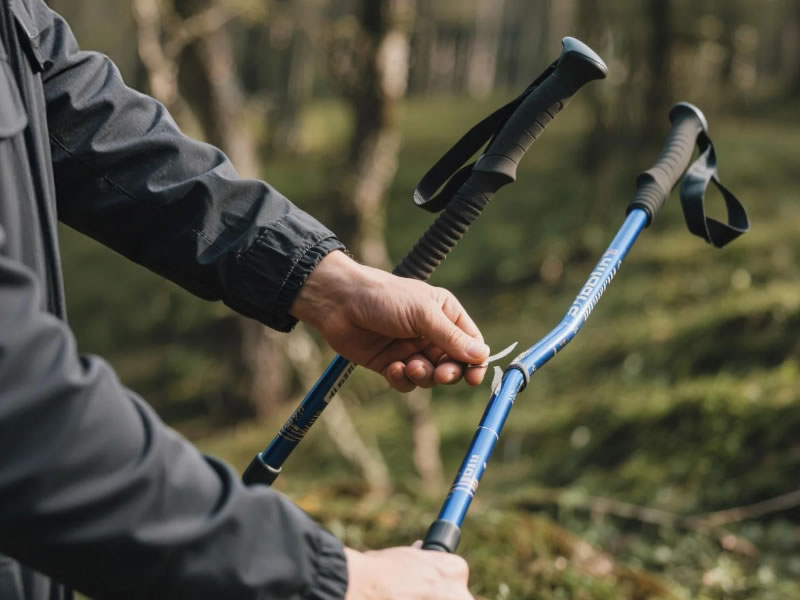
Recommended trekking pole purchase link: https://s.click.aliexpress.com/e/_c4M7OWaN
The Critical Divide: Aluminum vs. Carbon Fiber
The repair potential is almost entirely dictated by the pole's construction material.
1. Aluminum Poles: Possible, But Proceed with Extreme Caution
Aluminum, a malleable metal, can sometimes be physically straightened. However, this is rarely recommended for structural, load-bearing components.
- The Science of the Weak Point: When aluminum is bent, its crystalline structure is deformed and work-hardened at the bend. Straightening it further stresses this already weakened area, creating a high-risk fatigue failure point. It may look straight, but it has lost a significant portion of its original tensile strength and resilience.
- When Might Straightening Be Attempted? Only for a very slight, smooth bend in the middle of a shaft section—never near a lock or weld. The method involves gentle, incremental pressure (e.g., rolling on a flat surface, careful use of a padded vice). Forceful bending back will almost certainly cause it to snap.
- The Verdict: While physically possible, repairing a bent aluminum pole is a temporary, at-your-own-risk fix. It should never be trusted on technical terrain, steep descents, or for heavy weight-bearing. The risk of catastrophic failure mid-step, which could lead to a serious fall, far outweighs the cost of a replacement.
2. Carbon Fiber Poles: Absolutely Not
Under no circumstances should a bent or cracked carbon fiber pole be repaired.
- The Science of Failure: Carbon fiber derives its strength from continuous, intact fibers bound in resin. A bend indicates that these fibers have been splintered and compromised. Unlike metal, it doesn't deform plastically; it fails catastrophically. There is no safe way to restore the integrity of the fractured matrix.
- Hidden Damage: A visible bend often masks extensive internal delamination. The pole can fail suddenly and without further warning.
- The Verdict: A bent carbon fiber pole is a total loss for its structural purpose. It must be retired immediately and replaced.
The Practical and Safe Repair Pathway: Section Replacement
The true "repair" for modern, quality hiking poles is not bending them back, but replacing the damaged section. This is the only method that fully restores safety and integrity.
- Identify the Model and Part: Determine your pole's exact make and model. Most major brands (LEKI, Black Diamond, Komperdell, etc.) sell individual replacement parts—lower shafts, upper shafts, and locking mechanisms—directly or through authorized dealers.
- Order the Specific Section: If only one segment is bent, you can order just that piece. This is often far more economical than buying a whole new pair.
- Perform the Swap: Replacement is usually straightforward, involving unscrewing the old section from the grip or lock and installing the new one. This returns your pole to "like-new" condition safely.
Step-by-Step Assessment: What To Do With Your Bent Pole
- Assess the Damage: Is it a slight curve or a sharp kink? Is it on the shaft or at a joint? Is the material aluminum or carbon?
- Contact the Manufacturer: Before doing anything, check the warranty. Many brands offer limited warranties against defects. While accidental damage (like a rock fall or a misstep) is rarely covered, it doesn't hurt to inquire. More importantly, they can confirm part availability for a section replacement.
- Make the Safe Decision:Carbon Fiber: Retire it. Use it as a spare part donor (e.g., good grips, baskets) or recycle it responsibly.Aluminum with a Severe Bend/Kink: Retire it. The risk is too high.Aluminum with a Very Slight Bend: You may attempt gentle straightening for use as a backup/emergency spare on easy trails, but never as your primary pole. Prioritize ordering a replacement section.
- Implement the True Fix: Purchase and install a new shaft section. This is the only guaranteed method to regain a safe, reliable pole.
Conclusion: Safety Is Non-Negotiable
Hiking poles are critical safety equipment, bearing significant loads during precarious moments on descents, stream crossings, and uneven terrain. A failure can result in a severe injury.
While the temptation to save money by bending a pole back is understandable, it fundamentally compromises the tool's engineered integrity. The only legitimate repair for a bent pole—especially one made of carbon fiber—is replacement, not restoration.
Investigate part replacement with the manufacturer; it is the most cost-effective and utterly safe solution. When in doubt, err on the side of caution. Your poles are your allies against fatigue and instability; trusting compromised equipment undermines their very purpose. Prioritize the safety of your joints and your person by ensuring every piece of your gear is in trustworthy condition.




