




Do Hiking Poles Really Help Knees?
If you've ever finished a steep descent with your knees screaming in protest, you've likely wondered about solutions. A common piece of advice is to use trekking poles. But do they genuinely help, or is it just a placebo effect? The short, science-backed answer is a resounding yes. Hiking poles are one of the most effective, low-tech tools for protecting your knees on the trail. Here’s a deep dive into how and why they work.
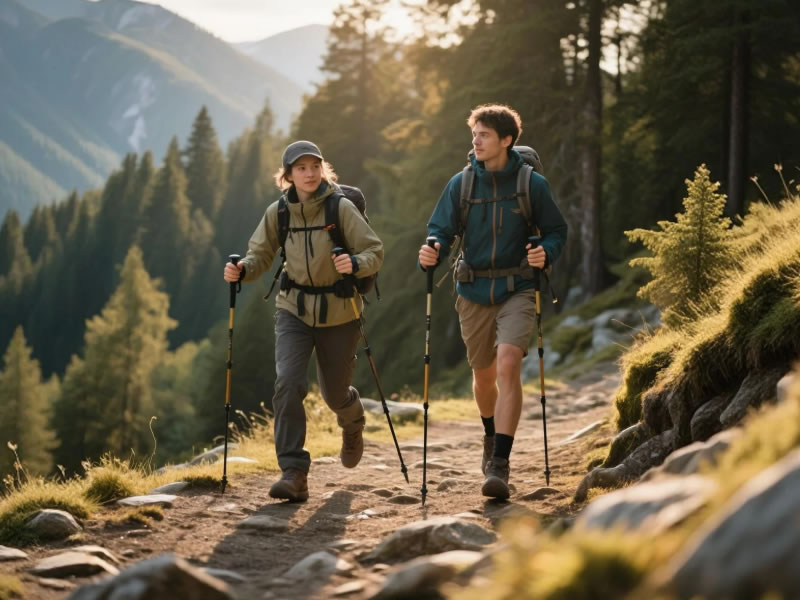
Recommended trekking pole purchase link: https://s.click.aliexpress.com/e/_c4M7OWaN
The Biomechanics: Taking the Load Off
The primary benefit comes from load distribution. When you walk or hike without poles, the full force of your body weight—plus any gear in your backpack—is absorbed by your legs with each step. During a descent, this force can multiply to several times your body weight due to gravity and momentum.
Trekking poles change this dynamic. By planting a pole with each step, you engage your upper body—your arms, shoulders, and core muscles. This action does two crucial things:
- It reduces the total compressive force on your knees. Research is clear on this point. A landmark study published in the Journal of Sports Sciences found that using trekking poles can reduce the compressive force on the knees by up to 25% during downhill walking. This is a massive reduction, equivalent to taking a significant portion of your bodyweight off your joints with every single step.
- It provides stability and slows momentum. On descents, poles act as forward anchors, allowing you to control your speed in a controlled manner rather than braking with your quads and knees. This reduces the eccentric loading (the stressful "braking" force) that is a major contributor to muscle soreness and joint strain.
Beyond the Downhill: Full-Trail Benefits
While the knee-saving effect is most dramatic on descents, poles offer protective benefits throughout your hike:
- Uphill Assistance: On ascents, you use your poles to "push off" and propel yourself upward. This leverages your upper body strength, reducing the workload on your quadriceps and knees. It makes climbs more efficient and less taxing on the lower body.
- Improved Stability on Uneven Terrain: A twisted ankle or a sudden slip can cause acute knee injuries. Poles dramatically improve balance and provide two extra points of contact with the ground, helping to prevent missteps that could lead to ligament strains or falls.
- Promotion of Better Posture: Poles encourage a more upright stance, preventing the tendency to hunch forward under a pack. This better alignment can reduce uneven stress on the knees and hips over long distances.
Important Caveats: Technique Matters
To reap these knee-saving rewards, proper technique is essential. Incorrect use can negate the benefits or even cause other issues.
- Correct Length: On flat ground, your elbow should form a 90-degree angle when the pole tip touches the ground. Shorten them slightly for uphill, lengthen them for downhill.
- Proper Grip and Strap Use: Don't strangle the grip. Instead, use the wrist strap correctly: thread your hand up from the bottom of the strap and then rest the strap across your palm before gripping. This allows you to transfer weight through your arm bones and straps without a tight, fatiguing grip.
- Rhythm: Develop a natural rhythm: opposite arm to leg (left pole forward with right foot). This provides balanced stability and efficient momentum.
Who Benefits the Most?
While all hikers can benefit, certain groups will find poles particularly invaluable:
- Hikers with existing knee concerns, osteoarthritis, or past injuries.
- Those carrying heavy overnight backpacks.
- Hikers tackling long distances or trails with significant elevation change.
- Anyone looking to hike longer into their lifetime by proactively preserving joint health.
The Verdict
The evidence is robust: hiking poles are not a gimmick. They are a proven biomechanical aid that significantly reduces impact forces on the knees. By distributing load, enhancing stability, and promoting efficient movement, they act as preventative health tools for your joints.
Investing in a sturdy, adjustable pair of poles and learning to use them correctly is one of the best decisions you can make for your long-term hiking health. Your knees—and your future self—will thank you for miles to come.




