




How to Use Wrist Straps Correctly? Mastering the Most Overlooked Skill in Hiking
For many hikers, the wrist straps on trekking poles are an afterthought—loops they mindlessly slide their hands into. However, this fundamental component is arguably the most critical for efficiency, power transfer, and injury prevention. Used incorrectly, straps can cause blisters, waste energy, and even contribute to falls. Used correctly, they transform your poles from simple balancing sticks into powerful extensions of your body, allowing you to hike farther with less fatigue.
Recommended trekking pole purchase link: https://s.click.aliexpress.com/e/_c4M7OWaN
The Core Principle: It's Not a Loop, It's a Lever
The biggest misconception is to treat the strap as a simple tether. Your hand should not be inside the loop like a bracelet. Instead, the strap is designed to create a lever system that transfers force from your skeleton to the pole with minimal muscular effort in your hand.
Proper use allows you to push down through the strap rather than squeezing the grip. This enables your larger back, shoulder, and arm muscles to do the work, while your hand remains relaxed, merely guiding the pole.
Step-by-Step Guide to Proper Strap Engagement
Follow this method every time you pick up your poles:
- Open the Strap: Locate the point where the strap splits from the grip. You'll see a clear top and bottom.
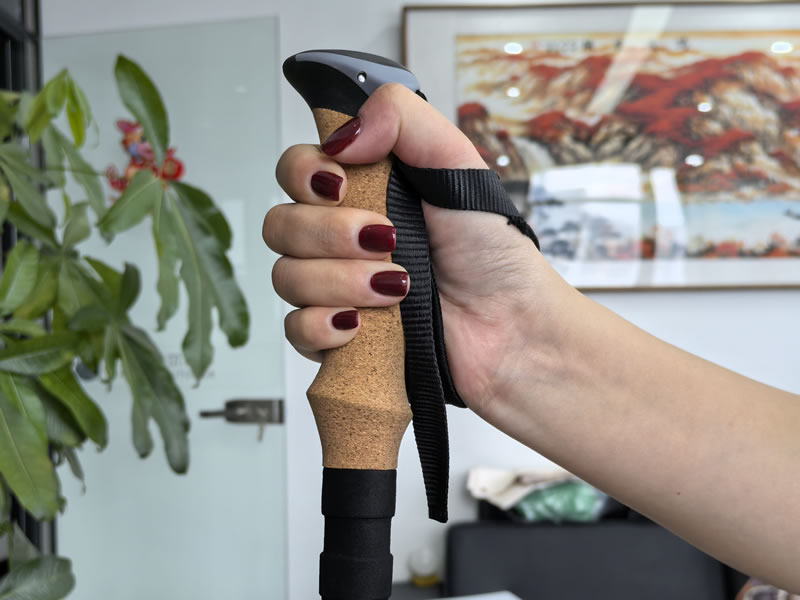
- Insert from Below: Slide your hand upward through the bottom of the strap from the palm side. Imagine you're putting on a watch from underneath.
- Grip the Handle: After your hand is through the bottom of the strap, now grip the pole handle normally.
- Position the Strap: Let the strap lie across the back of your hand and wrist. It should form a "V" or "X" between your thumb and index finger. The strap should cradle the bony part of your wrist (the ulnar styloid process).
- Adjust Tightness: Tighten or loosen the strap so it's snug but not restrictive. You should be able to open your hand fully without the strap falling off, but it shouldn't cut off circulation.
The Biomechanics: Why This Method Works
When you plant your pole and step forward, instead of clenching the grip to push yourself, you simply lean your weight into the strap. The tension of the strap against the back of your hand and wrist pulls the pole backward, creating forward propulsion. Your fingers can remain loose, often in a "C" shape around the grip.
This technique provides three major benefits:
- Eliminates Grip Fatigue & Blisters: By removing constant friction and pressure from your palm, you prevent hot spots and blisters.
- Maximizes Power Transfer: It creates a direct line of force from your skeleton, through the strap, to the pole. You get more push per plant.
- Enhances Safety: In a stumble, your hand can release the grip immediately without being tangled, allowing you to break a fall. An incorrectly worn strap can trap your hand, increasing injury risk.
Common Mistakes and How to Correct Them
- The "Bracelet" Method: Hand goes straight through the main loop. This forces you to grip tightly to control the pole, leading to fatigue and negating the strap's benefit. Correction: Always approach the strap from the bottom.
- Wearing Over a Watch or Jewelry: This creates hard pressure points that can cause pain and chafing. Correction: Remove or position your watch above the strap.
- Straps Too Loose: The pole will dangle and feel uncontrolled when you open your hand. Correction: Tighten until the pole is secure with an open palm.
- Straps Too Tight: Restricts blood flow, causes pressure points, and makes quick release difficult. Correction: Loosen to allow comfortable wrist movement.
Advanced Application: Adjusting for Terrain
- Uphill: You may slightly loosen the strap to allow for a more aggressive, shorter-range planting motion.
- Downhill: Ensure straps are snug. You will be leaning heavily into them to brace your descent and absorb shock.
- River Crossings or Technical Terrain: ALWAYS UNBUCKLE YOUR STRAPS. In a fall, you must be able to instantly discard your poles to avoid entanglement.
Strap Maintenance and Adjustment
Most straps are adjustable via a plastic slider or buckle. Ensure this mechanism is clean and functions smoothly. If your straps are worn, frayed, or uncomfortable, many brands sell replacement straps that can be easily installed, refreshing an old pair of poles.
Conclusion: From Accessory to Essential Technique
Mastering your wrist straps is a five-second adjustment that yields hours of dividends. It is the difference between carrying your poles and wielding them as efficient tools. By engaging the straps correctly, you unlock the true potential of trekking poles: to redistribute effort, protect your joints, and convert arm motion into forward momentum. On your next hike, take a moment to strap in properly. Your hands, arms, and knees will thank you for miles to come.




