




How to Hike Faster with Poles? Transforming Support into Propulsion
For many hikers, poles are viewed primarily as stability aids—tools for balance and joint protection. While these benefits are valid, they represent only half the story. Hiking poles are also powerful efficiency engines. When used correctly, they can significantly increase your walking speed and reduce your perceived effort, allowing you to cover more ground with less fatigue. This guide unlocks the techniques, gear choices, and biomechanical principles that transform your poles from passive supports into active propulsion systems.
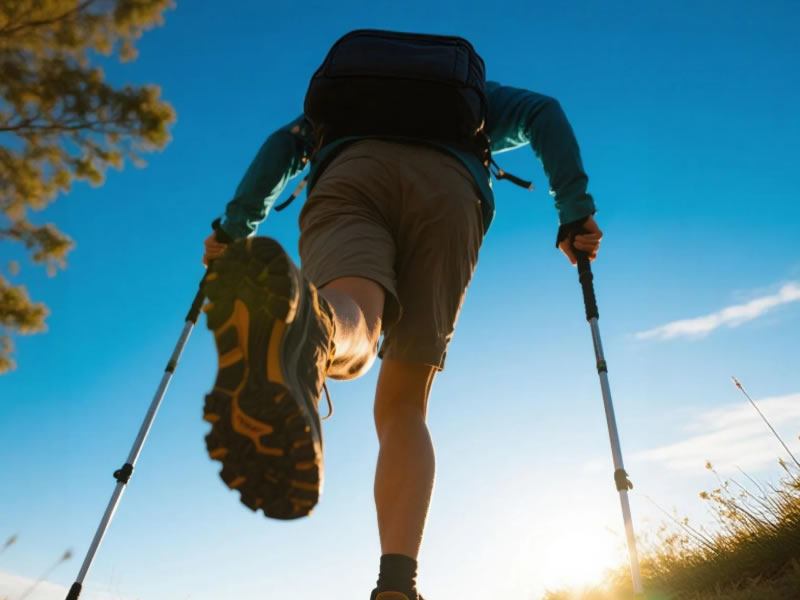
Recommended trekking pole purchase link: https://s.click.aliexpress.com/e/_c4M7OWaN
The Core Shift: From Passive Support to Active Propulsion
The fundamental mistake that slows most hikers is treating poles as passive walking canes. They plant the pole, step past it, and drag it along. This approach provides minimal speed benefit and can actually disrupt your natural gait.
The Solution: Treat each pole plant as a deliberate, powerful push-off event. Your poles should not simply meet the ground; they should push against it to drive you forward. This shift in intent is the single most important factor in hiking faster with poles.
Technique #1: Master the Propulsive Plant
The Action:
- Plant with Purpose: As your opposite foot swings forward, plant the pole tip firmly at an angle slightly behind or directly beside your trailing foot—not ahead of you.
- Push, Don't Just Place: Immediately after planting, engage your arm, shoulder, and lat muscles to push down and back against the pole. This generates forward thrust, similar to the motion of a cross-country skier.
- Complete the Extension: Allow your arm to extend fully behind you at the end of the push, maximizing the duration of force application.
Why It Works: By pushing off from a position behind your center of mass, you add propulsive force to your stride. You are no longer just lifting and placing your body; you are actively launching yourself forward with each step. This recruits your powerful upper-body musculature to assist your legs.
Technique #2: Optimize Your Rhythm and Coordination
The Opposite Arm/Leg Rule:
Maintain a strict opposite arm/leg rhythm (right pole with left foot). This is not arbitrary; it is biomechanically essential. This contralateral movement engages your core stabilizers, promotes spinal rotation, and creates a fluid, energy-efficient gait. A mismatched rhythm (poles and feet on the same side) creates a clumsy, hitching motion that slows you down and wastes energy.
Cadence:
Aim for a quick, light cadence. Your pole plants should match your foot strikes in a 1:1 ratio. Avoid long, lingering pauses with the pole tip on the ground.
Technique #3: Adjust Length for Speed on Varied Terrain
Fixed-length poles compromise speed on changing terrain. Adjustability is a speed feature.
- For Uphill Speed: Shorten by 5-10 cm. A shorter pole allows for a higher arm cadence and a more powerful rearward push. It keeps your torso upright, optimizing lung capacity. The goal is to climb with running efficiency, not plodding effort.
- For Downhill Speed: Lengthen by 5-15 cm. A longer pole allows you to plant farther ahead, creating a stable brace. This lets you run or fast-hike down steep terrain with confidence, as you can aggressively brake and transfer weight without fear of slipping or excessive joint impact.
- For Flats: Return to 90-Degree Baseline. Your standard setting (elbow at 90 degrees) is optimized for efficient, rhythmic walking.
Technique #4: Select Speed-Optimized Gear
Your equipment choices directly impact your ability to move quickly.
1. Ultralight Carbon Fiber Shafts:
Swing weight—the effort required to move the pole back and forth—is the critical metric for speed. Carbon fiber poles are significantly lighter than aluminum, reducing the energy cost of each plant. This allows for a faster cadence with less arm fatigue. Verdict: For speed, carbon fiber is non-negotiable.
2. Minimalist, Ergonomic Grips:
Bulky, heavily padded grips can feel clumsy during rapid plants. Look for streamlined, contoured grips that fit your hand securely without excess material. Cork remains excellent for moisture management and comfort during high-output efforts.
3. Secure, Instant-Adjust Locks:
You cannot afford to fiddle with twist locks when the terrain changes. External lever locks (FlickLock, Speed Lock) allow for one-handed, instantaneous length adjustments without breaking stride. This is a speed essential.
4. Low-Profile Baskets:
Use the smallest possible trail baskets. Large baskets create aerodynamic drag and can catch on undergrowth, disrupting your rhythm.
Technique #5: The "Double Plant" for Steep, Sustained Climbs
On very steep, sustained ascents where running is impossible, abandon the alternating rhythm. Plant both poles simultaneously at a point ahead of you. Use a powerful, symmetrical pull with both arms to hoist your body and pack upward. This is the most efficient method for gaining elevation rapidly with a heavy load.
Advanced: The "Nordic Walker" Grip for Flats
On flat, well-groomed trails, experiment with a more open grip. Allow the pole to swing forward from the strap, not your hand. Plant near your leading heel and push back with an open palm, emphasizing a long, powerful follow-through. This mimics classic Nordic walking technique and maximizes propulsion on level ground.
Common Speed Mistakes to Eliminate
| Mistake | Why It Slows You Down | Correction |
|---|---|---|
| Dragging Poles | Adds drag; no propulsive benefit. | Actively plant and push. |
| Death Grip | Wastes arm energy; slows cadence. | Use the strap; relax your hand. |
| Planting Too Far Ahead | Creates a braking action, not propulsion. | Plant beside or behind your foot. |
| Wrong Length | Compromises posture and power. | Adjust for every major terrain change. |
| Heavy Aluminum Poles | High swing weight; faster arm fatigue. | Invest in lightweight carbon fiber. |
Conclusion: Speed is a Skill, Not a Gift
Hiking faster with poles is not about raw fitness; it is about technique, intent, and equipment optimization. By shifting your mindset from passive support to active propulsion, mastering the propulsive plant, matching your rhythm, and equipping yourself with lightweight, adjustable gear, you unlock a new level of trail performance. You will climb with less effort, descend with greater confidence, and cover more ground with the same energy expenditure. Your poles become not just tools for stability, but engines for forward motion. Practice these skills on every hike, and soon, a faster, more fluid stride will become your new normal.




