




Should I Use One Walking Pole or Two? The Science of Symmetrical Support
It is a question almost every new hiker asks: If one pole provides some benefit, wouldn't two be redundant? Or worse—cumbersome? The answer, supported by biomechanics, clinical evidence, and the collective experience of millions of trail miles, is unambiguous. For nearly all hikers, on nearly all terrain, two poles are superior to one. This guide explains why, examines the rare exceptions where a single pole may suffice, and helps you decide based on your specific needs and hiking style.
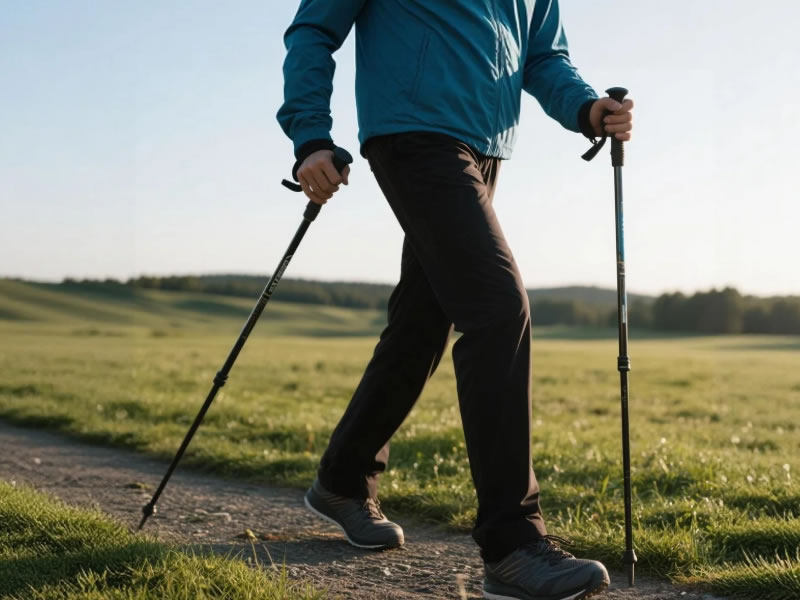
Recommended trekking pole purchase link: https://s.click.aliexpress.com/e/_c4M7OWaN
The Fundamental Principle: Your Body Is Symmetrical
Humans are bilaterally symmetrical organisms. We have two legs, two arms, two knees, and two hips. Locomotion—walking, running, hiking—is an alternating, reciprocal activity. The right leg moves forward as the left arm swings forward; the left leg moves forward as the right arm swings forward. This contralateral coordination is hardwired into our nervous system and optimizes balance, efficiency, and power transfer.
One pole disrupts this symmetry. A single pole forces your body into an asymmetrical movement pattern. You plant on one side, push off on one side, and stabilize predominantly on one side. The unassisted side must compensate—and does so imperfectly.
Two poles restore symmetry. They honor your body's natural design, providing balanced support and propulsion to both sides equally.
The Case for Two Poles: Four Key Benefits
1. Balanced Joint Protection
The single most compelling reason to use two poles is equal protection for both knees.
Research demonstrates that poles reduce compressive knee forces by up to 25% during descents . This benefit, however, is specific to the side using the pole. If you use only one pole:
- The knee on your poled side receives substantial load reduction.
- The knee on your unpoled side receives zero load reduction.
Over a long descent, this asymmetry creates a significant imbalance in cumulative joint stress. One knee is spared; the other absorbs the full impact of every step. For hikers with pre-existing conditions in one knee, this selective unloading may be temporarily useful. For everyone else, it is asymmetrical wear on a paired joint system.
Two poles ensure both knees receive equal protection.
2. Optimal Stability and Fall Prevention
Stability is a function of your base of support. With two feet on the ground, your base of support is a line between your stance foot and your trailing foot.
- One pole adds a third point of contact, creating a triangular base. This is more stable than two points, but the triangle is weighted toward the poled side.
- Two poles add two additional points of contact, creating a quadrilateral base. This is geometrically the most stable configuration achievable without additional limbs.
On uneven terrain, stream crossings, and slippery surfaces, this distinction is not academic. A single pole can assist in maintaining balance; two poles actively prevent loss of balance by providing outrigger support on both sides.
3. Efficient Propulsion
As established in our examination of walking speed, poles generate forward thrust when planted behind the body and pushed against. This propulsive force is generated each time you plant a pole.
- With one pole, you generate thrust on every other stride cycle (approximately 50% of steps).
- With two poles, you generate thrust on every stride cycle (100% of steps).
This is not merely additive; it is synergistic. The alternating push-off from both sides creates a continuous, rhythmic propulsive wave that propels you forward with significantly less perceived effort.
4. Load Distribution for Backpackers
When carrying a heavy pack, your center of gravity shifts upward and backward. This increases the demand on your lower back and reduces your inherent stability.
Two poles act as counter-levers, helping you maintain an upright posture and manage the lateral sway of a heavy load. A single pole cannot counteract rotational forces; it provides support primarily in one plane. Two poles create a stabilizing system that resists both forward-backward and side-to-side displacement.
The Case for One Pole: Examining the Exceptions
There are specific, legitimate scenarios where a single pole may be appropriate or even preferable.
1. The Traditional Hiking Staff
A single, sturdy wooden staff has been used by walkers for millennia. Its advantages:
- Simplicity: Nothing to adjust, nothing to break.
- Utility: Can be used to clear brush, test mud, or defend against animals.
- Aesthetics: Some walkers simply prefer the feel and tradition.
Limitations: A staff provides primarily downward support and lateral stability on the planted side. It offers minimal propulsive benefit and no symmetrical joint protection.
Suitable for: Casual walking on easy, non-technical terrain; individuals who prioritize simplicity over performance.
2. Injury or Recovery
A hiker with an acute injury to one arm, shoulder, or wrist may be unable to use a pole on that side. In this case, a single pole on the uninjured side is far better than no poles at all.
Similarly, individuals with unilateral knee or hip pathology may intentionally use a single pole on the unaffected side to reduce load on the affected joint. This is a legitimate therapeutic strategy, though it should be guided by a physiotherapist or physician.
3. Photography or Navigation
Hikers who frequently need one hand free for camera operation, map reading, or GPS navigation may prefer a single pole. This is a compromise between the benefits of pole assistance and the demands of other activities.
The better solution: Use two poles and develop proficiency in stowing one pole quickly when you need a free hand. Collapsible or folding poles make this practical.
4. Short, Easy Walks
For a 20-minute flat walk on paved path, the incremental benefit of a second pole may be negligible. A single pole provides adequate balance assistance, and the reduced weight and complexity may be worthwhile.
The caveat: This logic scales poorly. As soon as terrain becomes uneven, distance extends, or a pack is added, the case for two poles strengthens dramatically.
Comparative Summary: One Pole vs. Two Poles
| Consideration | One Pole | Two Poles |
|---|---|---|
| Joint protection | One knee only | Both knees equally |
| Stability | Triangular base; weighted to one side | Quadrilateral base; balanced |
| Propulsion | 50% of steps | 100% of steps |
| Load distribution (pack) | Minimal; one-sided | Optimal; symmetrical |
| Weight carried | Lower | Higher |
| Complexity | Lower | Higher |
| Cost | Half the price | Full price |
| Learning curve | Minimal | Moderate |
| Terrain versatility | Easy to moderate only | All terrain types |
| Backpacking suitability | Poor | Excellent |
The Verdict: A Decision Framework
Choose Two Poles IF:
- You hike on uneven, rocky, steep, or technical terrain.
- You carry a backpack exceeding 10-15 pounds.
- You have or wish to prevent knee, hip, or back issues.
- You value efficiency and speed on climbs and flats.
- You want maximum stability and fall prevention.
- You are backpacking, thru-hiking, or mountaineering.
Choose One Pole IF:
- You walk on flat, smooth, predictable surfaces.
- You have a temporary injury preventing two-pole use.
- You prefer the traditional staff experience and accept its limitations.
- You occasionally need a free hand and cannot develop quick-stow proficiency.
- Your walks are short, casual, and non-strenuous.
Choose Zero Poles IF:
- You are on Class 3+ technical terrain requiring hands-free scrambling.
- You are ultralight running on smooth trails where weight penalty exceeds benefit.
- You simply prefer the freedom of unencumbered arms and accept the trade-offs.
The Middle Path: One Pole, Two Purposes
Some hikers adopt a hybrid approach. They carry two poles but frequently stow one, using a single pole for casual sections and deploying both for challenging terrain, descents, or heavy loads.
This strategy captures most of the benefits of two poles while accommodating the desire for occasional one-handed freedom. It requires:
- Quick-stow capability: Folding or telescoping poles that collapse rapidly.
- Pack attachment system: A secure method for carrying one pole while using the other.
- Discipline: The willingness to deploy the second pole when conditions warrant, rather than persisting with suboptimal equipment out of convenience.
Conclusion: Two Is Not Twice as Good—It Is Exponentially Better
The question "Should I use one walking pole or two?" implies that two poles are simply one pole multiplied. This is incorrect.
Two poles are not twice as good as one. They are qualitatively different.
One pole provides point support —assistance at a single, asymmetrical location. Two poles provide system support —a balanced, integrated, whole-body assistance system that protects both knees, stabilizes both sides, and propels both strides.
For the casual walker on easy terrain, one pole may be sufficient. For the hiker—anyone who ventures onto uneven ground, carries weight, values their long-term joint health, or wishes to walk farther with less fatigue—two poles are not optional. They are essential.
Your body came equipped with two legs, two knees, and two arms. Your walking equipment should honor that design. Give both sides the same support. Your symmetrical self will thank you.




