




walking poles Speed lock vs quick lock – which adjusts faster?
When you are hiking rolling terrain where pole length needs to change frequently—shortening for steep climbs, lengthening for descents—adjustment speed becomes a critical factor. Two terms dominate the conversation: Speed lock and quick lock. But are these distinct technologies, or marketing variations on the same theme? This deep dive examines the nuances of external lever locking systems to determine which truly delivers faster, smoother adjustments on the trail.
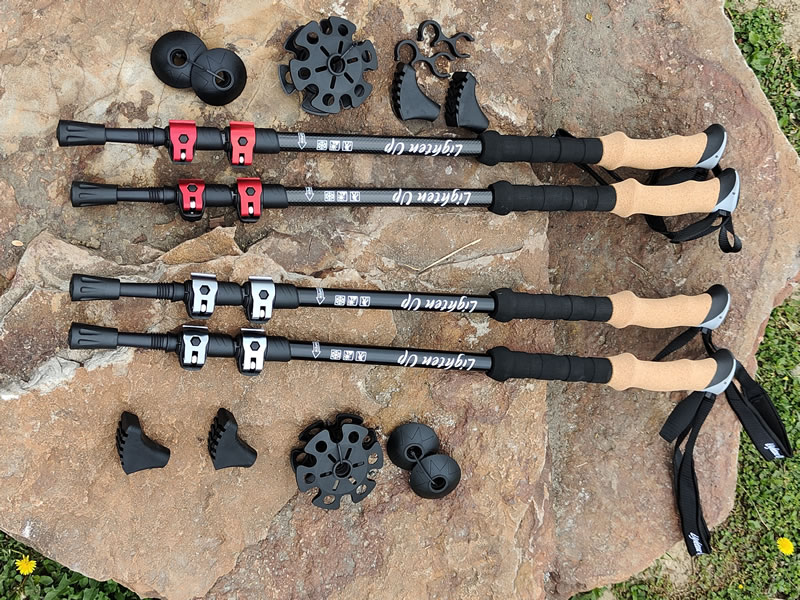
Recommended trekking pole purchase link: https://s.click.aliexpress.com/e/_c4M7OWaN
Defining the Terms
Speed Lock: This is actually a trademarked name for Leki's external lever locking system. Leki's Speed Lock (now often called Speed Lock Plus) uses a spring-loaded lever that flips open and closed with a satisfying click. The mechanism is engineered for tool-free operation and rapid adjustment. When hikers say "Speed lock," they are typically referring to this specific Leki system or its design philosophy.
Quick Lock: This is a more generic term used across the industry. Various brands—including Black Diamond (FlickLock), Komperdell (Power Lock), and others—offer their own versions of quick-release external levers. The term "quick lock" broadly describes any external lever system designed for fast, tool-free adjustment.
How They Operate
Leki Speed Lock (Plus):
The Speed Lock system features a single lever with a distinctive curved shape. To adjust: flip the lever open (it springs to a 90-degree position), slide the lower section to the desired length, then press the lever closed until it clicks. The spring-loaded design provides positive feedback—you know when it is fully engaged. The mechanism requires no tools and can be operated with one hand once you are accustomed to it.
Generic Quick Lock Systems:
Most external lever systems follow a similar pattern: open the lever, adjust the length, close the lever. However, subtle differences affect speed:
- Some levers require more travel to fully release the clamp
- Some lack spring assistance, requiring you to manually position the lever
- Some have tighter tension that requires more force to close
- Some use smaller levers that can be harder to grip with gloves
Speed Comparison: Which Is Faster?
In Ideal Conditions:
When the levers are properly tensioned and your hands are bare, the difference in pure speed is minimal. Both systems allow length changes in 3-5 seconds per pole. The Leki Speed Lock's spring-assisted lever may provide a slight edge in smoothness, but any quality external lever is dramatically faster than a twist lock (which can take 10-15 seconds and often requires two hands).
With Gloves:
This is where differences emerge. Leki's Speed Lock lever is designed with a pronounced curve that catches gloved fingers easily. The spring assist means you do not need to manually position the lever—it springs open to the correct angle. Many generic quick locks have smaller levers that can be fiddly with thick winter gloves, potentially adding 2-3 seconds per adjustment.
One-Handed Operation:
Experienced users can operate both systems with one hand while keeping the other hand on the grip. The Leki Speed Lock's positive click provides confidence that the lock is fully engaged without looking. Some generic levers lack this tactile feedback, requiring visual confirmation.
Factors Affecting Speed Beyond the Lock
Adjustment speed is not solely determined by the lock mechanism:
Tension Settings:
A lock that is too tight requires excessive force to close; a lock that is too loose may slip. Proper tension—easily adjustable with a screwdriver on most external levers—directly impacts how quickly and smoothly you can operate the mechanism.
Section Design:
Poles with clear length markings make it faster to find your preferred setting. Some poles use laser-etched rulers; others rely on guesswork.
Familiarity:
The fastest lock is the one you have practiced with. Consistent use builds muscle memory that trumps minor design differences.
The Speed Hierarchy
| Lock Type | Adjustment Speed | Notes |
|---|---|---|
| Leki Speed Lock (spring-assisted) | Very Fast (3-4 sec) | Best with gloves; tactile click |
| Quality external lever (e.g., Black Diamond FlickLock) | Fast (4-5 sec) | Reliable; slightly less spring assist |
| Generic quick lock | Moderate (5-7 sec) | Varies widely by brand |
| Twist lock (internal) | Slow (10-15 sec) | Often requires two hands |
The Verdict
Leki's Speed Lock system generally adjusts faster than generic quick locks, particularly in cold weather with gloves. The spring-assisted lever, ergonomic shape, and positive tactile feedback combine to create a truly rapid adjustment experience.
However, the gap is narrow among quality external locks. A Black Diamond FlickLock or Komperdell Power Lock is only marginally slower than a Leki Speed Lock—perhaps one second per adjustment. For most hikers, this difference is negligible in real-world use.
What matters more for speed:
- Choose any quality external lever system over twist locks
- Ensure proper tension adjustment
- Practice one-handed operation
- Look for levers with ergonomic shapes and spring assistance if you hike frequently in gloves
The fastest lock is the one that works reliably every time. Speed without reliability is no speed at all.




