




Magnetic locking walking poles – do they exist?
The short answer is no—not for securing pole length, and there are very good reasons why.
Magnetic locking systems for structural applications sound futuristic and appealing. The idea of poles that snap together effortlessly with a satisfying click is compelling. However, when it comes to supporting your body weight on uneven terrain, magnets are fundamentally unsuitable. This article explores why magnetic locks do not exist for length adjustment, what magnetic features actually appear on some poles, and why proven mechanical locks remain the only safe choice.
Recommended trekking pole purchase link: https://s.click.aliexpress.com/e/_c4M7OWaN
The Physics Problem
Magnets generate holding force, but that force has serious limitations:
Strength vs. Weight:
To create a magnet strong enough to secure a telescoping pole under dynamic loads—your body weight shifting, sudden impacts, lateral forces—the magnet would need to be enormous. Rare-earth magnets like neodymium are powerful for their size, but even they cannot match the holding power of a mechanical clamp. A magnet large enough to provide safe holding force would add significant weight, defeating the purpose of lightweight poles.
Shear vs. Pull Force:
Magnets are strongest in direct pull (pulling straight apart). Trekking poles experience shear forces (sliding or twisting) and sudden impacts. A magnetic connection that resists pulling apart may still slide or twist under lateral stress—exactly the kind of failure that causes falls.
Sudden Failure:
Mechanical locks give warning. A twist lock slips gradually; a flick lock loosens over time. A magnetic lock would either hold or release catastrophically. If a sharp impact overcomes the magnetic force, the pole collapses instantly with no warning. This is a safety risk no reputable manufacturer will accept.
What Does Exist: Magnetic Storage Features
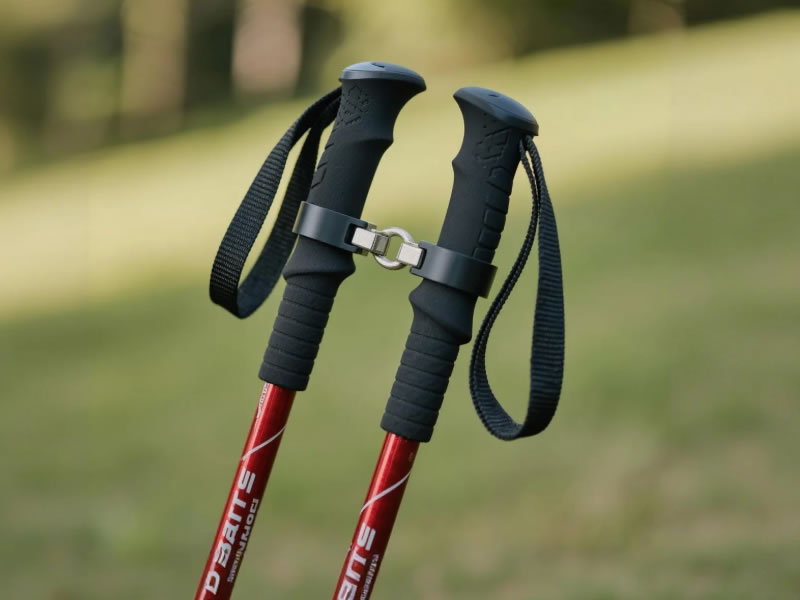
Some folding trekking poles incorporate small magnets for a completely different purpose: storage. When the poles are collapsed into their folded configuration, small magnets embedded in the sections help hold the bundle together. This prevents the sections from flopping around when the poles are strapped to a pack or stored in a suitcase.
These magnets are not structural. They do not secure the pole at hiking length. They provide convenience during transport only. Brands like Gossamer Gear and some folding carbon fiber poles have used this feature.
Why No Magnetic Length Locks?
Manufacturers have not pursued magnetic length locks because:
- Safety liability: Sudden failure is unacceptable.
- Weight penalty: Magnets strong enough would be too heavy.
- Reliability in field conditions: Dirt, ice, and debris would interfere with magnetic contact.
- No advantage over existing systems: Flick locks are already fast, reliable, and lightweight.
Proven Locking Systems
For securing pole length, stick to mechanisms with decades of proven reliability:
| Lock Type | Safety Profile |
|---|---|
| Flick lock (external lever) | Excellent; gradual failure, repairable |
| Twist lock (internal) | Good; gradual slip provides warning |
| Push-button | Fair; sudden failure possible with wear |
The Verdict
No, magnetic locking walking poles for length adjustment do not exist—and likely never will. The physics of magnetism makes them unsuitable for structural applications where safety and reliability are paramount.
Small magnets used to hold collapsed sections together are a convenience feature, not a locking mechanism. When your safety depends on your poles, trust mechanical locks that give warning before failure and can be repaired on the trail.




