




walking poles Collapsed length – how short is short enough for travel?
For outdoor enthusiasts who take their gear on the road, the ability to pack trekking poles efficiently can make or break a trip. A pair of poles that collapses into a compact bundle is far easier to slip into a suitcase, strap to a backpack, or—in the best case—tuck into carry-on luggage. But how short is “short enough” to travel without hassle? The answer depends on how you travel, what kind of luggage you use, and the ever‑changing rules of airlines. This guide breaks down collapsed length benchmarks, packing strategies, and the real‑world trade‑offs between ultra‑compact poles and their longer counterparts.
Recommended trekking pole purchase link: https://s.click.aliexpress.com/e/_c4M7OWaN
What Collapsed Length Means
Collapsed length is the shortest possible dimension of a trekking pole when fully disassembled or folded. For telescoping poles, this means all sections slid into one another; for folding (Z‑pole) designs, it is the length of the bundled sections, often held together by an internal cord or a small magnet. The number of sections directly influences collapsed length:
- 2‑section telescoping: 24–30 inches (61–76 cm)
- 3‑section telescoping: 18–24 inches (46–61 cm)
- 3‑section folding (Z‑pole): 16–18 inches (40–46 cm)
- 4‑section folding: 13–16 inches (33–40 cm)
The shorter the collapsed length, the more versatile the pole becomes for travel.
The Carry‑On Ideal: 16 Inches or Less
For travelers who hope to keep their poles in a carry‑on suitcase, 16 inches (about 40 cm) is the magic number. Most standard carry‑on suitcases have internal dimensions of roughly 22 x 14 x 9 inches. A pole that collapses to 16 inches or less can lie diagonally inside the main compartment, fit in a side pocket, or be nestled among clothing without protruding.
Why 16 inches matters:
- Airline compatibility: Although many airlines officially ban trekking poles in carry‑on, a pole that packs this small is easier to conceal and less likely to be flagged at security (though you should still check the latest rules).
- Bag fit: Fits inside small daypacks, personal items, and even some larger purses, giving you flexibility to carry poles on board if permitted.
- Protection: Short poles can be fully surrounded by clothing, reducing the risk of damage to the poles or to other gear.
Poles that achieve a collapsed length of 16 inches or less are almost always 4‑section folding designs, such as the Leki Micro Vario (15–16 inches) or Gossamer Gear GG4 (14 inches). Some 3‑section Z‑poles also fall in this range, e.g., the Black Diamond Distance Carbon Z (16 inches).
The Checked Luggage Sweet Spot: 16–20 Inches
If you plan to check your poles—either because you don’t want to risk them at security or because your poles are longer—a collapsed length between 16 and 20 inches is still very manageable.
- 18–20 inches: This range includes many 3‑section telescoping poles (e.g., Black Diamond Trail Ergo) and most 3‑section Z‑poles. They fit diagonally in a standard checked duffel or hard‑sided suitcase without requiring special tubes.
- 16–18 inches: Even easier to pack; can be placed inside a suitcase or large backpack without protruding.
Poles longer than 20 inches begin to cause packing headaches. They may need to be strapped externally, placed in a dedicated pole tube, or laid diagonally in a very large duffel. While still travel‑capable, they require more planning and are more susceptible to damage during baggage handling.
Airline Policies: The Unpredictable Factor
Collapsed length alone does not guarantee hassle‑free travel. Airline policies on trekking poles vary dramatically and are often subject to the discretion of security personnel.
- TSA (U.S.): Trekking poles are technically allowed in carry‑on luggage if they are collapsed and sheathed. However, enforcement is inconsistent; many agents consider any pole with a pointed tip a potential weapon. As a result, even a 16‑inch pole may be confiscated at the gate. The safest strategy is to always check trekking poles when flying domestically.
- International carriers: Rules differ by country. Some explicitly prohibit poles in carry‑on; others allow them if packed inside a checked bag. Always verify the specific airline’s policy before traveling.
Practical advice: Even with ultra‑short 4‑section poles, experienced travelers often choose to check them to avoid last‑minute drama. The short collapsed length then becomes a convenience for packing, not a loophole for carry‑on.
Packing Strategies
Internal packing (suitcase): Place poles in the bottom of your suitcase, ideally inside a shoe bag or wrapped in clothing to prevent rattling. Rubber tip covers protect luggage fabric from carbide tips.
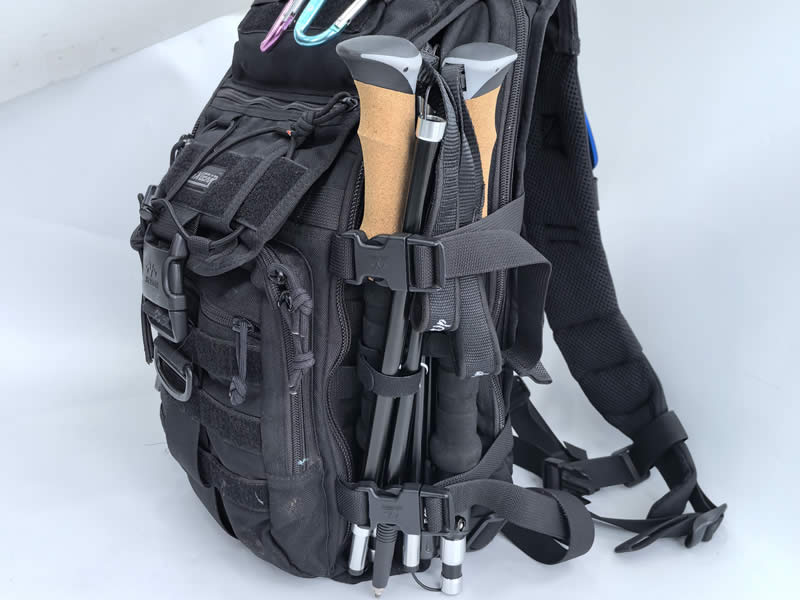
External carry (backpack): If you must carry poles externally, a collapsed length under 20 inches allows them to be strapped vertically to the side of a pack without extending above your head. Shorter poles (under 16 inches) can even be stowed inside the main compartment of a large daypack.
Protective tubes: For longer poles, consider a dedicated trekking pole tube (e.g., from REI or aftermarket). These tubes add bulk but protect poles during transit and make them easier to retrieve from checked luggage.
Trade‑Offs of Ultra‑Short Poles
Poles that collapse to 16 inches or less often use 4‑section folding designs. While they excel in packability, they have some drawbacks compared to longer‑collapsed poles:
- More sections = more flex: A 4‑section pole has more joints, which can introduce slight flex under heavy load. For most backpackers, this is negligible, but technical terrain specialists may prefer the rigidity of a 3‑section telescoping pole.
- Complexity: More sections mean more moving parts (cords, buttons, or locks), which can increase potential failure points. However, quality brands mitigate this with durable materials.
- Weight: Extra sections add a small amount of weight compared to a 2‑section pole of similar strength.
For frequent travelers, these trade‑offs are usually well worth the packing convenience.
The Verdict
For stress‑free travel, a collapsed length of 16 inches (40 cm) or less is “short enough.” Poles in this category can be packed inside most carry‑on suitcases, fit easily into checked luggage, and offer the greatest flexibility for travelers who want to keep their gear compact.
If you primarily check luggage, a collapsed length of 18–20 inches is still perfectly workable, though you lose the option to carry on. Poles longer than 20 inches become cumbersome and are best reserved for trips where you have ample packing space or a dedicated pole tube.
Final note: No matter how short your poles collapse, always verify current airline policies before flying. The most reliable approach for any trekking pole is to pack them in checked luggage. A short collapsed length simply makes that packing easier, more secure, and less likely to result in damage.
Short poles travel well. But the smartest traveler plans for the bag, not just the length.




