




Walking Poles for Reactive Dogs? A Guide to Calmer, Safer Walks
Walking a reactive dog—one who lunges, barks, or pulls toward triggers like other dogs, people, or vehicles—can be stressful and physically demanding. You’re constantly bracing for sudden movements, twisting to manage the leash, and trying to maintain balance while keeping your dog under threshold. Walking poles can be valuable tools in this context, not as training devices but as aids for your own stability, safety, and calm presence.
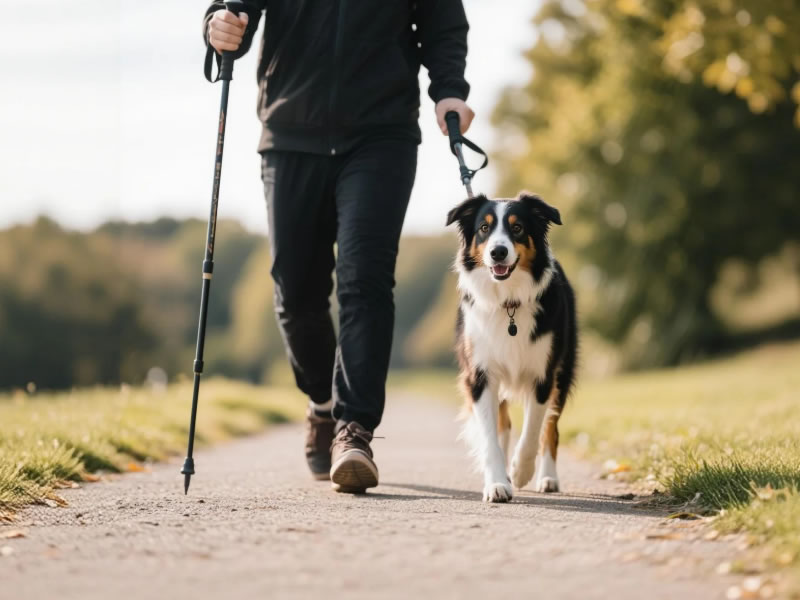
Recommended trekking pole purchase link: https://s.click.aliexpress.com/e/_c4M7OWaN
The Short Answer
Yes, walking poles can help you manage a reactive dog by improving your stability, reducing fatigue, and allowing you to remain calm and grounded when your dog reacts. They provide a secure anchor during sudden lunges, help you maintain a relaxed posture (which signals calm to your dog), and can be used as a visual barrier between your dog and a trigger. However, poles are not a substitute for proper training (counter-conditioning, positive reinforcement). They are tools for you to stay steady and focused so you can handle your dog with confidence.
How Walking Poles Help
1. Stability During Sudden Lunges
A reactive dog can pull or lunge with surprising force. Without poles, you may be pulled off balance, twist awkwardly, or even fall. With poles planted, you have a stable base—two additional points of contact—that anchors you against sudden jerks. This allows you to stay upright and in control, rather than being pulled into the dog’s reactive state.
2. Reducing Physical Strain
Constant tension on the leash, bracing for reactions, and managing a dog that pulls takes a toll on your shoulders, back, and knees. Poles distribute some of the load, reducing fatigue so you can stay calmer and more focused during the entire walk.
3. Creating a Calm Presence
Dogs read your body language. If you’re tense, gripping the leash, and hunched forward, your dog is more likely to react. Poles encourage an upright, relaxed posture. When you’re stable and grounded, your dog is more likely to mirror that calm.
4. Visual Barrier
A pole planted on the ground between your dog and a trigger can act as a subtle visual boundary. It doesn’t block the view but can help your dog orient toward you rather than fixating on the trigger. Some handlers also use a pole to gently guide their dog’s attention back to them.
5. Leash Management
With one hand on the pole and the other on the leash (or with a hands-free leash system), you can keep the leash loose and relaxed, which is essential for counter-conditioning. A tight leash signals tension; a loose leash allows your dog to feel safer.
What to Look For
- Lightweight, durable poles (carbon fiber or aluminum) so you can hold them comfortably for the whole walk.
- Cork or foam grips that stay comfortable even when your hands are sweaty or you’re gripping firmly during a reaction.
- Quick-release straps (or none) to ensure you can drop a pole instantly if needed—you never want to be tangled in a strap with a reactive dog.
- Rubber tips for quieter movement (loud clicking can add to your dog’s arousal).
Using Poles with a Reactive Dog: Best Practices
- Plant poles before a trigger appears. If you see a trigger in the distance, plant your poles, take a calm breath, and prepare to manage your dog from a stable base.
- Keep straps loose or remove them. Never loop a strap over your wrist when handling a reactive dog. If the pole gets caught or you need to free a hand, you must be able to release it instantly.
- Practice at home first. Get comfortable using poles with your dog in a low-distraction environment before introducing triggers.
- Combine with hands-free leash options. A waist belt or cross-body leash allows you to use both hands on poles while still maintaining leash control.
- Use poles as a visual cue, not a weapon. Never swing or point poles at your dog or another animal. The goal is calm presence, not intimidation.
What to Avoid
- Retractable leashes. They offer poor control and can tangle with poles.
- Clenching poles in fear. If you’re tense, your dog will feel it. Practice staying relaxed even when your dog reacts.
- Using poles as punishment. Poles are for your stability, not for correcting your dog.
When Poles Are Not Enough
If your dog’s reactivity is severe—if you’re at risk of being pulled over, if your dog is redirecting aggression toward you, or if you’re walking in high-traffic areas where a reaction could lead to a dangerous situation—seek professional help from a certified positive reinforcement trainer. Poles can support you, but they are not a replacement for a solid behavior modification plan.
What Handlers Say
“My dog is reactive to other dogs on trails,” shares Mike, who hikes with his German Shepherd. “Before poles, I’d tense up, my shoulders would ache, and I’d dread encounters. Now I plant my poles, take a breath, and I can actually manage her without getting yanked around. It’s made walks possible again.”
“I use one pole and a waist leash,” says Sarah, who works with a fearful rescue. “The pole gives me stability when she startles, and I can use it to create a little space between us and a trigger. It’s part of my ‘calm handler’ toolkit.”
The Bottom Line
Walking poles can be powerful allies when hiking with a reactive dog—not by controlling the dog, but by supporting you. They help you stay stable, reduce physical strain, maintain a calm posture, and create subtle visual boundaries. Combined with positive training, patience, and a good leash setup, poles can make walks safer, more manageable, and more enjoyable for both of you.
Disclaimer: This article provides general guidance for using walking poles with reactive dogs. For severe reactivity or aggression, consult a qualified, force-free dog trainer or behaviorist.




