




Avalanche safety – Walking poles with probes?
In the world of backcountry skiing, snowshoeing, and winter mountaineering, avalanche safety is non‑negotiable. The standard companion rescue gear includes three essential items: an avalanche transceiver (beacon), a shovel, and a probe. For hikers who already carry walking poles, a natural question arises: can those poles double as avalanche probes? The short answer is no. While walking poles share superficial similarities with probes—both are long, collapsible poles—they are not designed for the critical task of locating a buried victim. Understanding why this distinction matters could save a life.
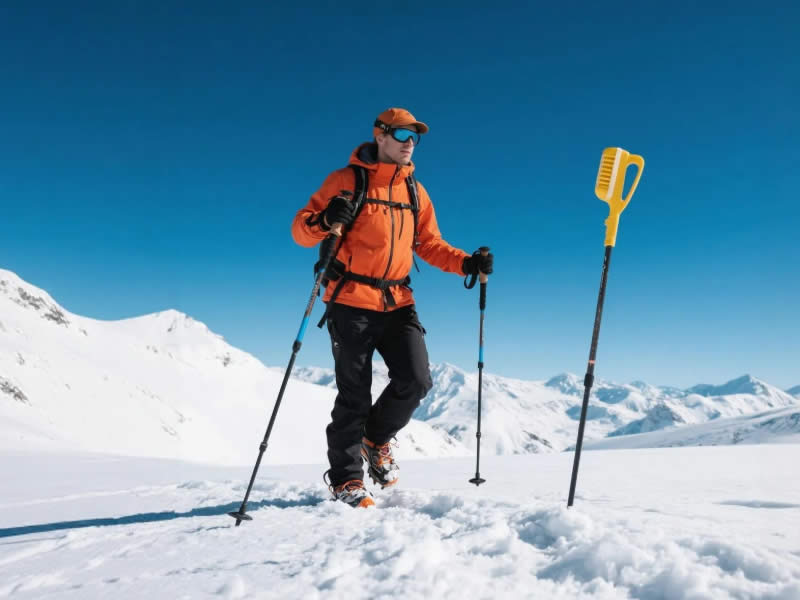
Recommended trekking pole purchase link: https://s.click.aliexpress.com/e/_c4M7OWaN
The Role of an Avalanche Probe
An avalanche probe serves one primary purpose: to pinpoint the exact location of a buried victim after a transceiver search has narrowed the area. Probing is a methodical, physically demanding process. Rescuers insert the probe into the snow debris, pushing through dense, compacted snow layers until they contact the victim’s body or gear.
Effective probing requires:
- Sufficient length – Victims can be buried several meters deep. Standard probes extend to 240–320 centimeters (roughly 8–10 feet).
- Rigid, locked sections – The probe must not collapse under downward force. Sections lock firmly together to transmit force consistently.
- Thin diameter – Probes are narrow (typically 8–12 mm) to penetrate compact snow with minimal resistance.
- Marked depth increments – Many probes have centimeter or inch markings to gauge burial depth.
Why Walking Poles Fall Short
Walking poles—whether aluminum or carbon fiber—are not designed for avalanche probing. Here’s why they cannot serve as a substitute:
1. Inadequate Length
Most trekking poles extend to a maximum of 130–145 centimeters (approximately 51–57 inches). In avalanche terrain, burial depths frequently exceed this range. A pole that cannot reach the victim’s depth is useless in rescue.
2. Unreliable Locking Under Force
Walking pole locking mechanisms (lever locks or twist locks) are designed to withstand vertical compression during normal walking—not the repeated, forceful thrusting of probing. Under the pressure of pushing through dense avalanche debris, these locks can slip or collapse. A pole that suddenly shortens during a probe strike wastes precious time and may cause the rescuer to miss the victim entirely.
3. Incompatible Tip Design
Carbide tips on walking poles are sharp and narrow, which might seem helpful for penetration, but they are not optimized for probing. More importantly, the tip is not designed to transmit tactile feedback effectively. Probes rely on a smooth, consistent tip that allows rescuers to feel the difference between snow, debris, and a body or pack.
4. Lack of Depth Markings
Even if a walking pole reached the victim, you would have no reliable way to measure burial depth—critical information for organizing excavation and coordinating with other rescuers.
The “Better Than Nothing” Myth
In survival situations, the mantra “something is better than nothing” can be dangerous. A rescuer who attempts to probe with walking poles may:
- Waste critical minutes that could have been used to deploy proper gear.
- Develop false confidence that a search area has been cleared.
- Fail to reach a deeply buried victim who might have been found with a proper probe.
If you are traveling in avalanche terrain without a probe, the correct response is not to improvise with walking poles—it is to recognize that you are traveling without essential safety equipment and adjust your plans accordingly. Choose lower‑risk terrain, stay with partners who carry proper gear, or postpone the trip.
Could Walking Poles Supplement a Probe?
Walking poles have a legitimate but supplementary role in avalanche safety:
- Terrain assessment – Poles can be used to probe snow layers while assessing stability, though this is not a substitute for a formal snow study.
- Marking – A brightly colored pole can mark the location of a victim after a proper probe has confirmed burial.
- Extending reach – In a multi‑victim scenario, a pole can be used to extend the handle of a probe or shovel for limited additional reach—but only after proper gear is already in use.
The Proper Gear Standard
For any group traveling in avalanche terrain, every member should carry:
- Avalanche transceiver – Worn on the body, powered on, and checked at the trailhead.
- Avalanche probe – A dedicated, collapsible probe meeting industry standards (240–320 cm length, locking sections).
- Snow shovel – Metal blade, collapsible handle, capable of moving dense snow.
These items are non‑negotiable. Walking poles are not replacements; they are additional tools for stability and mobility.
A Note on Combination Products
Some manufacturers produce hybrid poles that incorporate a removable probe section. These are marketed to ski tourers who want to reduce gear weight. While these products are better than using a standard walking pole as a probe, they still have limitations:
- The probe section is typically shorter than a dedicated probe.
- When the probe is deployed, the pole is non‑functional as a walking aid.
- In a rescue scenario, having your walking pole dismantled into a probe may leave you without stability during the excavation phase.
If you choose such a product, understand its limitations and always carry a full‑sized probe in high‑consequence terrain.
Final Thoughts
Walking poles are invaluable for stability, weight distribution, and mobility in winter conditions. They are not, however, avalanche probes. In a burial scenario, seconds matter. A dedicated probe—long, rigid, and designed for the task—is the only tool that can reliably locate a victim beneath the snow. If you travel in avalanche terrain, carry a proper probe, practice with it, and never compromise on the three essentials: beacon, shovel, probe. Your walking poles can stay in your hands where they belong—helping you move safely through the mountains, not substituting for the gear that could save a life.




