




App-connected Trekking Poles for technique feedback?
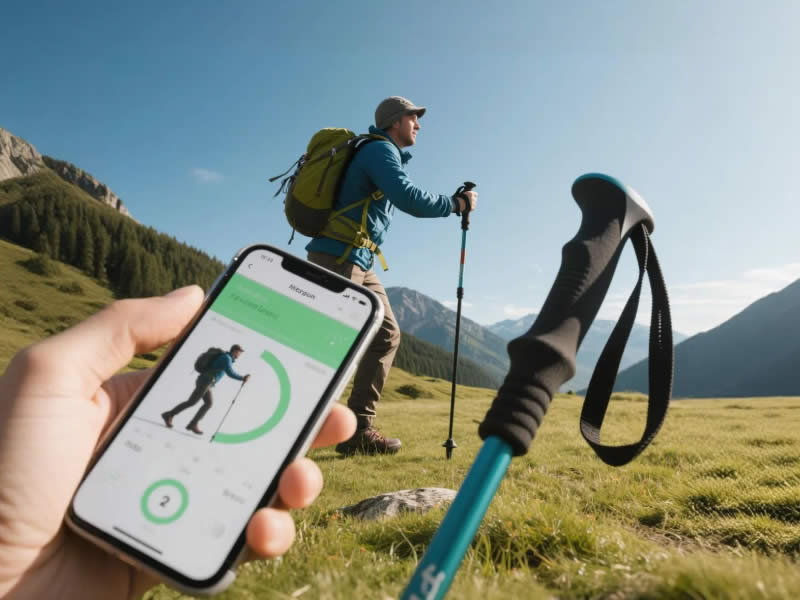
For anyone who has taken up Nordic walking or trekking with poles, one question quickly arises: Am I doing this correctly? Unlike running or cycling, where cadence and form are relatively intuitive, pole walking involves a coordinated rhythm of opposite arm and leg, a firm plant, and a controlled release. Poor technique not only reduces efficiency but can also lead to shoulder strain or blisters. Enter app-connected trekking poles—smart poles that use embedded sensors to analyze your technique and provide real-time feedback via a smartphone app. This emerging category promises to transform pole walking from a casual activity into a data-driven practice. But are they worth the investment? Let’s explore the technology, benefits, limitations, and whether they suit your needs.
Recommended trekking pole purchase link: https://s.click.aliexpress.com/e/_c4M7OWaN
What Are App-Connected Technique Feedback Poles?
These poles look like standard trekking or Nordic walking poles but contain sensors (accelerometers, gyroscopes, and sometimes force sensors) in the grips or shafts. They connect via Bluetooth to a companion app on your phone. The app analyzes metrics such as:
- Cadence – Number of pole plants per minute.
- Symmetry – Left vs. right arm force and timing; identifies imbalances.
- Plant angle – Whether you’re planting too far forward or too far back.
- Propulsive force – How much power you’re generating through each plant.
- Stride length – Estimated from pole and arm movement.
- Rhythm consistency – Variation in timing between left and right plants.
The app provides feedback in various forms: real-time audio cues (“plant slightly earlier”), visual graphs, post-walk summaries, and sometimes video tutorials showing correct form alongside your own data.
Why Technique Matters
Proper pole walking technique offers significant benefits:
- Engages core and upper body – Incorrect technique turns poles into mere walking sticks, losing 80% of the fitness benefit.
- Reduces injury risk – Overreaching or planting too far forward stresses shoulders and elbows.
- Increases efficiency – Correct rhythm propels you forward with less effort.
- Improves posture – Poles encourage an upright stance when used correctly.
Without feedback, most self-taught users develop subtle but detrimental habits. A coach or instructor is ideal, but not always accessible. App-connected poles aim to fill that gap.
How the Feedback Works
Typical workflow:
- Pair poles with app (Bluetooth).
- Select activity type (Nordic walking, fitness walking, trekking).
- Walk for a few minutes to establish baseline.
- App gives real-time voice or beep cues to adjust cadence or symmetry.
- After walk, view detailed metrics and improvement suggestions.
- Some apps offer video analysis: record yourself walking, and the app overlays sensor data.
Advanced models may include haptic feedback (vibration) in the grip to signal when you plant incorrectly, though this is rare due to battery constraints.
Current Products (2026)
The market remains small but growing. Notable examples:
- Leki Smart Nordic – Offers cadence, symmetry, and plant force tracking; app includes technique tutorials. ~$250.
- Komperdell Techniq – Focuses on real-time audio coaching; simpler interface. ~$180.
- Traxion FormPole – Budget option (~$130) with basic symmetry and cadence.
- Black Diamond Distance IQ (rumored 2027) – Might include haptic feedback.
None of these are widely available; many are direct-to-consumer or sold through specialty Nordic walking shops.
Benefits of App-Connected Poles
1. Objective feedback – You can’t feel your own asymmetry. The sensors provide unbiased data.
2. Learn at your own pace – Practice with instant corrections, no need for a live instructor.
3. Track progress – See cadence improve over weeks; identify which side is weaker.
4. Motivation – Gamification (badges, challenges) keeps you engaged.
5. Injury rehab – Physical therapists can prescribe specific symmetry targets.
Drawbacks and Limitations
1. Cost – Smart poles are 2–4 times more expensive than quality standard poles.
2. Battery life – Typically 10–15 hours. Forgetting to charge means losing feedback.
3. Durability – Electronics add complexity; water resistance varies. Not ideal for harsh backcountry use.
4. App dependency – If the app is buggy or discontinued, poles become ordinary (heavy) poles.
5. Learning curve – Some users find constant audio cues annoying or distracting.
6. Limited to pole walking – The sensors are useless for other activities.
Who Should Buy?
Ideal for:
- Nordic walking beginners – Especially those without access to a certified instructor.
- Rehabilitation patients – Recovering from stroke, joint replacement, or imbalance issues.
- Data enthusiasts – Love tracking every metric and optimizing performance.
- Fitness walkers – Who want to ensure they’re getting full upper-body engagement.
Not recommended for:
- Casual hikers – Who use poles occasionally for balance, not fitness.
- Backpackers – Who need rugged, simple gear without batteries.
- Budget-conscious buyers – Standard poles + occasional workshop is far cheaper.
- Tech-averse users – Who find smartphone apps frustrating.
App-Connected vs. Instructor: Which Is Better?
| Aspect | App-connected poles | Live instructor |
|---|---|---|
| Cost | $150–250 one-time | $50–100 per session |
| Feedback type | Quantitative (cadence, symmetry) | Qualitative (visual, tactile correction) |
| Availability | Anytime | Scheduled |
| Personalization | Limited to sensor metrics | Full body analysis |
| Motivation | Gamification | Human encouragement |
For most people, a single session with a certified Nordic walking instructor provides foundational technique that no app can replace. The instructor can see your posture, shoulder alignment, and grip issues that sensors miss. After that, app-connected poles can reinforce good habits and track progress. The ideal combination: instructor + standard poles for practice, then upgrade to smart poles if you want ongoing data.
Privacy and Data Considerations
These apps collect your movement patterns, location, and health data. Review the privacy policy. Some brands sell anonymized data to researchers; others keep it local on your phone. If you’re concerned, look for poles that store data offline or allow export/ deletion.
The Verdict
App-connected trekking poles for technique feedback are a promising niche tool for dedicated Nordic walkers, rehab patients, and data-driven fitness enthusiasts. They provide objective, real-time feedback that can improve form faster than solo practice. However, they are not a substitute for live instruction, nor are they necessary for casual hikers. The high cost, battery management, and app dependency mean they aren’t for everyone. If you already love pole walking and want to take your technique to the next level—and you enjoy gadgets—give them a try. Otherwise, invest in a lesson with a certified instructor and use standard poles. Your technique will improve, and you’ll save money for other gear. As sensor technology matures and prices drop, app-connected poles may become mainstream. For now, they remain a specialized tool for the passionate few.




