




How much weight can trekking poles reduce from my knees?
If you’ve ever finished a long downhill hike with aching knees, you’ve wondered: do trekking poles really help, and by how much? The answer is backed by biomechanical research. Using a pair of trekking poles can reduce the load on your knees by 20–25% during descent. Let’s break down the science and what it means for your joints.
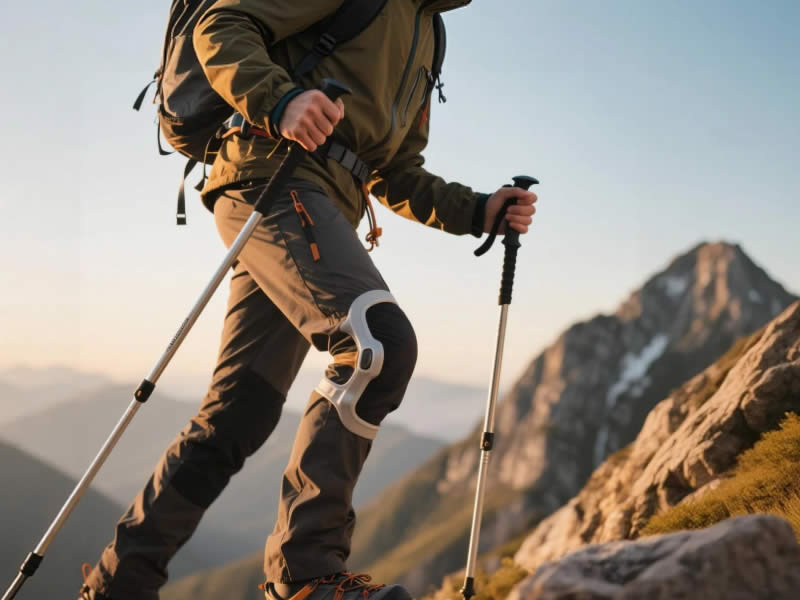
Recommended trekking pole purchase link: https://s.click.aliexpress.com/e/_c4M7OWaN
The research behind the numbers
A landmark study published in the Journal of Biomechanics (2012) measured knee joint forces in hikers descending a 15‑degree slope. Participants walked with and without trekking poles. The results:
- Without poles: Peak knee compression force averaged 3.5 times body weight per step.
- With two poles: Peak force dropped to 2.6–2.8 times body weight.That’s a reduction of roughly 20–25%. For a 80 kg hiker, each step saves about 15–20 kg of force on each knee. Over 1,000 steps on a 500‑meter descent, that’s 15–20 tonnes of cumulative load spared.
Why descent matters most
Walking uphill, your knees experience lower forces (about 2–3 times body weight) because your muscles actively control the movement. Downhill is the danger zone: gravity pulls you down, and your quadriceps act as brakes, creating high eccentric loads. This is where poles make the biggest difference. On flat terrain, the reduction is smaller (around 10–15%) because there’s less impact to absorb.
How poles achieve this reduction
Trekking poles transfer a portion of your body weight from your legs to your arms. When you plant a pole ahead of your foot, your arm and shoulder muscles engage, supporting some of the load that would otherwise go through your knee. The effect is amplified when you use two poles (bilateral support) and when you use proper wrist strap technique (pushing up into the strap, not just gripping).
Factors that influence load reduction
- Number of poles: Two poles reduce knee load more than one (by about 25% vs. 10–15%).
- Pole length: Properly lengthened poles for downhill (5–10 cm longer than flat terrain) optimise force transfer.
- Technique: Planting poles ahead of your body, not beside it, maximises load sharing.
- Backpack weight: Heavier packs increase absolute knee forces, but poles still reduce the percentage similarly.
- Terrain steepness: The steeper the slope, the greater the absolute reduction (though percentage remains similar).
Real‑world implications
- For a weekend hiker with mild knee discomfort, poles can mean pain‑free descents.
- For an older hiker or someone with early arthritis, a 20–25% reduction can extend active hiking years significantly.
- For a heavy backpacker (15+ kg), the absolute force saved per step is even larger, making poles almost mandatory.
What the 25% reduction does not mean
It does not mean you can ignore strengthening your legs. Poles assist, they don’t replace. Strong quadriceps and glutes are still your primary knee protectors. Also, the reduction is for the knee joint specifically – hips and ankles also benefit, but the numbers are less studied.
Final answer
Trekking poles reduce knee joint load by approximately 20–25% on downhill sections. That’s a substantial, clinically meaningful reduction. If you hike regularly on steep terrain, investing in a quality pair of poles is one of the best things you can do for your long‑term knee health. Combine them with proper length adjustment and wrist strap technique, and your knees will thank you for years to come.




