




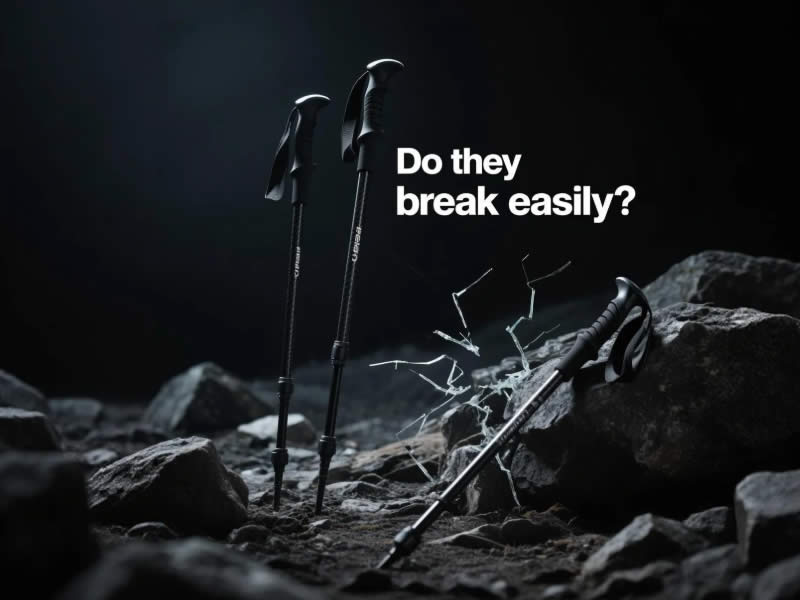
Do carbon trekking poles break easily?
This is the most common question about carbon fiber trekking poles – and the answer isn't a simple yes or no. Carbon poles are not fragile, but they fail differently than aluminum. Understanding how and when they break will help you decide if they're right for your hikes.
Recommended trekking pole purchase link: https://s.click.aliexpress.com/e/_c4M7OWaN
The short answer
Under normal, vertical loading (planting the pole straight down), carbon poles are very strong and will not break easily. However, they can snap suddenly when subjected to lateral (sideways) forces – like getting wedged between rocks, falling sideways with the pole trapped, or using the pole to pull yourself up a steep ledge. Aluminum bends in these situations; carbon shatters.
Why carbon breaks – the material science
Carbon fiber is made of thin strands of carbon atoms woven together and set in epoxy resin. It has incredible tensile strength (pulling) and compressive strength (pushing) along the axis of the fibers. But it is brittle under point impacts or torsion. When a carbon pole is bent sideways, the fibers on the outside stretch beyond their limit, and the epoxy cracks catastrophically. There is no warning bend – one moment the pole is fine, the next it's in two pieces.
Real‑world scenarios where carbon poles break
- Jam between rocks: You're walking on a boulder field. The pole tip slips into a crack, you continue moving forward, and the shaft is levered sideways. Snap.
- Trip and fall: You trip on a root, and your body weight lands on the pole at an angle. Carbon can snap at the ferrule or joint.
- Using as a lever: You try to pull yourself up a steep step by grabbing the middle of the pole. The lateral force snaps it.
- Dropping on a sharp edge: A carbon pole falls tip‑first onto a granite edge – the impact can crack the shaft.
How common is breakage?
Among thru‑hikers on the Pacific Crest Trail (mostly smooth, well‑maintained trails), carbon pole breakage rates are low – perhaps 5–10% over a 4,000 km hike. But on the rugged, rocky Appalachian Trail, breakage rates are significantly higher. Anecdotally, many hikers report snapping one carbon pole per long trail. Aluminum poles, by contrast, rarely snap – they bend, and you can often straighten them.
When carbon poles are safe to use
- Smooth, well‑maintained trails (e.g., German Rennsteig, Camino de Santiago).
- Trail running or fastpacking where you plant lightly and move quickly.
- Ultralight backpacking with a total pack weight under 10 kg.
- Flat or rolling terrain with few rocks or roots.
When to avoid carbon
- Rocky Alpine terrain (e.g., Bavarian Alps, Dolomites).
- Scrambling or off‑trail hiking where poles can get jammed.
- Heavy backpacking (over 15 kg) – the extra weight increases lateral stress.
- Clumsy hikers who fall often.
How to make carbon poles last longer
- Never use them as a lever to pull yourself up.
- Avoid planting at extreme sideways angles.
- Don't extend them beyond the “STOP” mark.
- Inspect for cracks after any hard fall.
- Carry a spare section or repair sleeve (some brands offer them).
Final verdict
Carbon trekking poles do not break easily under normal, vertical use – but they can snap without warning under lateral stress. For smooth trails and lightweight loads, they are reliable and offer great weight savings. For rugged, rocky terrain or heavy packs, choose aluminum. The key is matching the pole material to your hiking style. If you're unsure, start with aluminum – it's more forgiving. If you go carbon, treat them with respect and accept that a single bad jam could end your pole.




