




What is the difference between Nordic walking poles and trekking poles?
At first glance, Nordic walking poles and trekking poles look similar – two sticks with pointed tips. However, they are designed for different activities, and using one for the other can lead to discomfort or even injury. Here are the key differences.
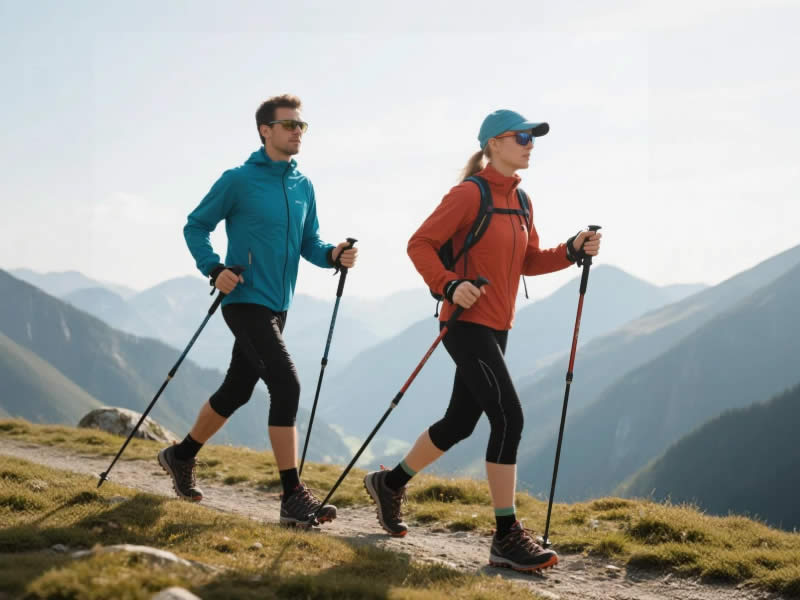
Recommended trekking pole purchase link: https://s.click.aliexpress.com/e/_c4M7OWaN
Purpose and movement
- Nordic walking poles are designed for fitness walking on flat, even surfaces like pavement, gravel paths, or gentle park trails. The technique involves a specific diagonal arm‑leg motion that engages the upper body, similar to cross‑country skiing. The poles are used to propel you forward, not primarily for balance or support.
- Trekking poles are designed for hiking on uneven, steep, or rocky terrain. Their main purpose is to provide stability, reduce impact on knees, and assist with balance during ascents and descents. You plant them for support, not propulsion.
Length adjustability
- Nordic walking poles are almost always fixed length. They should be sized to your height (typically height × 0.68) and do not adjust. A fixed length ensures consistent technique and efficient power transfer.
- Trekking poles are adjustable (telescopic or foldable). You need to shorten them for uphill and lengthen them for downhill. Adjustability is essential for varying trail gradients.
Grip and strap design
- Nordic walking poles feature a special glove‑like strap (often called a “cork or rubber grip with an integrated glove”). Your hand goes into the strap, and you release the grip on the backswing – the strap stays attached to your wrist, allowing a natural open‑handed motion. This is key to the Nordic walking technique.
- Trekking poles have a simple wrist strap (adjustable loop). You push your hand up through the strap and grip the handle. The strap transfers load from your grip to your arm, but you do not release the pole during the stride. The grip is usually cork or foam for comfort.
Tip and basket
- Nordic walking poles often have a removable rubber tip (paw) for pavement, and a carbide tip underneath for soft surfaces. They may have a small, permanent basket. The tip is angled slightly to facilitate the rolling planting motion.
- Trekking poles have a carbide tip as standard, with interchangeable baskets (small for summer, large for snow/mud). The tip is straight, designed to bite into dirt, rock, or ice.
Weight and construction
- Nordic walking poles are typically lightweight (150–200g per pole) and often made of carbon or aluminium. They need to be swung repeatedly, so low weight is critical.
- Trekking poles are slightly heavier (250–300g per pole for aluminium) because they need more durability for rocky terrain. Carbon trekking poles exist but are lighter.
Can you use them interchangeably?
- Using trekking poles for Nordic walking: Possible but not ideal. The adjustable length may shift during the rhythmic motion; the wrist straps are not designed for release; the tips may be too aggressive for pavement. Many people do it casually, but technique suffers.
- Using Nordic walking poles for trekking: Not recommended. Fixed length cannot adapt to steep slopes; the glove strap can be awkward for planting; the poles are less durable for rocky trails; and the lack of large snow baskets limits winter use.
Which one should you buy?
- Choose Nordic walking poles if you primarily walk on flat, paved or gravel paths for fitness, and you want to engage your upper body.
- Choose trekking poles if you hike on uneven, steep, or off‑road terrain, even occasionally. They are far more versatile for outdoor adventures.
Final verdict
Nordic walking poles and trekking poles are designed for different activities and are not truly interchangeable. Nordic poles are fixed‑length, have glove straps, and are for fitness walking on flat surfaces. Trekking poles are adjustable, have simple wrist straps, and are for hiking on varied, steep terrain. If you do both activities, you likely need two separate pairs. For most outdoor hikers in Germany, trekking poles are the correct choice.




