




Are folding Z-poles as strong as telescopic poles?
This is a critical question for any hiker choosing between lightweight foldable poles and traditional telescopic models. The short answer is: no, folding Z‑poles are generally not as strong as telescopic poles, especially when it comes to lateral (sideways) forces or heavy loads. However, “strong enough” depends entirely on your terrain and hiking style. Let’s break down the engineering and real‑world performance.
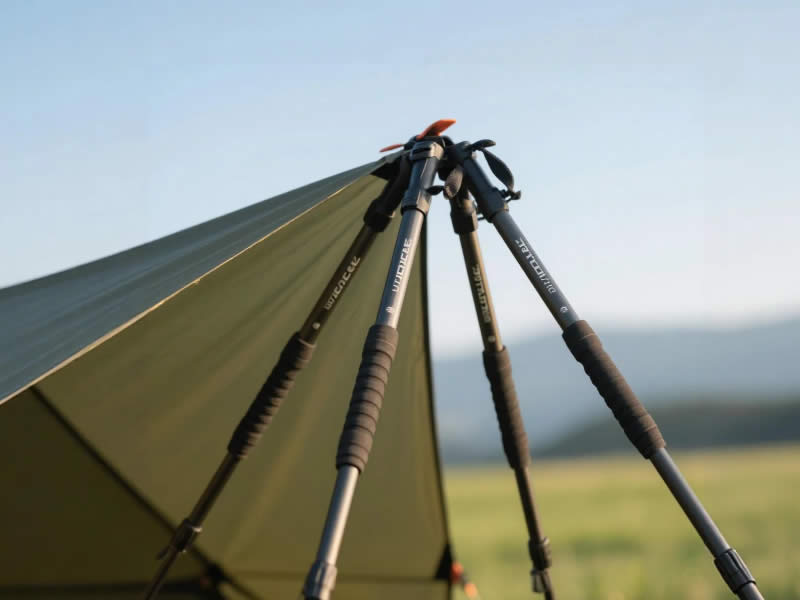
Recommended trekking pole purchase link: https://s.click.aliexpress.com/e/_c4M7OWaN
How the designs differ
- Telescopic poles consist of 2–3 nested tubes that slide into one another. When extended, the overlapping sections create a continuous, reinforced column. The locking mechanism (usually lever or twist) adds compression strength. Under lateral stress, the overlap distributes force across a longer area, reducing the risk of bending or snapping.
- Folding Z‑poles use a tension cord to connect 3–4 separate shaft sections. Each section snaps into place via a push‑button or cam joint. The walls are often thinner to save weight. When force is applied sideways (e.g., jamming the pole between rocks), the joints act as stress concentrators. The cord allows some flex, but the sections can snap at the joint or in the middle of a thin‑walled tube.
Strength in different loading directions
- Vertical compression (planting straight down): Both types are very strong. A quality Z‑pole can support 100+ kg vertically. For normal walking on flat or gentle slopes, you won’t notice a difference.
- Lateral (sideways) force: This is where Z‑poles are significantly weaker. If you trip and your body weight pushes the pole sideways, or if the tip gets wedged in a crack while you continue moving forward, the leverage can snap a carbon Z‑pole. Aluminum Z‑poles may bend. Telescopic poles, with their overlapping sections and thicker walls, resist lateral force much better.
- Torsion (twisting): Z‑poles with push‑button joints can rotate slightly, but the cord limits twisting. Telescopic poles are more rigid.
Real‑world failure examples
- Z‑pole failure: A trail runner plants a pole in a hidden root. The pole catches, the runner falls sideways, and the carbon shaft snaps just above the lower joint. The pole is unusable.
- Telescopic failure: The same scenario with an aluminum telescopic pole: the shaft bends slightly. The hiker can often straighten it enough to continue the hike. Later, the bent section can be replaced.
When Z‑poles are strong enough
- Trail running or fastpacking on well‑maintained, non‑technical trails.
- Ultralight backpacking with total pack weight under 10 kg.
- Hiking on smooth, rock‑free terrain (e.g., forest paths, gravel roads).
- Day hikes where you prioritize packability over durability.
In these scenarios, modern Z‑poles from reputable brands (Black Diamond, Leki, Komperdell) are sufficiently strong and have a very low failure rate.
When telescopic poles are mandatory
- Rocky Alpine terrain (e.g., Bavarian Alps, Dolomites).
- Heavy backpacking (pack weight over 12–15 kg).
- Scrambling or off‑trail hiking where poles can get jammed.
- Winter hiking with deep snow (snow baskets add lateral stress).
Quantifying the difference
Independent lab tests (e.g., Outdoor Gear Lab) have shown that a typical aluminum telescopic pole can withstand about 50–60 kg of lateral force before bending. A carbon Z‑pole of similar weight may fail at 30–40 kg. However, the failure mode is different: telescopic bends, Z‑pole snaps. For vertical load, both exceed 100 kg.
Durability over time
Telescopic poles generally last longer because the overlapping sections protect the locking area from grit. Z‑poles have exposed joints that can collect dirt, leading to wear on the push‑button mechanism. However, high‑end Z‑poles are very reliable for their intended use.
Final verdict
Folding Z‑poles are not as strong as telescopic poles under lateral stress or heavy loads. However, for many hikers – especially those on smooth trails, running, or carrying light packs – they are strong enough. Choose telescopic for rugged terrain, heavy packs, or if you tend to be rough on gear. Choose Z‑poles for weight savings, packability, and low‑impact hiking. Never assume Z‑poles can handle the same abuse as a good aluminum telescopic pole – they can’t.




