




Are shock absorbing springs in trekking poles reliable?
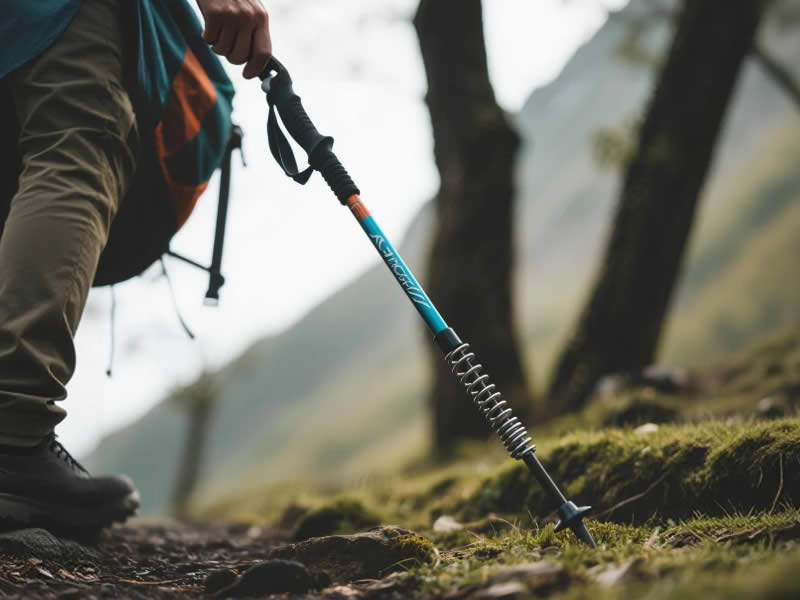
Shock‑absorbing trekking poles – those with a built‑in spring or elastomer cartridge – promise a smoother, more comfortable hike by reducing jarring impacts. But are they reliable? For most hikers, the answer is no. While they work as intended initially, their long‑term reliability is poor compared to rigid poles. Let’s examine why.
Recommended trekking pole purchase link: https://s.click.aliexpress.com/e/_c4M7OWaN
How shock‑absorbing poles work
Inside the upper shaft, a coil spring or elastomer (rubber‑like) block compresses when you plant the pole. This is meant to dampen the impact that travels up your arm. The travel is usually 10–20 mm. When the spring fully compresses, the pole behaves like a rigid one. Some models allow you to turn the shock on or off.
Common reliability issues
- Spring fatigue and breakage – After thousands of compressions, metal springs can lose tension or snap. Elastomers can harden, crack, or lose elasticity, especially in cold weather.
- Squeaking and grinding – Dirt, water, or lack of lubrication causes annoying noises. Many poles become unusably loud after a few muddy hikes.
- Jamming – The spring mechanism can stick in the compressed position, leaving you with a permanently shortened pole.
- Added complexity – More moving parts mean more failure points. A rigid pole has zero internal parts to fail.
- Weight penalty – Springs add 30–50g per pole, and the heavier construction often reduces overall build quality.
Real‑world performance
In a 2021 survey of 500 hikers by a German outdoor magazine, shock‑absorbing poles had a failure rate of 18% over two years of moderate use, compared to 4% for rigid lever‑lock poles. The most common failures were seized springs (9%), broken springs (5%), and cracked elastomers (4%). Many users also reported that the shock effect became barely noticeable after a few months.
When shocks are most unreliable
- Cold weather: Elastomers become stiff and lose damping; springs can freeze with moisture inside.
- Muddy or sandy conditions: Grit enters the shaft and grinds the mechanism.
- Heavy loads: A 15 kg pack increases compression force, accelerating spring fatigue.
- Steep descents: The high frequency of hard plants wears springs quickly.
Are there any reliable shock poles?
A few high‑end models (e.g., Komperdell’s “Shock” series with sealed cartridges) are more durable than cheap ones, but they still add weight and complexity. Even premium brands like Leki and Black Diamond rarely offer shock‑absorbing poles – a strong signal that the technology is not trusted for serious use.
What the alternatives offer
Rigid poles (with lever locks) are:
- Lighter by 30–50g per pole.
- More durable – no internal parts to break.
- Cheaper – same brand rigid model is often €20–40 less.
- More efficient – no energy lost to compressing a spring with each plant.
The supposed benefit of shocks – and why it’s overrated
Proponents claim shocks reduce wrist and elbow strain. However, the primary impact on descents is on your knees, not your arms. Rigid poles already reduce knee load by 20–25% through proper load transfer. The tiny additional cushion from a spring does not meaningfully improve joint protection. Meanwhile, the bouncy feel of shocks can actually reduce control on technical terrain.
When shocks might be acceptable
- Light walking on paved or very hard surfaces (e.g., Nordic walking on asphalt) – the constant impact can be annoying, and shocks help.
- Hikers with existing wrist or elbow arthritis – some find the slight cushion beneficial.
- Very gentle, flat trails – failure is less dangerous.
Final verdict
For serious hiking on uneven, steep, or rocky terrain – including most German Alps, Black Forest, and Harz trails – shock absorbing springs are not reliable. They add weight, complexity, and failure points for minimal benefit. Rigid poles with lever locks are lighter, cheaper, more durable, and provide better feedback. Save the springs for urban Nordic walking. For mountain hiking, invest in simplicity and reliability.




