




Do trekking poles make hiking more tiring or easier?
This is a common debate among new hikers. Some feel poles are unnecessary extra weight; others swear by them. The scientific answer is clear: for most terrain and hikers, trekking poles make hiking easier – not more tiring – by reducing joint strain, improving balance, and distributing effort across more muscles. Let’s break down why.
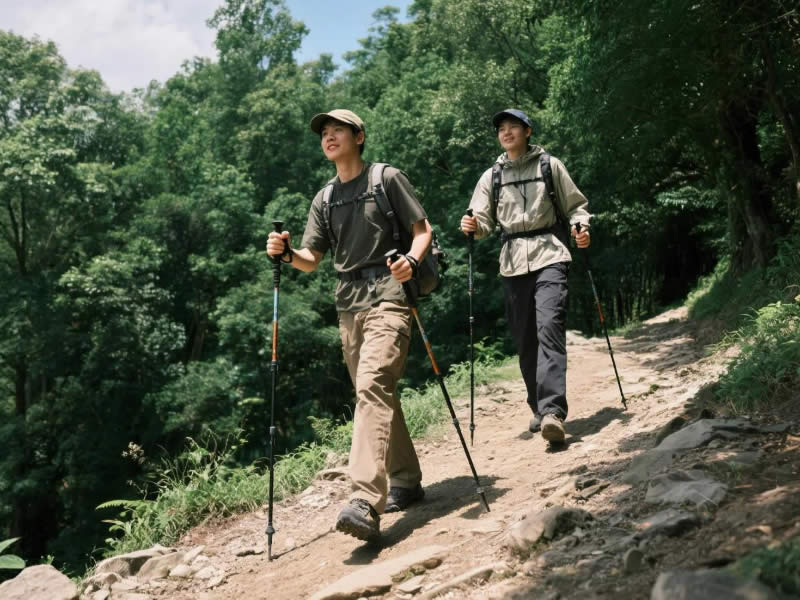
Recommended trekking pole purchase link: https://s.click.aliexpress.com/e/_c4M7OWaN
The energy equation
Hiking is not just about calories burned; it’s about fatigue management. Trekking poles add about 400–500g of weight to your hands. At first glance, that seems like extra work. However, they transfer a significant portion of the load from your legs to your arms and shoulders. On steep descents, this reduces knee impact by 20–25% (research from Journal of Biomechanics). On ascents, poles help you push upward, taking some strain off your quadriceps.
When poles make hiking easier
- Steep descents: Without poles, your legs act as brakes, hammering your quadriceps and knees. With poles, you plant ahead and transfer weight to your arms. Most hikers feel noticeably less leg fatigue after a long downhill when using poles.
- Steep ascents: Poles allow you to use your arm strength to help pull/push you up. This spreads the work across more muscle groups, reducing the load on your legs.
- Uneven or slippery terrain: Poles provide four points of contact, improving balance. You waste less energy recovering from stumbles or tensing up on unstable ground.
- Heavy backpack: A pack shifts your center of gravity forward. Poles counteract this, reducing back and shoulder strain. For loads over 10 kg, poles are almost essential.
When poles might feel more tiring
- Flat, smooth, short trails (under 5 km): The benefit is minimal. The extra arm movement can feel unnecessary, and you might tire your shoulders if you’re not used to poling.
- Poor technique: If you don’t use wrist straps correctly, you’ll grip the poles too tightly, leading to hand and forearm fatigue. Proper strap use makes poles effortless.
- Overly long poles: If poles are too long, you’ll hike with elevated shoulders, causing neck and upper back fatigue. Adjust length properly.
What the research says
Several studies have measured energy expenditure (oxygen consumption) with and without poles. Results vary by terrain:
- On flat ground, poles increase energy expenditure by 5–10% because you’re moving extra mass. However, this small increase is offset by reduced leg muscle fatigue.
- On steep terrain, poles reduce overall perceived exertion by 15–20% because they spread the load. Hikers report feeling less tired after a long climb when using poles.
The fatigue trade‑off: legs vs. arms
Without poles, your legs do nearly all the work. With poles, your arms and shoulders contribute. Since your leg muscles are larger and more prone to fatigue on long hikes, offloading some work to your upper body actually reduces total fatigue. Your arms may feel a new kind of tiredness at first, but after a few hikes, they adapt.
Real‑world experience from long‑distance hikers
Thru‑hikers on trails like the Pacific Crest Trail (4,000+ km) almost universally use poles. They report that poles reduce leg fatigue, prevent knee pain, and allow them to hike longer days. Many also use poles to set up shelters (e.g., tarp tents). The few who don’t use poles often cite personal preference, not energy savings.
Proper technique to avoid fatigue
If poles make you more tired, you’re likely using them wrong:
- Use wrist straps: Insert hand from below, then grip. The strap bears weight, not your fingers.
- Shorten poles for uphill (elbow at 90° when holding near the top).
- Lengthen poles for downhill (plant ahead of your body).
- Don’t death‑grip – relax your fingers.
- Swing naturally – don’t over‑reach.
Final verdict
For the vast majority of hikers on moderate to steep terrain, trekking poles make hiking easier, not more tiring. They reduce leg fatigue, protect knees, improve balance, and spread work across more muscles. The small extra weight and arm movement are far outweighed by the benefits. Only on very flat, short, or paved walks are poles unnecessary. If you find poles tiring, check your technique and length adjustment. Once mastered, you’ll wonder how you ever hiked without them.




