




Do trekking poles work well on slippery or icy trails?
Winter hiking in Germany – whether on the icy trails of the Zugspitze, the frozen paths of the Black Forest, or the slippery planks of a high‑alpine via ferrata – raises a critical question: will your trekking poles actually help, or will they become a hazard? The answer is yes, if you equip them correctly and use proper technique. Standard summer poles can be dangerous on ice; the right setup transforms them into life‑saving tools.
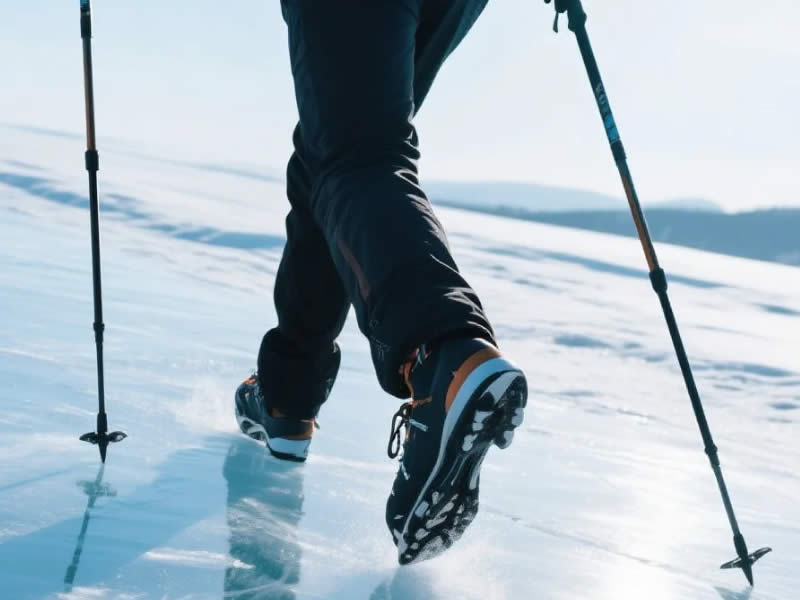
Recommended trekking pole purchase link: https://s.click.aliexpress.com/e/_c4M7OWaN
The problem with standard tips on ice
A bare tungsten carbide tip is hard and pointy. On wet rock or hard‑packed snow, it provides decent grip. But on smooth, solid ice (e.g., glacial ice or frozen waterfalls), a carbide tip skids sideways with almost no bite. Worse, rubber tips (used for pavement) are deadly on ice – they have zero traction. Without modification, your poles will slip, potentially causing a fall.
Solutions for icy trails
- Carbide tips alone – Acceptable for hard snow (neve) or mixed ice/dirt. Not safe for pure ice.
- Ice grips (spiked rubber covers) – These are rubber boots that fit over your carbide tip, with small metal spikes (usually 2–4 spikes) protruding from the bottom. They provide excellent traction on solid ice. Brands like Leki (“Ice Grips”), Black Diamond (“Ice Tip”), and Komperdell offer them for €10–20 per pair.
- Ice claws / crampon tips – Some poles have a replaceable tip that is essentially a miniature ice crampon (a star‑shaped cluster of small spikes). These are even more aggressive than ice grips and are ideal for steep glacier travel.
- Snow baskets – While not for grip, large snow baskets prevent the pole from sinking into soft snow, which is essential when transitioning from ice to powder.
How well do they work?
With ice grips or ice claws, trekking poles work very well on icy trails. You can plant firmly, lean on them, and even use them to arrest a minor slip. Many winter mountaineers use a single ice axe for steep slopes and poles for moderate terrain, but for flat to moderately angled ice, poles with ice tips are sufficient. In a test by the German Alpine Club, poles with ice grips provided 3–4 times more lateral resistance on ice than bare carbide tips.
Technique for icy conditions
- Plant vertically, not at an angle: On ice, a slanted pole is more likely to skid. Try to plant straight down.
- Use two poles: Four points of contact (two feet + two poles) are far more stable than two.
- Shorten poles slightly: A shorter pole gives you more control and reduces leverage that could cause a slip.
- Test your grip before leaning: Give the pole a firm push to ensure the tip has bitten.
- Carry an ice axe for steep slopes: For slopes over 25–30 degrees, an ice axe is safer than poles.
When poles are not enough
On steep, exposed ice (e.g., a frozen couloir), trekking poles with ice grips are not a substitute for an ice axe and crampons. The poles are not designed for self‑arrest (stopping a slide) – the wrist strap can snag, and the shaft may break. For serious glacier travel or technical ice, use proper mountaineering tools.
Product recommendations for ice
- Leki Ice Grips: Fit most Leki poles and many others. Four small spikes. Around €15.
- Black Diamond Ice Tip: A spiked rubber cover, compatible with Black Diamond and many standard tips. €12.
- Komperdell Ice Star: A star‑shaped metal tip that replaces the standard carbide tip. Very aggressive. €20.
- Cascade Mountain Tech Ice Tips: Budget option, around €8. Works well for occasional use.
DIY and temporary solutions
- Screw a small hex nut over the tip – the sharp edges provide some bite on ice (not recommended for serious use).
- Wrap wire or cord around the tip – gives minimal improvement.
- Better to buy proper ice grips.
Final verdict
Yes, trekking poles work very well on slippery or icy trails – provided you add ice grips or ice claws. Standard carbide tips are insufficient on solid ice. With the right attachment, your poles become reliable stabilisers on frozen ground, snow, and mixed ice. However, for steep, exposed ice, carry an ice axe instead. Always test your setup on a safe patch before committing to a dangerous traverse. And remember: on ice, two poles are far better than one. Stay safe, and enjoy the winter wonderland.




