




How to use trekking poles for trail running efficiently?
Trail running with trekking poles can boost your speed, reduce leg fatigue, and improve stability on technical terrain. But the technique differs significantly from hiking. Efficient running requires lightweight poles, a quick cadence, and the ability to stow them on the fly. Here’s how to master the skill.
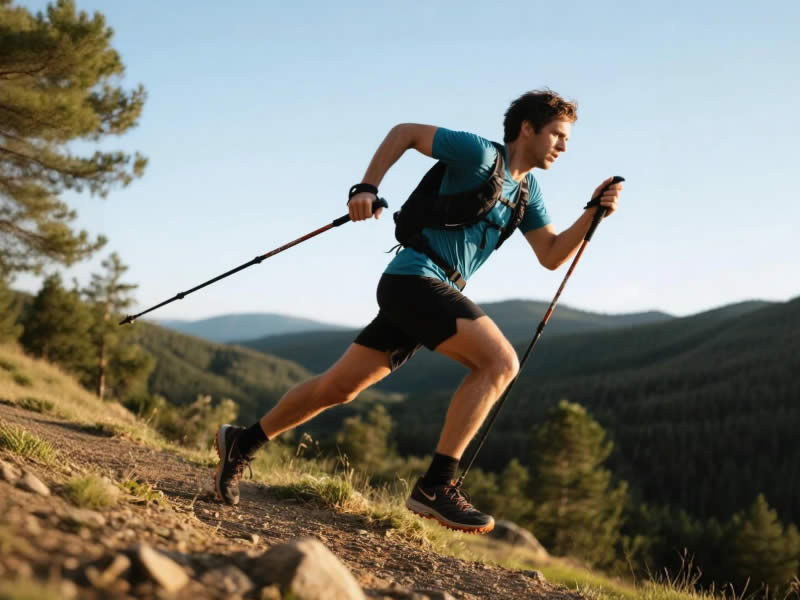
Recommended trekking pole purchase link: https://s.click.aliexpress.com/e/_c4M7OWaN
Choose the right poles for running
Standard hiking poles are too heavy and slow to deploy. For trail running, use ultralight foldable (Z‑pole) poles:
- Weight: Under 150g per pole (300g per pair).
- Material: Carbon fiber – stiff and light.
- Grip: Foam (warm, comfortable, and lightweight).
- Length: Fixed or with minimal adjustment. Choose based on your height (e.g., 120 cm for a 175 cm runner).
Top models: Black Diamond Distance Carbon Z, Leki Ultratrail FX.One, Komperdell C4 Carbon Pro.
Set the correct length
For running, use a slightly shorter pole than for hiking. Stand with elbows at 90° – the tip should touch the ground. Then shorten by 2–5 cm. A shorter pole promotes a faster cadence and prevents over‑reaching. If using fixed‑length poles, choose a size that matches your height (most brands have a size chart).
Master the running pole technique
1. Light, quick plants – Unlike hiking, you don’t need to push hard. Plant the pole lightly, just enough to maintain rhythm. Over‑planting slows you down and wastes energy.
2. High cadence – Aim for 170–190 steps per minute. Your pole plants should match your foot strikes: opposite pole to forward foot. The poles should feel like an extension of your arms.
3. Short stride – Keep your feet under your body. Over‑striding with poles can cause tripping.
4. Relaxed grip – Use wrist straps loosely (or not at all for very short runs). Your hands should be relaxed, almost holding the poles like eggs. A death grip tires your forearms.
5. Use poles for climbing – On steep uphills, shorten your effective grip by choking down on the foam extension. Plant both poles together and pull yourself up, using your arms to save leg energy.
6. Descending with poles – On steep, technical downhills, plant poles ahead to brake and stabilise. Keep the plants light and quick. For moderate descents, you may stow the poles.
Stowing and deploying poles while moving
The key to efficient trail running is knowing when to use poles and when to stow them.
- Stow when: On flat, smooth sections, or long, non‑technical descents.
- Deploy when: On steep climbs, muddy or rocky terrain, or when you need extra balance.
Stowage methods:
- Running vest pockets: Many vests have elastic loops or bungees on the front or back. Fold your Z‑poles and slide them diagonally into the front stretch pocket or under a bungee cord.
- Magnetic clips: Some vests have magnetic toggles that snap onto the pole grips. Quick and secure.
- Hand carry: For short sections, you can carry both poles in one hand (folded) while running.
Practice stowing and deploying at home – try to do it in under 10 seconds without stopping.
Drills to improve efficiency
- Cadence drill: Run on flat ground with a metronome set to 180 bpm. Plant poles every second beat.
- No‑poles intervals: Run 100 m without poles, then 100 m with poles, focusing on the difference in leg effort.
- Uphill bounding: On a moderate slope, use poles to launch yourself up with exaggerated pushes.
- Stow/deploy practice: On a safe trail, stop, stow poles, run 50 m, then deploy and continue. Repeat until smooth.
Common mistakes to avoid
- Planting too far forward – This slows you down and stresses shoulders. Plant just ahead of your forward foot.
- Using hiking‑style heavy plants – Running requires a light touch.
- Gripping too tightly – Relax your fingers; let the pole pivot.
- Forgetting to stow – Carrying poles unfolded when not needed throws off your balance.
- Poles too long – Causes over‑reaching and shoulder strain.
Energy savings and performance gains
Studies show that using poles on steep, technical trails can reduce leg muscle fatigue by 15–20% and improve running economy (oxygen consumption) by 5–8% compared to no poles. On flat ground, poles offer little benefit and may increase energy cost slightly – hence the importance of stowing them.
Final verdict
Efficient trail running with poles requires ultralight foldable poles, a shorter length, light quick plants, a high cadence, and the ability to stow them when not needed. Practice the rhythm, drill your transitions, and use poles primarily on climbs and technical sections. With a few hours of practice, you’ll run faster, climb stronger, and finish your runs with fresher legs.




