




Can trekking poles help with carrying a heavy backpack?
If you’ve ever shouldered a 15‑kg backpack for a multi‑day trek, you know the strain: aching shoulders, a forward pull that threatens to tip you over, and legs that feel like lead. Trekking poles are often seen as accessories for balance, but they are also powerful tools for managing heavy loads. The short answer is yes – trekking poles help significantly when carrying a heavy backpack. Here’s how and why.
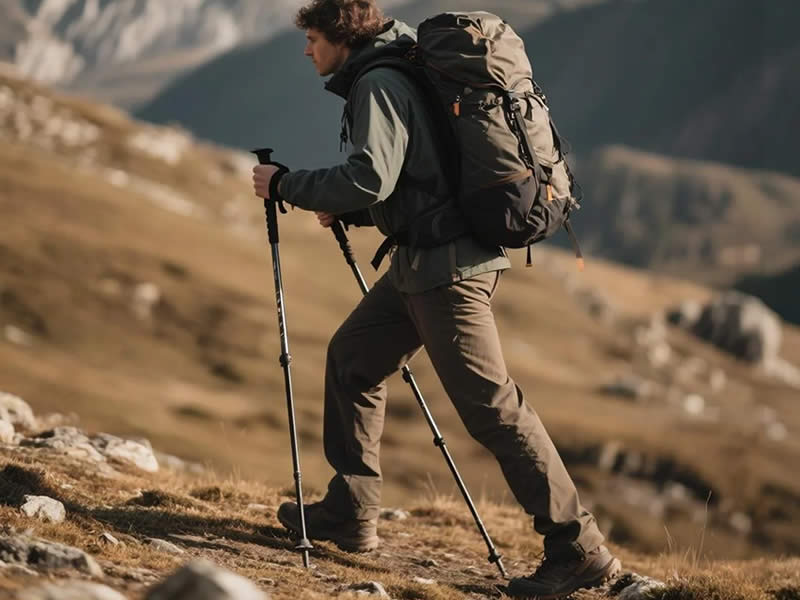
Recommended trekking pole purchase link: https://s.click.aliexpress.com/e/_c4M7OWaN
How a heavy pack changes your biomechanics
A heavy backpack shifts your center of gravity upward and backward (if loaded poorly) or forward (if you lean). Your body compensates by leaning forward at the hips, rounding the shoulders, and tightening the lower back. This “hiking slouch” increases fatigue, compresses spinal discs, and puts extra stress on your knees, especially downhill. Without poles, every step is a battle against the pack’s weight.
Four ways trekking poles help with heavy loads
1. Load transfer from legs to arms
When you plant a pole and push down, you transfer a portion of your body weight (including the pack) from your legs to your arms and shoulders. Studies show that using two poles can reduce knee joint loading by 20–25% on descents. For a heavy pack, this reduction is even more noticeable because the absolute load on your knees is higher. Your arms become active partners in carrying the weight.
2. Improved balance and stability
A heavy pack makes you top‑heavy and more prone to falls, especially on uneven terrain. Two poles add two extra points of contact, widening your base of support. This dramatically reduces lateral sway and the risk of tripping. When you stumble, a quick pole plant can arrest the fall before it happens.
3. Reduced shoulder and back strain
Without poles, your trapezius and shoulder muscles must constantly contract to keep the pack straps from digging in. With poles, you can take some weight off your shoulders by pushing down into the poles. This shifts some load to your latissimus dorsi and triceps, giving your shoulders a break. Many heavy backpackers report less neck and shoulder pain after switching to poles.
4. Assistance on uphills
On steep ascents, a heavy pack multiplies the work your quadriceps must do. Poles allow you to use your strong upper body to pull yourself up. Plant both poles ahead, then push down and pull back – you’ll feel your arms helping your legs. This can reduce the perceived effort of a steep climb by 15–20%.
Proper technique for heavy loads
- Use two poles – never one. A single pole unbalances you and transfers load unevenly.
- Lengthen poles slightly – add 2–3 cm to your flat‑terrain length. The extra leverage helps with the pack’s weight.
- Shorten for uphill – 5–10 cm shorter than flat length for steep climbs.
- Lengthen for downhill – 5–10 cm longer than flat length for descents.
- Use wrist straps correctly – hand up from below, strap between thumb and index finger. The strap bears the weight, not your grip.
- Plant firmly – with a heavy pack, you need a solid plant. Push down with conviction.
What to avoid
- Weak, wobbly poles – cheap twist‑lock poles may slip under heavy loads. Use quality lever‑lock poles (Leki, Black Diamond).
- Carbon poles – they can snap under lateral stress from a heavy pack. Choose 7075 aluminum.
- Using poles that are too short – this forces you to lean forward, increasing back strain.
Real‑world evidence
Thru‑hikers on the Pacific Crest Trail (4,000 km) almost universally use poles. Many report that without poles, their shoulders would be in agony by day two. German Alpine Club (DAV) instructors require poles for any backpacking course with loads over 10 kg.
Final verdict
Yes, trekking poles are immensely helpful when carrying a heavy backpack. They transfer weight from your legs to your arms, improve balance, reduce shoulder strain, and make steep climbs more manageable. To get the full benefit, use two quality aluminum poles with lever locks, adjust length for terrain, and master wrist strap technique. Your knees, shoulders, and back will thank you – especially on multi‑day treks with a heavy pack. Never hike heavy without them.




