




How to store trekking poles in a backpack when traveling?
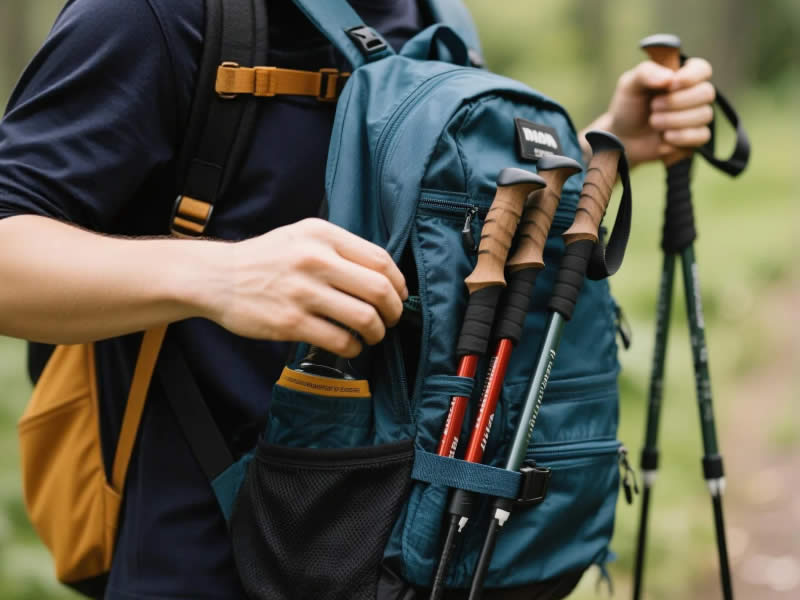
Traveling with trekking poles – whether by plane, train, or car – requires careful packing to protect both the poles and your other gear. Improper storage can lead to bent shafts, damaged tips, or punctured tent fabric. Here’s how to store trekking poles safely and efficiently inside or on your backpack.
Recommended trekking pole purchase link: https://s.click.aliexpress.com/e/_c4M7OWaN
Step 1: Collapse or fold your poles
- Telescopic poles: Completely collapse each section to the shortest length. Ensure all locks are loosened slightly (to prevent pressure damage) but not so loose that sections slide apart.
- Foldable (Z) poles: Fold them completely by pulling the sections apart and bending at the joints. The folded bundle should be tight – the internal cord will keep sections together.
Step 2: Remove baskets and tips
- Take off baskets (small summer or large winter baskets) by pulling or twisting. Store them in a small ziploc bag to avoid losing them.
- Cover carbide tips with rubber tip covers (often included with poles). If you don’t have covers, use a wine cork, a piece of duct tape, or a thick glove – anything to prevent the sharp tip from poking through your backpack or damaging clothing.
Step 3: Choose your carry method
Option A: Inside the pack (best for air travel)
- Vertical placement: Place collapsed poles vertically inside the main compartment, against the back panel. This keeps weight close to your spine.
- Use a stuff sack or pole bag: Many poles come with a fabric bag. If not, use a lightweight stuff sack or wrap them in a piece of clothing (e.g., a fleece jacket) to prevent rattling.
- Keep tips at the bottom: Position the tip end at the bottom of the pack, away from your back. If a tip cover fails, the bottom of the pack is more durable.
- Secure with compression straps: If your pack has internal compression straps, use them to hold the poles in place.
Option B: External carry (convenient for quick access)
- Side compression straps: Slide collapsed poles vertically under the side compression straps. This is fast and leaves pack space free.
- Daisy chain / ice axe loops: Insert the pole tips into an ice axe loop at the bottom of the pack, then secure the upper section with a strap or bungee.
- Top lid: Place poles horizontally between the top lid and the main pack body, securing with the lid straps. Not recommended for flying (airlines may consider them external and require checking).
Step 4: Prepare for air travel
- Check airline regulations: Most airlines allow trekking poles in checked luggage only. They are often prohibited in carry‑on luggage because they can be used as blunt instruments. Always confirm with your airline.
- Pack in checked bag: Place collapsed poles inside your checked backpack or a durable duffel bag. Use padding (clothes) to prevent damage from other items.
- If carrying on (rarely allowed): Poles must be collapsed and completely enclosed within the pack, with no tips exposed. Even then, security may confiscate them. Safest to check.
Additional tips for different types of travel
- Train or bus travel: You can usually carry poles openly, but keep them collapsed and in a bag to avoid bothering other passengers.
- Car travel: Store poles in the trunk or footwell. If left in the sun, the heat can weaken carbon shafts – don’t leave them in a hot car for days.
- International travel: Research destination regulations – some countries (e.g., Australia, New Zealand) have strict biosecurity rules for used trekking poles (they must be clean of soil and seeds).
Maintenance before storage
- Clean your poles: Wipe off mud, dirt, and salt. Pay attention to locking mechanisms – grit can wear them down.
- Dry completely: Moisture trapped inside telescopic sections can cause corrosion. Extend poles and let them air dry before collapsing for storage.
- Inspect for damage: Check for cracks, bent sections, or worn tips. Repair or replace before your next trip.
Final checklist for packing poles
- Collapsed / folded to shortest length
- Baskets removed and stored
- Tips covered with rubber caps or alternative
- Placed vertically inside a stuff sack or wrapped
- Positioned against back panel (inside) or secured with external straps
- Checked airline rules (if flying)
- Clean and dry
Final verdict
Proper storage of trekking poles when traveling protects both the poles and your other gear. Collapse or fold them, remove baskets, cover the tips, and store them vertically inside your pack (in a stuff sack) for air travel, or externally using side compression straps for quick access. Always check airline regulations – most require poles in checked luggage. With these simple steps, your poles will arrive ready for the trail, and your pack will stay organized and damage‑free.




