




How to lubricate trekking pole locks and joints?
Lubrication is one of the most misunderstood aspects of trekking pole maintenance. Some hikers never lubricate anything, leading to seized twist‑locks and squeaky flick‑lever pivots. Others over‑lubricate, turning their poles into slippery, dirt‑attracting messes. The truth is that selective, minimal lubrication – using the right product on the right parts – can extend the life of your poles and keep them operating smoothly. This guide explains exactly what to lubricate, what to avoid, and how to do it correctly.
Recommended trekking pole purchase link: https://s.click.aliexpress.com/e/_c4M7OWaN
The golden rule: lubricate sparingly and specifically
Trekking poles are not like bicycle chains or door hinges. Most of the pole’s function relies on friction – the locking mechanisms need grip, not slip. Adding oil or grease to the wrong areas will cause sections to collapse unexpectedly. The only components that benefit from lubrication are:
- Twist‑lock internal expanders – These need a dry lubricant to prevent the plastic from sticking to the metal shaft.
- Flick‑lock pivot points – The metal‑on‑metal hinge of the lever can squeak or stiffen.
- Threads on screw‑together sections – Rare, but some poles have threaded joints.
Never lubricate: the outside of telescoping shafts, the inside of outer tubes where clamping occurs, or any part of a flick‑lock’s clamping surface. These areas must remain clean and dry to create friction.
Choosing the right lubricant
| Lubricant Type | Good for | Bad for |
|---|---|---|
| Dry silicone spray | Twist‑lock expanders, flick‑lock pivots | Shafts (attracts dirt if wet) |
| PTFE spray (Teflon) | Same as silicone | Same as above |
| Graphite powder | Threaded joints | Twist‑locks (can gum up) |
| WD‑40 | Cleaning, NOT long‑term lube | Everything – it evaporates and leaves residue |
| Grease / oil | Nothing on a trekking pole | Attracts dirt, causes lock slippage |
Recommendation: Buy a can of dry silicone spray (e.g., WD‑40 Specialist Silicone, Blaster Dry Lube). It leaves a thin, non‑sticky film that repels moisture without collecting grit.
Lubricating twist‑lock mechanisms
Twist‑locks are the most lubrication‑dependent. They contain a plastic or rubber expander that presses against the inner shaft. Over time, the expander can stick or squeak.
Step‑by‑step:
- Disassemble the pole – Unscrew the end cap of the twist‑lock section and pull out the inner shaft. You’ll see the expander (often a split cylinder or conical piece).
- Clean first – Wipe all dirt from the expander and the inside of the outer tube. Use a cloth wrapped around a dowel.
- Apply dry silicone – Spray a tiny amount onto the expander and the inner contact area of the outer tube. Do not soak. Let it dry for 1 minute (dry silicone becomes dry to the touch).
- Reassemble – Slide the inner shaft back, screw the cap tight. Work the twist‑lock several times to distribute the lubricant.
Do this once a year or whenever the twist‑lock feels sticky.
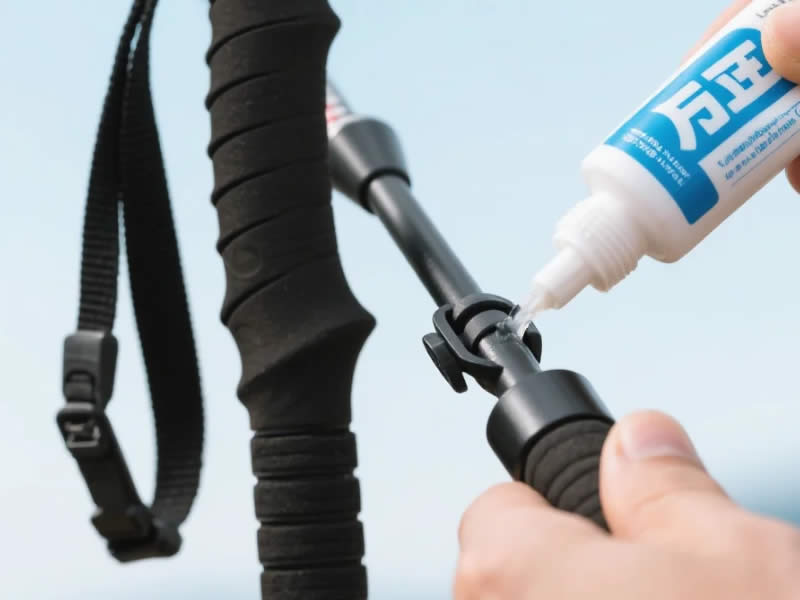
Lubricating flick‑lock pivots
Flick‑locks (external cam levers) rarely need lubrication for their clamping function. However, the metal pin that holds the lever can become squeaky or stiff to open.
Step‑by‑step:
- Open the lever fully.
- Apply one tiny drop of dry silicone or light machine oil to the pivot point (where the lever rotates against the metal bracket). Use the tip of a toothpick or a needle oiler.
- Work the lever back and forth 5–10 times to work in the lubricant.
- Wipe away any excess with a clean cloth.
Never spray lubricant directly onto the lever – it might seep onto the clamping surface. Less than a drop is enough.
Lubricating the joint between sections (incorrect habit)
Some hikers try to lubricate the sliding surfaces between the inner and outer shaft to make extension easier. Do not do this. Oil or spray on the shaft will get into the locking mechanism and cause it to slip. If your pole sections stick when extending, the solution is cleaning (removing dried mud) – not lubrication.
Lubricating threaded baskets or tips
If your trekking pole has screw‑on baskets or screw‑on replacement tips, a tiny amount of graphite powder or dry silicone on the threads can prevent galling (threads seizing). Avoid liquid oils – they attract dirt into the threads.
What about carbon fiber poles?
Carbon fiber shafts are more sensitive to certain lubricants. Solvents in some sprays can potentially damage the resin. Stick to dry silicone spray (test on a hidden area first) or use graphite powder for twist‑locks. Never use penetrating oils like PB Blaster on carbon fiber.
Signs you need lubrication
- Twist‑lock is hard to turn or grinds – needs cleaning + dry silicone.
- Flick‑lock lever squeaks when closing – needs a drop on the pivot.
- Pole sections are hard to separate – clean, don’t lubricate.
- Lock slips after cleaning – you may have accidentally oiled the shaft. Clean with alcohol.
Lubrication schedule
| Component | Frequency | Product |
|---|---|---|
| Twist‑lock expanders | Once a year or when sticky | Dry silicone spray |
| Flick‑lock pivots | As needed (squeaking) | Dry silicone or tiny drop of oil |
| Threaded joints | Once a year | Graphite or dry silicone |
| Shafts (external) | Never | N/A |
| Lock clamping surfaces | Never | N/A |
Pro tip: the “clean instead of lube” rule
Most “stuck” or “stiff” lock problems are caused by dirt, not lack of lubrication. Before adding any lubricant, always clean the mechanism thoroughly with a brush and alcohol. Often, cleaning alone restores smooth operation. Only after cleaning, if the problem persists, consider a minimal application of dry silicone.
Final thoughts
Lubricating trekking pole locks and joints is a simple but precise task. Use dry silicone spray sparingly on twist‑lock expanders and flick‑lock pivots. Keep lubricants away from clamping surfaces and shafts. Remember: when in doubt, clean first, lubricate last. A well‑lubricated (but not over‑lubricated) pole will extend smoothly, lock securely, and stay quiet on the trail. Take 15 minutes once a year to maintain your poles, and they’ll serve you reliably for a decade.




