




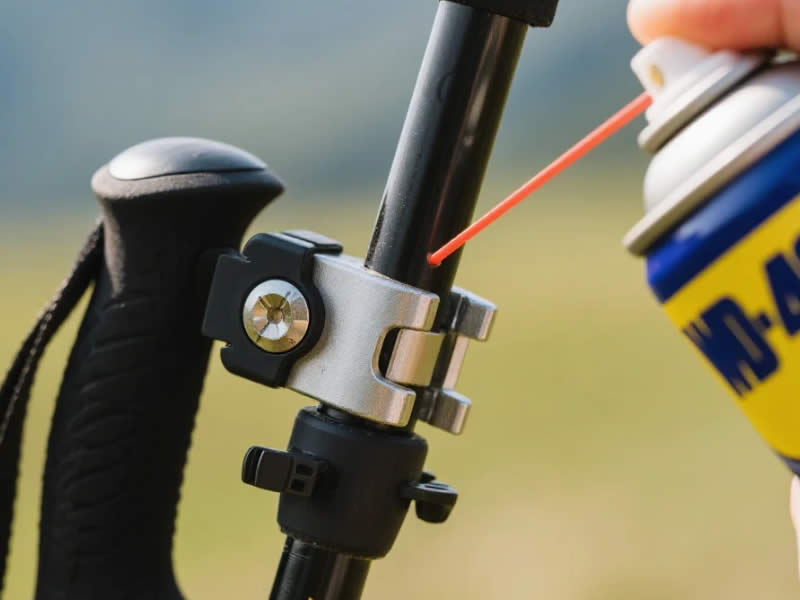
Can I use WD-40 on trekking pole locking mechanisms?
If you have a squeaky or sticky trekking pole lock, reaching for a can of WD‑40 might seem like the obvious solution. After all, WD‑40 is famous for loosening rusted bolts and silencing squeaks. However, when it comes to trekking pole locking mechanisms, using WD‑40 is almost always a bad idea. This article explains why, what risks it poses, and which products you should use instead to keep your poles functioning safely.
Recommended trekking pole purchase link: https://s.click.aliexpress.com/e/_c4M7OWaN
What WD‑40 actually is
Many people think WD‑40 is a lubricant. In reality, it’s primarily a solvent and water displacer (the “WD” stands for Water Displacement). Its main ingredients include aliphatic hydrocarbons and petroleum-based oils, but it evaporates relatively quickly, leaving behind a thin, sticky residue. That residue is problematic for trekking pole locks.
Why WD‑40 damages locking mechanisms
Trekking poles use either flick‑locks (external cam levers) or twist‑locks (internal expanders). Both rely on friction to hold the pole sections in place. WD‑50 compromises that friction in several ways:
- Attracts dirt and grit – The sticky residue acts like flypaper for dust, sand, and mud. Once dirt gets into the lock, it accelerates wear and causes slipping.
- Degrades plastic components – Many twist‑lock expanders and flick‑lock cams are made of nylon or ABS plastic. WD‑40 can soften or swell certain plastics over time, leading to cracking or loss of clamping force.
- Leaves a slippery film – On clamping surfaces (the inner shaft and the inside of the outer tube), any oil or solvent residue reduces the coefficient of friction. The result: your pole collapses under load.
- Evaporates incompletely – Unlike dry lubricants, WD‑40 doesn’t fully dry. The remaining oily film continues to migrate into joints, making the problem worse.
What happens if you already used WD‑40?
If you’ve already sprayed WD‑40 into your locks, don’t panic. Here’s how to fix it:
- Disassemble the lock – For flick‑locks, open the lever and remove the screw if possible. For twist‑locks, unscrew the end cap and pull out the expander.
- Degrease thoroughly – Use isopropyl alcohol (rubbing alcohol) or a citrus-based degreaser on a cloth to wipe all WD‑40 residue from the shaft, the inside of the outer tube, and the lock components.
- Clean with soap and water – Follow up with mild dish soap and a brush, then rinse and dry completely.
- Apply the correct lubricant (see below) – Only after the parts are completely clean and dry should you lubricate with an appropriate product.
What to use instead: dry silicone spray
The only lubricant recommended for trekking pole locks is dry silicone spray (e.g., WD‑40 Specialist Silicone, Blaster Dry Lube, or Finish Line Dry Lube). Key characteristics:
- Contains no oil – Leaves a dry, non‑sticky film that repels moisture but does not attract dirt.
- Safe on plastics – Will not swell or degrade nylon, ABS, or rubber expanders.
- Reduces friction without reducing grip – On twist‑lock expanders, a light application allows smooth twisting while maintaining clamping force.
How to apply dry silicone correctly:
For flick‑locks: Open the lever. Spray a tiny amount (or use a toothpick to apply) directly onto the pivot point (metal pin). Do not spray the clamping surface. Work the lever several times, then wipe away any excess.
For twist‑locks: Disassemble the lock, spray a light coat on the expander and the inside of the outer tube, let it dry for 60 seconds, then reassemble. Never spray directly into an assembled twist‑lock – you’ll coat the shaft and cause slipping.
What about other lubricants?
| Product | Safe? | Reason |
|---|---|---|
| WD‑40 | ❌ No | Leaves sticky residue, attracts dirt |
| Lithium grease | ❌ No | Too thick; collects grit |
| Motor oil | ❌ No | Same as above |
| Cooking oil | ❌ No | Goes rancid, gums up |
| Graphite powder | ⚠️ Use with care | Can work on threads, but messy; not for clamp surfaces |
| PTFE/Teflon spray | ✅ Yes (dry type) | Similar to silicone, acceptable |
| White lithium spray (dry) | ✅ Possible | If labelled “dry” and plastic‑safe |
Strongest recommendation: Dry silicone spray. It’s inexpensive, widely available, and specifically designed for plastic‑on‑metal and metal‑on‑metal applications where dirt resistance is critical.
When you should not lubricate at all
Many locking problems are caused by dirt, not lack of lubrication. Before reaching for any spray:
- Extend the pole and wipe the inner shaft with a damp cloth.
- Use a toothbrush to clean the inside of flick‑lock cams and the grooves of twist‑lock outer tubes.
- Rinse with water and dry thoroughly.
- Test the lock. If it holds securely and operates smoothly, you don’t need any lubricant.
Only lubricate if the lock is stiff to operate (e.g., hard to twist or flip) despite being clean. And even then, use the smallest amount possible.
The bottom line
No, you should not use WD‑40 on trekking pole locking mechanisms. It will do more harm than good by attracting dirt, potentially damaging plastic parts, and causing your poles to slip. Instead, clean your locks regularly and, if necessary, apply a dry silicone spray sparingly to pivot points or expanders. Your poles will remain secure, quiet, and reliable for many miles. Remember: when in doubt, keep it dry and clean – that’s the real secret to long‑lasting trekking pole locks.




