




Are winter trekking poles different from summer trekking poles?
If you already own a pair of trekking poles for summer hiking, you might wonder whether you need to buy a separate set for winter. The short answer is no – the poles themselves are usually identical. However, the way you equip and use them changes significantly. This article explains the key differences between summer and winter setups, and when you might consider dedicated winter poles.
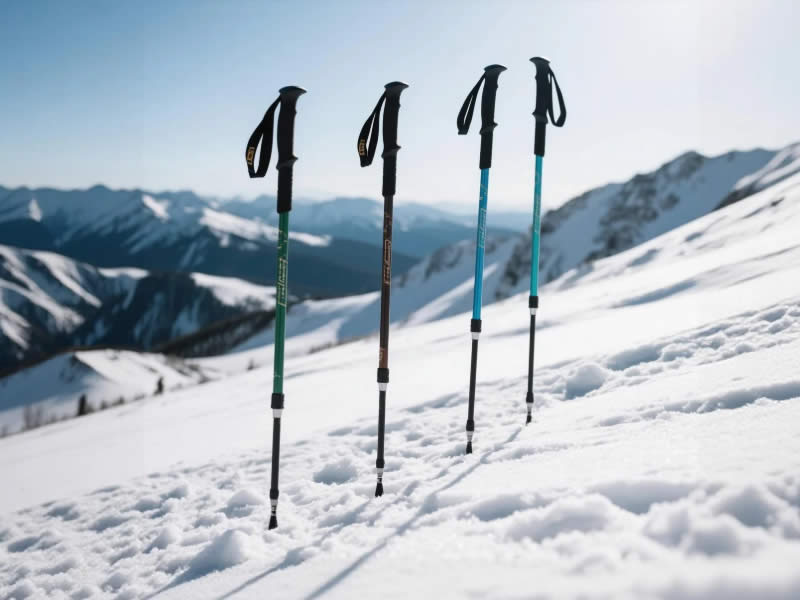
Recommended trekking pole purchase link: https://s.click.aliexpress.com/e/_c4M7OWaN
The pole shaft: same material, same strength
The aluminium or carbon shaft of a trekking pole doesn’t know what season it is. A good 7075 aluminium pole works just as well in January as in July. Carbon fibre is also usable in winter, though it becomes slightly more brittle in extreme cold. For most winter hikers, the same poles they use in summer are perfectly fine – as long as they are paired with winter‑appropriate accessories.
Baskets: the biggest difference
In summer, you use small baskets (40‑50 mm) to prevent the pole from sinking into mud or gravel. In winter, especially in deep snow, you need large powder baskets (70‑120 mm) . These act like snowshoes for your poles, keeping them from plunging into soft snow. Summer baskets on a snowy trail will sink 30‑60 cm with every plant, ruining your balance and exhausting your arms. So while the pole is the same, the baskets are very different – and they are interchangeable on most quality poles.
Locking mechanism: flick‑lock vs. twist‑lock
Here, the pole design matters. Twist‑locks are problematic in winter. Moisture can seep into the mechanism and freeze, making it impossible to twist. Snow can also pack into the threads. External flick‑locks (like Leki’s SpeedLock or Black Diamond’s FlickLock) are far superior in cold weather. They are easy to operate with thick gloves, resist icing, and can be adjusted even when wet. If your summer poles have twist‑locks, you may struggle in winter – but the pole itself isn’t “winter” or “summer”; it’s just a less suitable design for cold conditions.
Grip material: cork vs. foam
Summer hikers often love cork grips because they wick sweat and mould to the hand. In winter, cork becomes cold, wet, and slippery. It can also crack in sub‑freezing temperatures. Foam grips (EVA) are much better for winter. Foam stays warm, provides insulation, and remains grippy even when handling snow or ice. Many poles come with foam grips year‑round; others allow you to swap grips. If your summer poles have cork grips, they will still function in winter, but you may find them less comfortable.
Shaft material: aluminium vs. carbon
Both materials work in winter, but there are trade‑offs. Aluminium is more forgiving – if you hit a hidden rock under snow, it may bend but rarely breaks. Carbon fibre is lighter but more brittle; a sharp impact can shatter it. For deep snow where you can’t see obstacles, aluminium is safer. However, this is not a “winter vs. summer” difference – it’s a durability preference that applies year‑round.
Tips: carbide with or without ice grippers
The carbide tip itself is the same. But for icy trails, you can add ice grippers (also called ice tips or winter tips) – small spiked attachments that fit over the carbide. These provide exceptional bite on hard ice. Summer hikers rarely use them. So again, the pole is the same, but the accessory changes.
Do dedicated winter trekking poles exist?
Yes, some manufacturers sell “winter trekking poles” that come pre‑equipped with large powder baskets, foam grips, and flick‑locks. For example, the Leki Sherpa Lite and Black Diamond Traverse Compactor are designed for snow. However, these are essentially the same as summer flick‑lock poles, just bundled with winter accessories. If you already own a pair of flick‑lock aluminium poles with foam grips, you can simply buy a set of powder baskets and ice grippers – no need to buy new poles.
Summary table
| Feature | Summer setup | Winter setup | Same pole? |
|---|---|---|---|
| Baskets | Small (40‑50 mm) | Large powder (70‑120 mm) | No – swap baskets |
| Lock type | Flick‑lock or twist | Flick‑lock strongly preferred | Yes (but twist‑locks struggle) |
| Grip | Cork or foam | Foam recommended | Yes (cork works but less ideal) |
| Shaft | Aluminium or carbon | Aluminium safer | Yes |
| Tip | Bare carbide | Carbide + ice gripper on ice | Yes – add accessory |
Final verdict
Winter trekking poles are not fundamentally different from summer trekking poles. The shaft, locks, and grips can be identical. The key differences lie in accessories (large baskets, ice grippers) and material preferences (flick‑locks over twist‑locks, foam over cork). If your summer poles have external flick‑locks and foam grips, you can easily convert them for winter by swapping baskets and adding ice grippers. Only if your summer poles have twist‑locks or cork grips that you find problematic in cold might you consider buying a dedicated winter pair. Otherwise, save your money and just buy the right accessories.




