




How to adjust trekking pole length for snowshoeing?
Adjusting your trekking pole length correctly for snowshoeing is essential for efficiency, balance, and preventing shoulder strain. While many hikers simply use the same length as for summer hiking, snowshoeing demands a different approach due to the added height of the snowshoes, the softness of the snow, and the need for a stable plant. This guide explains how to find the ideal length for flat terrain, ascents, and descents.
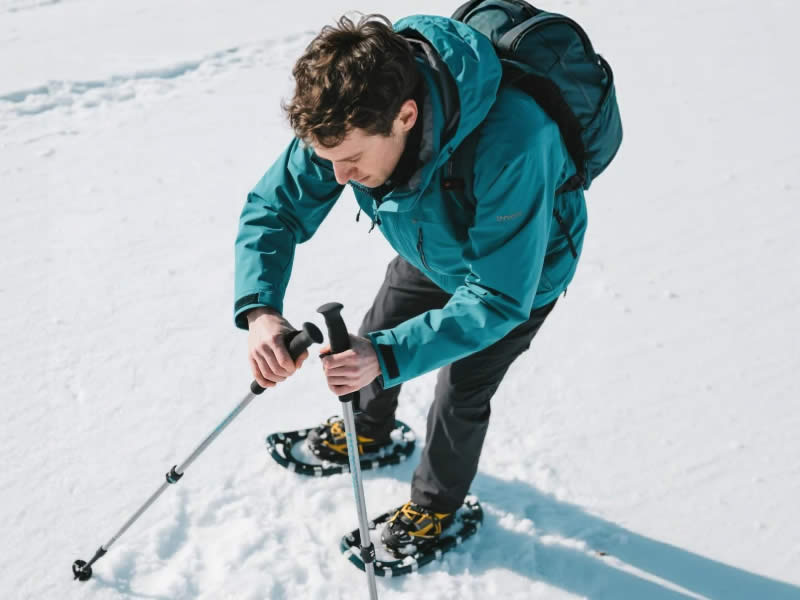
Recommended trekking pole purchase link: https://s.click.aliexpress.com/e/_c4M7OWaN
Why snowshoeing requires different pole lengths
When you wear snowshoes, your feet are raised by the thickness of the snowshoe deck (typically 2–5 cm). More importantly, you are often walking on soft snow where your poles will sink deeper than on hard ground. Additionally, snowshoeing often involves a wider stance and a more deliberate planting motion. Using summer‑length poles will force you to lean forward, causing back pain and reducing stability.
The general rule: lengthen your poles by 5–10 cm (2–4 inches) compared to your summer setting on flat terrain. However, the exact length depends on snow depth, terrain steepness, and your personal biomechanics.
Setting the baseline length for flat snowshoeing
- Put on your snowshoes and stand on a flat, packed section of snow (or a hard floor if testing at home).
- Hold your trekking pole vertically with the tip on the ground. Your elbow should be bent at approximately 90 degrees, with your forearm parallel to the ground.
- Measure or note the length – this is your baseline. Compare it to your summer setting (elbow at 90° on bare ground). The snowshoe baseline will typically be 5–7 cm longer because of the snowshoe height and the need for a slightly higher plant to avoid hitting the snowshoe binding.
Most hikers find that for flat snowshoeing on soft snow, the pole tip should reach the ground when your arm hangs naturally, and then you raise your hand to comfortably hold the grip – effectively a longer setting than summer.
Adjusting for snow depth and snow condition
- Shallow snow (less than 15 cm / 6 inches): Use baseline length or even slightly shorter. Your pole won’t sink much.
- Moderate snow (15–30 cm / 6–12 inches): Add 5 cm to baseline. The large powder baskets will stop the pole from sinking fully, but the extra length compensates for the sinking.
- Deep powder (over 30 cm / 12 inches): Add 10 cm or more. In very deep snow, even large baskets let the pole sink 10–15 cm. Lengthen until your arm is comfortable without leaning.
Adjusting for ascents and descents
Snowshoeing rarely involves perfectly flat terrain. On slopes, you need to change pole length on the fly.
Uphill
Shorten your poles by 5–10 cm from the flat baseline. A shorter pole allows you to plant higher up the slope while keeping your torso upright. Your elbow angle will be greater than 90° – that’s fine. Plant the pole close to your foot, not far ahead.
Downhill
Lengthen your poles by 5–10 cm from the flat baseline. A longer pole lets you plant further downslope without leaning forward, providing a strong braking action. Your elbow will be almost straight when the tip contacts the snow – this gives you leverage to control your descent.
Traversing (side‑hilling)
Shorten the uphill‑side pole and lengthen the downhill‑side pole. The uphill pole should be 10–15 cm shorter than the downhill pole. This keeps both poles in good contact with the sloping snow surface and prevents you from tipping sideways.
Practical tips for on‑trail adjustment
- Use flick‑locks (external levers) – They are much faster to adjust with gloves or mittens than twist‑locks. You can change length in seconds.
- Mark your settings – Use a permanent marker or a piece of tape on the inner shaft to mark your flat, uphill, and downhill lengths. This saves fiddling.
- Check your basket – Make sure you have large powder baskets (70–90 mm) installed. Without them, your pole will sink too deep, and length adjustments become useless.
- Test plant – Before starting, plant the pole firmly into the snow. The basket should stop the pole at or just below the snow surface. If the basket disappears under the snow, lengthen the pole.
Common mistakes
- Using summer length on deep snow – You will lean forward, tire your back, and the pole may not reach a firm layer.
- Not adjusting for ascent/descent – Keeping the same length leads to awkward planting and reduced control.
- Making poles too long – Over‑lengthening forces you to hike with your shoulders raised, causing neck and trapezius fatigue.
- Forgetting to adjust back to baseline on flats – After a steep section, return to your flat setting for efficiency.
A simple rule of thumb
If you don’t want to carry a tape measure or mark settings, use this quick method:
- Flat: Pole top at armpit height when standing on snowshoes.
- Uphill: Pole top at shoulder height (shorter by ~5 cm).
- Downhill: Pole top above your head by ~5 cm (longer).
Final advice
The perfect pole length for snowshoeing is not a fixed number – it changes with snow conditions and slope angle. The key is to adjust frequently (every time the terrain or snow depth changes) and to use flick‑locks for speed. Start with a baseline 5–10 cm longer than your summer length, then fine‑tune by feel. Your goal is a comfortable upright posture, with your elbows slightly bent on the flat, and the pole planting firmly without excessive sinking. With proper length adjustment, snowshoeing will be much less tiring and far more enjoyable.




