




Can I use trekking poles for backcountry skiing?
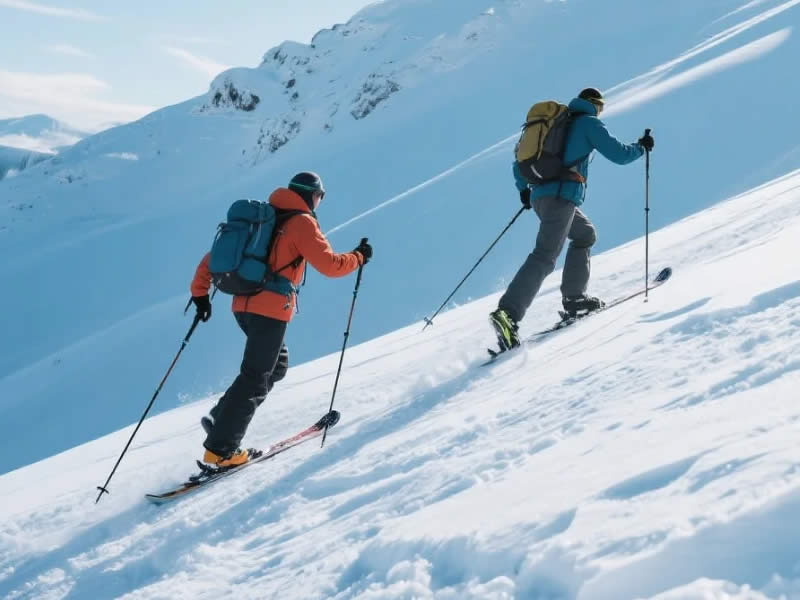
No, you should not use trekking poles for backcountry skiing. While both activities involve poles and snow, trekking poles and backcountry ski poles are designed for fundamentally different purposes. Using trekking poles for skiing can be uncomfortable, inefficient, and even dangerous. This article explains the key differences and why proper ski poles are essential for backcountry skiing.
Recommended trekking pole purchase link: https://s.click.aliexpress.com/e/_c4M7OWaN
The critical differences
| Feature | Trekking pole | Backcountry ski pole |
|---|---|---|
| Length | Typically 100–135 cm | Often 120–155 cm (longer for downhill stability) |
| Shaft | Lightweight aluminium/carbon, moderate wall thickness | Thicker wall, often aluminium, designed for lateral forces |
| Baskets | Small (40–50 mm) | Large powder baskets (70–120 mm) |
| Grip | Straight or slightly angled | Angled (15–30°) for ergonomic poling |
| Wrist strap | Basic adjustable | Wide, padded, often with quick release |
| Tip | Carbide, replaceable | Carbide or steel, often with ice teeth |
| Certification | None | May meet ski pole safety standards |
Why trekking poles fail for backcountry skiing
1. Insufficient length
Backcountry skiing requires longer poles than trekking. When descending on skis, you plant the pole further downslope, and an adequate length provides leverage and balance. Most trekking poles max out at 135 cm, which is too short for an average‑height skier (175–185 cm) in a downhill stance. Using short poles forces you to lean forward, compromising control and increasing fall risk.
2. Weak shafts
Ski poles must withstand lateral (sideways) forces – from pushing off, bracing against turns, or hitting hidden obstacles under snow. Trekking poles are designed for vertical compression (planting) and are much weaker in bending. An aluminium trekking pole can bend or snap when used as a ski pole; a carbon trekking pole may shatter. A broken pole on a steep descent can cause a serious fall.
3. Small baskets are useless in powder
Trekking poles come with small baskets (40–50 mm). In deep backcountry snow, these will plunge deep, offering no flotation. You’ll waste energy pulling the pole out of the snow after each plant. Backcountry ski poles have large powder baskets (70–120 mm) that keep the tip near the surface, allowing efficient poling.
4. Straight grips cause wrist strain
Trekking pole grips are straight. Ski pole grips are angled (typically 15–30 degrees) to align with your wrist when poling in a skiing stance. Using a straight grip for skiing forces an unnatural wrist angle, leading to fatigue, discomfort, and reduced power transfer.
5. Inadequate straps
Ski pole straps are wider, more padded, and often feature quick‑release mechanisms for safety – important if you fall and need to free your hands. Trekking pole straps are narrower and not designed for the dynamic forces of skiing.
6. No certification or safety testing
Backcountry ski poles are built and tested to withstand the rigours of skiing. Trekking poles have no such certification. Manufacturers explicitly warn against using trekking poles for skiing.
What could go wrong?
- Pole snap – A carbon trekking pole snaps on a hidden rock. You lose your balance, fall, and potentially trigger an avalanche or injure yourself.
- Lock failure – Flick‑locks or twist‑locks may slip under the higher forces of skiing, causing the pole to collapse when you lean on it.
- Tip breakage – The carbide tip of a trekking pole is not designed for the abrasive action of skiing; it may wear out or break off in a single day.
- Hand injury – Without proper quick‑release straps, a fall could trap your hand, causing wrist or thumb injury.
Are there any exceptions?
Some adjustable trekking poles can be pressed into light, low‑angle backcountry skiing if they meet all of the following:
- Extend to at least 140 cm (test with your skiing stance).
- Have metal flick‑locks (not plastic or twist).
- Are made of thick‑walled aluminium (7075‑T6, minimum 16 mm diameter).
- Have large powder baskets available (at least 80 mm).
- You attach proper ski straps (or modify existing ones).
- You accept the risk and ski conservatively.
Even then, they will never perform as well as dedicated ski poles. For any serious backcountry skiing – especially on steep terrain or in deep powder – use proper ski poles.
What to look for in backcountry ski poles
- Adjustable length – For transitioning between uphill (shorter) and downhill (longer).
- Large powder baskets – 80–120 mm, interchangeable.
- Aluminium shaft – 7075 series, thick wall. Carbon is acceptable for experts, but aluminium is safer.
- Angled foam grip – Warm, comfortable, and ergonomic.
- Flick‑lock (external cam) – Reliable in cold and easy to adjust with gloves.
- Carbide tip with ice teeth – For grip on hard snow or ice.
Recommended models: Black Diamond Compactor, Leki Trekking (Sherpa), Komperdell Expedition.
Final verdict
No, you should not use trekking poles for backcountry skiing. The differences in length, strength, basket size, grip angle, and strap design make trekking poles unsuitable and potentially hazardous. Invest in a pair of dedicated backcountry ski poles – they are designed for the forces, conditions, and techniques of skiing. Your safety, comfort, and enjoyment on the slopes are worth the investment. Use your trekking poles for what they are made for: summer hiking and winter walking on trails, not for skiing.




