




Can trekking poles help with walking after knee surgery?
Recovering from knee surgery – whether a total knee replacement (TKR), arthroscopy, or ligament repair – is a gradual process. Patients often transition from a walker to crutches, then to a cane, and finally to unassisted walking. But could trekking poles be a valuable intermediate or long‑term tool? The short answer is yes, for many people. This article explores the biomechanical benefits, proper technique, and precautions of using trekking poles during knee rehabilitation.
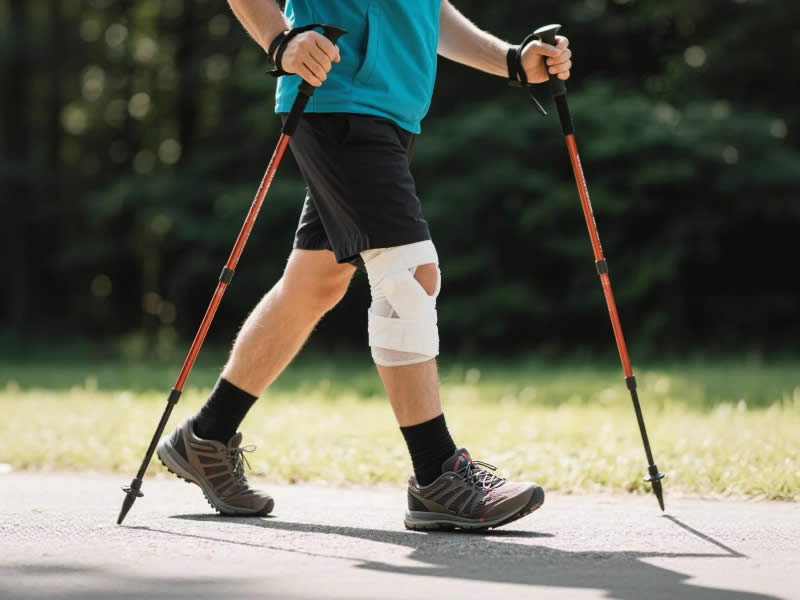
Recommended trekking pole purchase link: https://s.click.aliexpress.com/e/_c4M7OWaN
How trekking poles reduce knee load
Walking places significant force on the knee joint – up to 3–4 times your body weight when descending stairs or slopes. After surgery, this load can cause pain, swelling, and delay healing. Trekking poles act as load‑sharing devices. By transferring some of your body weight from your legs to your arms and core, poles can reduce the force transmitted through the knee by an estimated 20–30%. A study in the Journal of Orthopaedic Research (2013) found that using two hiking poles with a wide stance reduced medial knee contact forces by up to 34% during walking – a substantial relief for an arthritic or post‑surgical joint.
Benefits beyond load reduction
- Improved balance and fall prevention – Knee surgery often weakens the quadriceps and affects proprioception (awareness of joint position). Trekking poles provide two extra points of ground contact, widening your base of support and dramatically reducing fall risk – a critical safety factor for older adults recovering from TKR.
- Restored natural gait – Unlike a wheeled walker that can encourage a shuffling gait, poles promote a reciprocal arm‑leg pattern. This helps retrain normal walking mechanics, which is especially useful after prolonged immobilisation.
- Increased walking endurance – By reducing pain and fatigue, poles allow you to walk longer distances, which accelerates overall recovery. Many physical therapists now incorporate “Nordic walking” (using poles) into post‑knee replacement protocols.
- Upright posture – Leaning on a single cane often causes a sideways tilt. Poles encourage symmetry and keep your spine aligned, reducing secondary back and hip pain.
When to start using trekking poles
The timing depends on your surgery and your surgeon’s protocol. Generally:
- First 2‑4 weeks: Walker or crutches (non‑weight‑bearing or partial weight‑bearing).
- Weeks 4‑8: Transition to a cane or two trekking poles as weight‑bearing increases.
- After 8 weeks: Poles can be used for outdoor walking, hiking, and longer distances. Many patients continue using them permanently for high‑risk activities (uneven terrain, stairs, slopes).
Always get clearance from your surgeon or physiotherapist before switching to poles.
Proper technique for post‑surgery walking
- Choose the right poles – Use flick‑lock poles (not twist‑locks) for easy, secure adjustment. Foam grips are gentler on arthritic hands. Ensure the poles are height‑adjustable.
- Set correct height – With the tip on the ground and your arm hanging naturally, your elbow should be bent at about 90°.
- Move opposite arm and leg – As you step forward with your operated leg, plant the opposite pole. This mimics a normal walking rhythm and provides stability precisely when your weak leg is under load.
- Use a light grip – Let the wrist strap bear the weight; don’t death‑grip the handle.
- Start on flat, hard surfaces – A paved path or gym floor is ideal. Progress to grass, gravel, and gentle hills as strength returns.
- Adjust length for slopes – Shorten poles for uphill (to keep your torso upright); lengthen for downhill (to act as brakes and reduce knee jarring).
Potential drawbacks and precautions
- Not a substitute for a walker early on – If you still need significant weight‑bearing assistance, a walker or crutches are safer.
- Requires upper body strength – Patients with weak shoulders, wrists, or grip may struggle. Consider occupational therapy to build upper body strength.
- Risk of overdoing it – Poles can mask pain, leading you to walk further than your healing knee can tolerate. Follow your physio’s activity guidelines.
- Avoid on icy or very steep terrain – A fall could be disastrous. Use spikes (ice grippers) on poles for winter walking, or wait until you are fully healed.
Real‑world evidence and expert opinion
Several studies support the use of walking poles after knee replacement. A 2018 randomized controlled trial found that patients who performed Nordic walking (using poles) after TKR had better gait speed, step length, and functional scores at 6 months compared to those who did conventional physiotherapy alone. The British Mountaineering Council notes that using two poles can reduce the cumulative load on knees by as much as 20 tonnes per 1,000 metres of descent.
Physiotherapists often recommend poles because they transfer the patient’s focus from “protecting the knee” to “moving naturally” . The poles provide confidence, allowing the patient to adopt a normal stride pattern rather than a limping gait.
Choosing the best poles for knee recovery
For post‑surgery use, look for:
- Adjustable length (to perfect your fit).
- External flick‑locks – easy to operate with reduced hand strength.
- Foam grips – cushion and warmth.
- Rubber tip covers – for indoor or pavement walking.
- Weight under 260g per pole – to minimise arm fatigue.
Recommended models: Leki Khumbu Lite (affordable, foam grip, SpeedLock), Black Diamond Trail Pro (very durable, excellent grip), or Cascade Mountain Tech Quick Lock (budget option).
Final verdict
Yes, trekking poles can be extremely helpful for walking after knee surgery – once you have progressed past the initial healing phase. They reduce knee joint load, improve balance, encourage a normal gait, and build walking confidence. However, always obtain medical clearance, learn proper technique, and progress gradually. For many patients, poles become a lifelong companion for staying active without pain – allowing them to return to hiking, walking, and even gentle trail running. If you are recovering from knee surgery, ask your physiotherapist about incorporating trekking poles into your rehabilitation plan.




