




Are trekking poles recommended for osteoporosis patients?
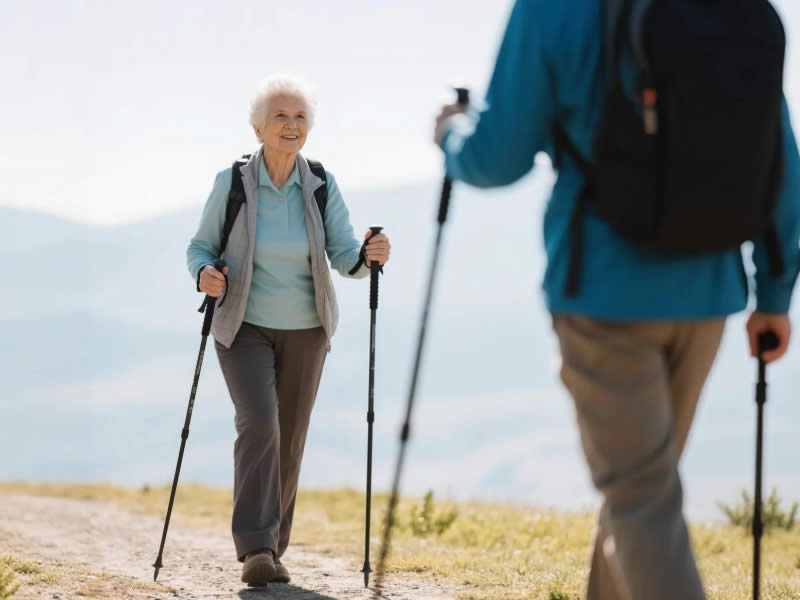
Osteoporosis is a condition where bones become weak and brittle, significantly increasing the risk of fractures – especially from falls. For patients with osteoporosis, maintaining an active lifestyle is crucial for bone health, but the fear of falling can be paralyzing. The question arises: can trekking poles help? The short answer is yes, with careful guidance. This article explores the benefits, risks, medical perspectives, and best practices for using trekking poles in osteoporosis patients.
Recommended trekking pole purchase link: https://s.click.aliexpress.com/e/_c4M7OWaN
Why trekking poles can be beneficial
Trekking poles, when used correctly, address two major concerns for osteoporosis patients: fall prevention and load management.
- Improved balance: Two poles widen the base of support (two feet + two poles), providing superior stability compared to a single cane or unaided walking. This reduces the likelihood of trips and stumbles – the most common cause of osteoporotic fractures.
- Proactive hazard detection: Poles planted ahead of the feet act as “feelers” on uneven terrain, alerting the user to roots, rocks, or holes before stepping into them.
- Reduced joint impact: By transferring up to 20‑25% of body weight from the legs to the arms and core, poles lessen the force on hip and knee joints. While not directly strengthening bone, this allows patients to walk longer and more confidently, promoting overall activity.
- Fall arrest: If a loss of balance occurs, planted poles can be used to regain stability or at least slow a fall, potentially reducing fracture severity.
Medical and physiotherapy perspectives
Many physiotherapists and geriatric specialists now recommend trekking poles for osteoporosis patients who are otherwise mobile but at moderate fall risk. For example, the Royal Osteoporosis Society (UK) notes that walking with two poles can improve balance and confidence, particularly on uneven surfaces.
However, there are important caveats:
- Not for those with severe vertebral fractures or very low bone density: The impact of planting poles – even gently – may cause vertebral compression fractures if the patient has advanced osteoporosis in the spine. A DEXA scan and medical clearance are essential.
- Upper body strength required: Poles require shoulder, arm, and grip strength. Patients with shoulder arthritis or muscle weakness may find them difficult to use.
- Proper technique is critical: Incorrect pole use (e.g., planting too far ahead, leaning heavily) can actually increase fall risk or strain the spine.
Potential risks for osteoporosis patients
- Vertebral fracture from pole planting: The axial loading (pushing down) on the spine when planting poles could theoretically trigger a fracture in osteoporotic vertebrae. However, this risk is very low if poles are used with a light touch and proper rhythm. Patients with known vertebral fractures should seek professional guidance.
- Wrist and forearm fractures: If a patient falls onto an outstretched pole, the handle could transmit force to the wrist. Some experts recommend using poles with shock‑absorbing sections and ensuring the wrist strap is correctly adjusted so the pole releases on impact.
- Overconfidence: Poles can give a false sense of security, leading patients to walk on terrain that is too risky. Always assess environmental hazards realistically.
Choosing the right poles for osteoporosis
- Shock‑absorbing (anti‑shock) poles: These contain an internal spring that dampens impact forces transmitted to the hands and wrists. For osteoporosis patients, this feature is highly recommended.
- External flick‑locks: Easier to operate than twist‑locks, reducing hand strain.
- Foam grips: Softer and warmer than cork, requiring less gripping force.
- Lightweight aluminium or carbon: Lower weight reduces arm fatigue. Carbon is very light but more brittle; aluminium is durable and affordable.
- Carbide tips with rubber covers: Use rubber tips on pavement to reduce jarring; expose carbide on soft trails.
Best practices for osteoporosis patients
- Get medical clearance – Discuss with your doctor or physiotherapist before starting. They may recommend a bone density threshold (e.g., T‑score > -2.5) for safe pole use.
- Learn proper technique from a professional – A physical therapist can teach you the correct reciprocal gait (right pole with left foot, left pole with right foot) and how to plant lightly without jarring the spine.
- Start on flat, even ground – Progress to gentle slopes only after mastering technique.
- Use both poles, always – Never use a single pole for balance; it creates asymmetry and increases fall risk.
- Avoid harsh planting – Do not slam the poles into the ground. Use a smooth, controlled motion.
- Consider shock‑absorbing poles – The internal spring reduces impact transmission.
- Wear appropriate footwear – Poles are not a substitute for good hiking shoes with traction.
- Avoid icy or very uneven terrain – Even with poles, high‑risk surfaces may be too dangerous.
Recommended models with shock absorption
- Leki Makalu Anti‑Shock – Classic aluminium pole with internal spring.
- Black Diamond Trail Shock – Reliable flick‑lock with shock absorber.
- Komperdell Contour Anti‑Shock – Good value with cork/foam grip.
Final verdict
Trekking poles can be recommended for osteoporosis patients, but only after medical evaluation and with correct technique. For patients with mild to moderate osteoporosis (T‑score between -1.0 and -2.5) who have good upper body strength, poles offer significant fall‑prevention benefits. For those with severe osteoporosis (T‑score < -2.5), vertebral fractures, or very low bone density, the risks may outweigh the benefits – consult a specialist. When used appropriately, trekking poles help patients stay active, confident, and safe, potentially reducing the very falls that lead to fractures. Always prioritise professional guidance over self‑prescription.




