




Do professional hikers use trekking poles?
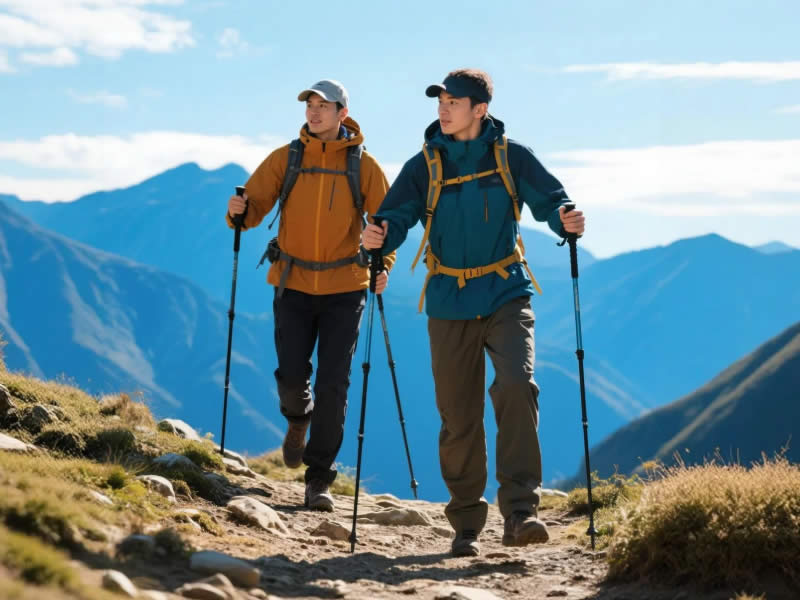
If you watch experienced long‑distance hikers, mountain guides, or professional backpackers, you will notice something interesting: many of them use trekking poles, but not all. The decision is highly personal and depends on factors like terrain, pack weight, injury history, and personal biomechanics. This article explores the prevalence of trekking poles among professional hikers, the reasons they choose (or reject) them, and what you can learn from their example.
Recommended trekking pole purchase link: https://s.click.aliexpress.com/e/_c4M7OWaN
Who are “professional hikers”?
The term includes:
- Mountain guides (IFMGA certified) who lead clients on technical terrain.
- Thru‑hikers who complete long trails like the Pacific Crest Trail (PCT), Appalachian Trail (AT), or Continental Divide Trail (CDT) in a single season.
- Fastpackers and ultra‑distance trail runners who cover 50‑100+ km per day.
- Outdoor educators and backcountry rangers who live and work on trails.
- Professional backpacking gear testers and influencers.
These individuals spend hundreds or thousands of hours on trail each year. Their choices are based on efficiency, safety, and long‑term joint health.
The majority do use trekking poles
Among professional thru‑hikers and mountain guides, a clear majority use trekking poles – typically lightweight, flick‑lock models made of aluminium or carbon. Surveys of PCT and AT thru‑hikers consistently show that 70‑80% use poles for at least part of their hike. Many professional guides require their clients to bring poles on steep or uneven terrain.
Reasons professionals use poles:
- Knee and joint protection – Descending with a heavy pack puts tremendous stress on knees. Poles transfer up to 20‑25% of the load from legs to arms. Veteran guide and author Andrew Skurka states: “I use trekking poles on almost every trip because they save my knees, especially on long descents.”
- Increased stability and fall prevention – On loose scree, slippery roots, or stream crossings, two extra points of contact prevent many falls. Professional hikers carry heavy loads (often 15‑20 kg for work) where a fall could mean serious injury.
- Improved uphill efficiency – Planting poles behind you and pushing off engages the upper body, creating a “four‑wheel drive” effect. Studies have shown that poles can reduce perceived exertion on steep climbs by 10‑15%.
- Tent/shelter support – Many ultralight backpackers use trekking poles as the uprights for their shelter (e.g., Zpacks Duplex, Tarptent). Professionals who count every gram appreciate this dual use.
- Balance on snow and ice – In winter conditions, poles with powder baskets and ice tips are essential for crossing snowfields or glaciers.
- Probing and clearing – Poles can test snow depth, push aside branches, or part tall grass to check for obstacles.
Notable professional hikers who use poles
- Andrew Skurka (long‑distance backpacker, guide) – Uses lightweight aluminium flick‑lock poles on most trips.
- Cam “Swami” Honan (around‑the‑world trekker) – Advocates for two poles, especially in mountainous terrain.
- Heather “Anish” Anderson (FKT holder on PCT, AT, AZT) – Used poles on her record‑setting unsupported hikes.
- John Zahorian (ultralight triple crown thru‑hiker) – Often carries carbon Z‑poles.
- Many IFMGA guides in the Alps and Rockies require poles for their clients and use them personally on approaches.
The minority: professionals who don’t use poles
Despite the benefits, some elite hikers and fastpackers forgo poles. Reasons include:
- Preference for free hands – On very technical scrambling, poles can be a hindrance. Some mountaineers prefer to keep their hands on rock or ice tools.
- Weight and faff – Even lightweight poles add 300‑500g to a pack. For unsupported FKT (Fastest Known Time) attempts where every gram matters, some athletes drop poles.
- Terrain type – On flat, smooth trails (e.g., the Camino de Santiago, canal paths), poles offer little advantage and are just extra clutter.
- Personal gait – A small number of people find that poles disrupt their natural rhythm or cause shoulder irritation.
Examples: Kilian Jornet (famous skyrunner) sometimes uses poles on steep ascents but often forgoes them on moderate terrain. Scott Jurek (ultra‑runner/ former AT record holder) used poles extensively on his AT FKT, but not always on shorter runs.
What the science says
A 2018 meta‑analysis in Sports Medicine concluded that trekking poles reduce impact forces on lower limb joints (especially knees) and increase walking economy on steep inclines. However, on flat ground, the metabolic benefit is negligible. Professionals are aware of these trade‑offs and choose accordingly.
Conclusion: do professional hikers use trekking poles?
Yes, most do, especially on mountainous terrain, long backpacking trips, or when carrying heavy loads. They appreciate the knee‑saving, balance‑enhancing, and efficiency‑boosting properties. However, there is no universal mandate – a minority of professionals skip poles on gentle ground or when they value free hands above all. If you are trying to decide, emulate the pros: consider the terrain, your pack weight, and your own injury history. For the vast majority of hikers, learning to use trekking poles well will make you more efficient and reduce your risk of overuse injury. That’s why so many professionals – from guides to thru‑hikers – keep them in hand.




