




Folding vs 3‑section trekking poles: which is more durable in rocky terrain?
When hiking on rocky terrain – whether in the Peak District, the Alps, or the Rocky Mountains – your trekking poles will take a beating. They will be jammed between boulders, dropped onto sharp edges, and leaned on heavily during steep descents. The choice between folding (Z‑pole) and 3‑section telescoping trekking poles is critical for durability. The short answer: 3‑section telescoping poles with external flick‑locks are significantly more durable on rocky ground. This article explains why, and when folding poles might still be acceptable.
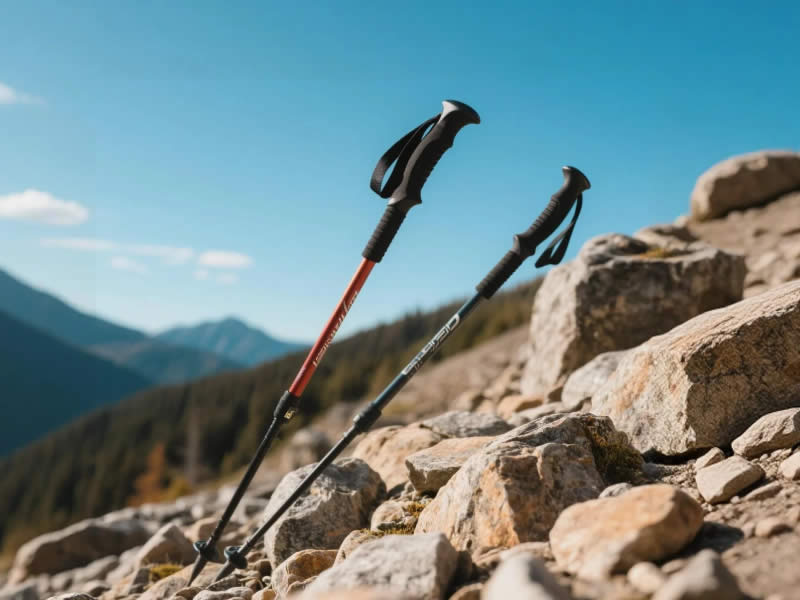
Recommended trekking pole purchase link: https://s.click.aliexpress.com/e/_c4M7OWaN
What are the two designs?
- Folding (Z‑pole): Three sections connected by an internal elastic cord. They snap together and lock via a small button or a cam. Popular examples: Black Diamond Distance Z, Leki Micro Vario, Cascade Mountain Tech Carbon Z.
- 3‑section telescoping: Two or three tubes that slide inside each other, secured by external flick‑locks (cam levers). Examples: Leki Makalu, Black Diamond Trail Pro, Komperdell Contour.
Why telescoping poles excel in rocky terrain
1. Thicker, more robust walls
Telescoping poles typically use thicker‑walled tubes than folding poles. A folding pole must be lightweight and thin to allow sections to nest, which inherently reduces material thickness. On a sharp rock impact, a thin‑walled carbon or aluminium tube is more likely to dent, crack, or snap. Telescoping poles often have wall thicknesses of 0.8‑1.2 mm, whereas folding poles may be 0.5‑0.7 mm.
2. External locks are field‑servicable
If a flick‑lock lever breaks or a screw comes loose on a telescoping pole, you can often replace the lock with a spare part. On a folding pole, a broken snap‑button or internal cord typically requires sending the pole back to the manufacturer or a complex DIY repair. In remote rocky terrain, repairability matters.
3. No internal cord to fatigue
Folding poles rely on an elastic cord that runs through all sections. Over time, this cord stretches, frays, and can snap. Rocky terrain, where you repeatedly plant and pull the pole, accelerates cord wear. Telescoping poles have no such cord – they rely solely on external friction locks.
4. Better resistance to lateral forces
When you plant a pole off‑axis (common on uneven rocks), a folding pole’s thin junction can twist or break. Telescoping poles with overlapping sections distribute lateral loads over a longer area, reducing stress concentration.
5. Replaceable sections
Many telescoping poles allow you to replace the lower section if it bends or the tip wears out. Folding poles often require replacing the entire pole or section through complex re‑cordings.
When folding poles are acceptable – or preferable
Folding poles have their place, but not on very rocky terrain. They excel when:
- You prioritise ultralight weight and packability for long, non‑rocky trails (e.g., the South West Coast Path, canal paths).
- You are a very careful user who never jams poles between rocks and always plants vertically.
- You are trail running where speed and low weight matter more than ultimate durability.
For rocky environments like the Scottish Highlands, the Lake District scrambles, or the Alps’ scree slopes, folding poles are a gamble.
Real‑world evidence
Experienced long‑distance hikers and guides almost universally recommend telescoping poles for rocky terrain. A thru‑hiker on the Pacific Crest Trail (which has significant rocky sections) reported that folding poles failed at a higher rate – primarily because of snapped buttons and broken cord locks. Among guides in the Alps, telescoping flick‑lock poles are the standard.
Material considerations – aluminium vs. carbon
Even within 3‑section poles, aluminium is more durable than carbon on rocks. Carbon can shatter on a sharp impact; aluminium will dent or bend but rarely break. For maximum durability, choose 7075 aluminium telescoping poles with external flick‑locks.
Summary comparison
| Feature | Folding (Z‑pole) | 3‑section telescoping |
|---|---|---|
| Typical weight | 150‑190g | 240‑280g |
| Packed length | 35‑45 cm | 60‑70 cm |
| Wall thickness | Thin | Moderate to thick |
| Impact resistance | Low – can snap | High – bends |
| Field repairability | Poor (cord, buttons) | Good (lock parts, sections) |
| Cord fatigue risk | Yes | No |
| Best for | Flat, smooth trails, running | Rocky, uneven, steep terrain |
Final verdict
For hiking in rocky terrain – where the risk of jamming, dropping, or levering the pole is high – 3‑section telescoping trekking poles with external flick‑locks are significantly more durable than folding poles. They offer thicker walls, superior impact resistance, field‑repairable locks, and no internal cord to fail. Invest in a pair of aluminium telescoping poles (e.g., Leki Makalu, Black Diamond Trail Pro) for rocky environments. Reserve folding poles for smooth, gentle trails or fastpacking where weight is paramount and rocks are few. Your safety and wallet will thank you.




