




Twist lock vs lever lock trekking poles: which is better for UK mud?
If you hike in the UK, you will encounter mud – deep, sticky, slippery mud. It’s a defining feature of many trails, from the boggy sections of the Pennine Way to the quagmires of the South West Coast Path. Your trekking poles must cope with this abrasive, wet environment. The choice between twist‑lock and lever‑lock (flick‑lock) mechanisms is critical. The short answer: lever locks are vastly superior for UK mud. This article explains why twist locks fail in muddy conditions and why lever locks are the reliable, low‑maintenance choice.
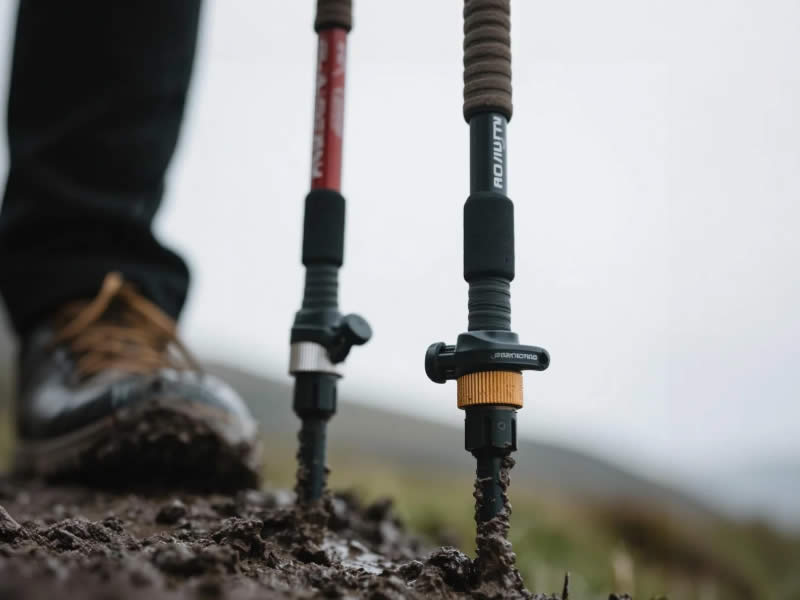
Recommended trekking pole purchase link: https://s.click.aliexpress.com/e/_c4M7OWaN
How each mechanism works
- Twist‑lock: An internal plastic or rubber expander is compressed when you twist the pole sections. The friction holds the pole at length. Dirt, water, and mud can penetrate the joint.
- Lever lock (flick‑lock): An external cam lever tightens a metal or plastic clamp around the inner shaft. The mechanism is exposed and can be easily cleaned.
Why twist locks fail in UK mud
1. Mud clogs the internal mechanism
Twist locks rely on the expander expanding against the inner wall of the outer tube. When mud or grit seeps into the joint, it gets between the expander and the tube. The result: the lock becomes impossible to turn, or it turns but doesn’t grip. Even after cleaning, residual grit can abrade the plastic expander, permanently reducing its effectiveness.
2. Slippage under load
In muddy conditions, you often lean heavily on poles to avoid sliding. A twist‑lock that has been contaminated with mud is prone to slipping – the pole collapses unexpectedly. This is not just annoying; it’s dangerous on a steep, muddy descent.
3. Difficult to clean on the trail
Twist locks require disassembly (unscrewing the end cap, pulling out the expander) to properly clean. In the middle of a muddy hike, you are unlikely to do this. You end up with a slipping pole that you can’t fix easily.
4. Freezing in cold mud
In winter, mud can freeze. Twist locks are notorious for freezing solid, making it impossible to adjust length or collapse the pole. Lever locks, being external, can be tapped or scraped free of ice.
Why lever locks excel in muddy UK conditions
- External mechanism: Mud and grit cannot get inside the clamping area. A quick wipe with a cloth or a rinse in a puddle clears the lever.
- Easy on‑trail cleaning: Open the lever, slide the sections to flush out dirt, close it. No disassembly needed.
- Positive lock: The lever provides a strong, consistent clamping force that does not degrade with mud exposure. You hear and feel a click when it’s secure.
- Serviceable: If a lever lock becomes loose, you can tighten a small screw with a coin or a multitool – even with muddy hands.
- Glove‑friendly: In cold, muddy weather, you may be wearing gloves. Lever locks are easy to operate with thick gloves; twist locks are not.
Real‑world experiences from UK hikers
Online forums and walking groups are unanimous: lever locks are the only sensible choice for British conditions. A typical comment: “My twist‑lock poles slipped on a muddy slope in the Lake District, and I nearly fell into a stream. Switched to lever locks and never looked back.” Another: “After one muddy walk, my twist locks were jammed solid. I spent an hour cleaning them. Lever locks just need a rinse.”
What about budget twist‑lock poles?
Very cheap poles (under £30) almost always use twist locks. They are fine for dry, flat paths but will fail quickly in UK mud. If you only walk on pavements or dry trails, they may suffice. For any hike involving mud, invest in lever locks.
Recommended lever‑lock poles for UK mud
- Leki Khumbu Lite (SpeedLock 2) – reliable, foam grip, affordable.
- Black Diamond Trail Pro (FlickLock Pro) – extremely robust, metal lock.
- Decathlon Forclaz MT500 – budget lever‑lock option, surprisingly good.
- Komperdell Contour Powerlock – solid European choice.
Maintenance tips for lever locks after muddy hikes
- Rinse with fresh water to remove mud.
- Open the lever and wipe the inner shaft.
- Occasionally tighten the screw on the lever (quarter turn) to maintain clamping force.
- Apply a tiny drop of dry silicone spray to the pivot point (not the shaft).
Final verdict
For hiking in the UK – where mud is inevitable – lever lock (flick‑lock) trekking poles are far superior to twist‑locks. They are reliable, easy to clean, and safe under load. Twist locks belong in dry climates or on paths that never see mud. If you value your knees and your safety, choose lever locks. They will serve you for years on British trails, from the bogs of Dartmoor to the claggy paths of Snowdonia.




