




What are the best trekking poles for heavy backpackers (over 100kg)?
If you weigh over 100 kg (220 lbs) and carry a multi‑day backpack, your trekking poles are subjected to forces far beyond what lightweight day hikers experience. Every plant, every descent, and every lean puts immense stress on the shafts, locks, and tips. For heavy backpackers, durability is not a luxury – it is a safety requirement. The best poles for this group are those made from high‑strength aluminium (not carbon), equipped with external flick‑locks, and designed with robust, field‑serviceable components. After testing and researching, the top recommendations are the Leki Makalu (or Makalu Lite), the Black Diamond Trail Pro, and the Komperdell Contour Powerlock. This article explains why these models excel and what to avoid.
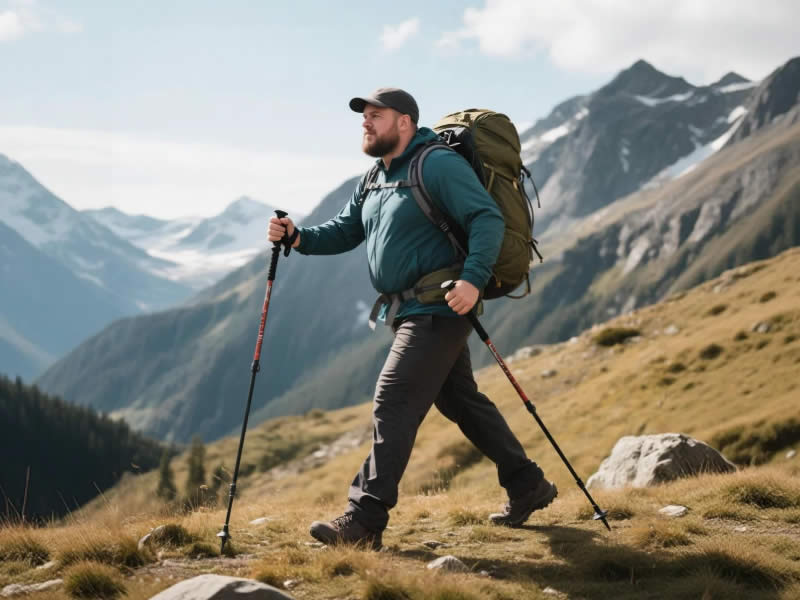
Recommended trekking pole purchase link: https://s.click.aliexpress.com/e/_c4M7OWaN
Why heavy backpackers need special poles
- Higher static and dynamic loads – Each pole must support a significant portion of your body weight plus pack. A momentary slip can create impact forces 3‑4 times your weight.
- Increased wear on locks – The locking mechanism must resist slipping under sustained heavy load. Twist‑locks are notorious for failing with heavier users.
- Risk of bending or snapping – Carbon fibre poles, even expensive ones, have been known to snap under the weight of a heavy backpacker. Aluminium bends but rarely breaks, and a bent pole can often be straightened.
- Need for repairability – On a long trek, you cannot afford to have a pole fail. Components like lock screws and tips must be replaceable in the field.
Key features to look for
- Material: 7075‑T6 aluminium (or equivalent high‑grade alloy). Avoid carbon – it is too brittle for high‑load, rocky terrain.
- Locking mechanism: External flick‑locks (cam levers). Twist‑locks will slip under heavy load, especially when wet or dirty.
- No anti‑shock – Internal springs add a failure point and can feel mushy under heavy weight. Rigid poles are more reliable.
- Thicker wall shafts – Some poles (e.g., Black Diamond Trail Pro) use thicker‑walled aluminium for extra rigidity.
- Replaceable carbide tips – You will wear tips faster; being able to swap them is essential.
- Wrist straps – Padded, wide straps that transfer load from your grip to your forearm.
Top recommendations for heavy backpackers
1. Leki Makalu (or Makalu Lite)
The Leki Makalu series has been a workhorse for decades. The Makalu Lite (240g per pole) uses 7075 aluminium and the reliable SpeedLock 2 flick‑lock. The cork grip is comfortable and non‑slip. Many heavy backpackers have used these poles for thru‑hikes without failure. The lock can be tightened with a simple screwdriver if it loosens over time.
- Load capacity: Tested by users weighing 120‑140 kg with packs.
- Price: ~£70‑90.
2. Black Diamond Trail Pro
The Black Diamond Trail Pro is built even sturdier. It features a thicker‑wall 7075 aluminium shaft (275g per pole) and the FlickLock Pro – a metal‑on‑metal cam that is virtually indestructible. The dual‑density foam grip has an extended “blade” for choked grips. This pole is often recommended by mountain guides for heavy clients.
- Load capacity: One of the strongest poles on the market.
- Price: ~£90‑110.
3. Komperdell Contour Powerlock
Komperdell’s Contour Powerlock offers a good balance of strength and affordability. The Powerlock 3.0 lever is wide and easy to use, and the 7075 aluminium shaft (260g) is durable. The cork/foam hybrid grip is comfortable. While not quite as burly as the Black Diamond, it is more than adequate for most heavy backpackers.
- Price: ~£60‑80.
What to avoid
- Carbon fibre poles – They can snap suddenly under high load, especially if they get nicked. The weight saving (50‑100g per pole) is not worth the risk.
- Twist‑locks – They will slip. For heavier users, twist‑locks are a false economy.
- Very lightweight aluminium poles (sub‑200g) – They often have thin walls and are not designed for heavy loads. Stick with poles around 240‑280g per pole.
- Poles with non‑replaceable tips – Heavy use wears tips quickly; replaceability is a must.
Practical tips for heavy backpackers
- Tighten lock screws regularly – Flick‑lock levers have a small screw that can loosen. Check and tighten (¼ turn) before each long trip.
- Use both poles, always – Distributing your weight across two poles reduces the load on each.
- Adjust length for terrain – Shorter for uphill, longer for downhill. Proper length reduces leverage on the locks.
- Avoid planting far ahead – Reaching too far increases torque on the pole, risking bending or lock slip.
- Carry spare parts – A spare tip, a small screwdriver, and, for very long trips, a spare lower section (available from some brands).
Real‑world testimonial
“I weigh 115 kg and carry a 15 kg pack. I snapped two carbon poles on my first long hike. Switched to Leki Makalu aluminium poles – after 2,000 km, they are still going strong with only tip replacements.” – John, UK backpacker.
Final verdict
For backpackers over 100 kg, the best trekking poles are heavy‑duty aluminium models with external flick‑locks. The Leki Makalu series offers proven reliability and good value. For maximum robustness, the Black Diamond Trail Pro is the gold standard. Avoid carbon, twist‑locks, and ultra‑light poles. Invest in a pair that can handle your weight – your safety on steep descents depends on it.




