




Do anti-shock trekking poles really reduce knee pain on descents?
If you suffer from knee pain on steep downhills, you’ve likely seen anti‑shock (spring‑loaded) trekking poles promising a softer, gentler descent. But do those internal springs actually protect your knees? The short answer is no. Anti‑shock poles do not directly reduce knee pain. Here’s the science and why rigid poles are just as effective – if not more so – for knee protection.
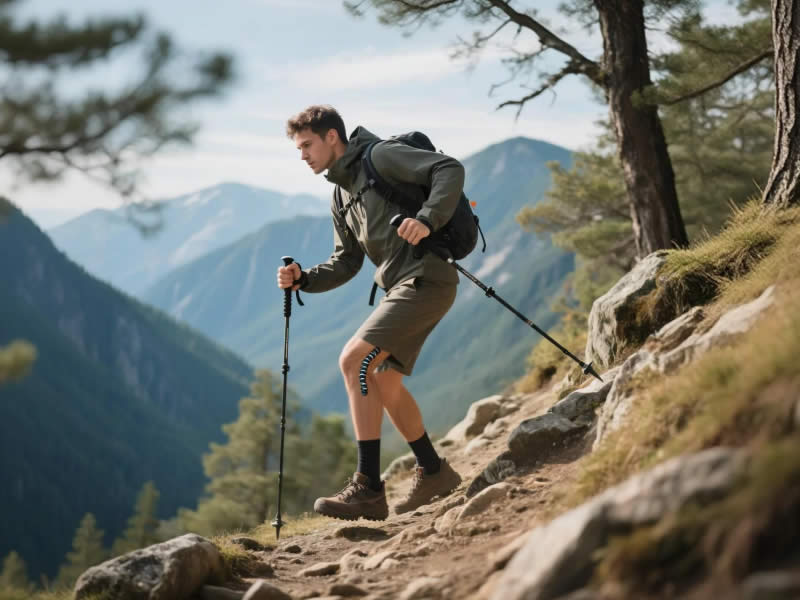
Recommended trekking pole purchase link: https://s.click.aliexpress.com/e/_c4M7OWaN
How knee pain happens on descents
When you walk downhill, your quadriceps act as brakes, and each footstrike sends a force of 3–5 times your body weight through your knee joint. The primary way to reduce that load is to transfer some of your weight from your legs to your arms using trekking poles. This load transfer – not cushioning – is what protects your knees. Research shows that using two poles (any poles) can reduce knee joint loading by 20–25% on descents.
What anti‑shock actually does
An anti‑shock mechanism (a coil spring or elastomer) is located in the upper shaft. When you plant the pole, the spring compresses slightly (10–20 mm), absorbing some of the impact that travels up your arm to your shoulder and wrist. It does not reduce the force transmitted through your legs to your knees. The spring only cushions your arms – not your knees. Some marketing claims imply otherwise, but the biomechanics are clear.
Why anti‑shock doesn’t help knees
- Load path: The weight that would go to your knee is transferred via the wrist strap and your arm, regardless of whether the pole has a spring. A rigid pole transfers load just as effectively.
- Direction of force: Knee impact is vertical, from your foot hitting the ground. Anti‑shock acts horizontally along the pole’s axis – it cannot affect the vertical force on your knee.
- No evidence: No published study has shown that anti‑shock poles reduce knee joint forces compared to rigid poles. The proven benefit comes from using any poles with proper technique.
Potential downsides of anti‑shock for knees
- Bounciness: On rocky descents, the spring can create a “pogo” effect, reducing feedback and control. This can actually increase fall risk.
- Weight: Springs add 30–50g per pole, making the poles heavier and potentially increasing arm fatigue.
- Energy loss: Each compression absorbs a small amount of your forward momentum, making descents slightly less efficient.
- Maintenance: Springs can squeak, jam, or fail over time.
What actually reduces knee pain on descents
- Using two poles (any kind) – Bilateral support distributes load.
- Correct pole length for downhill – Lengthen poles by 5–10 cm from your flat setting. This allows you to plant ahead of your body and brake effectively.
- Proper wrist strap technique – Hand up through the strap from below, then grip lightly. The strap transfers load to your arms.
- Active push down – Don’t just let the pole touch; push down as you step. This actively transfers weight away from your knees.
- Shortened stride – Smaller steps reduce impact force.
When anti‑shock might help (but not for knees)
- Wrist or elbow arthritis – The spring can reduce jarring in your upper limbs.
- Walking on very hard surfaces (pavement) – Constant impact can be tiring for arms.
- Light, casual walking – The extra cushion is harmless.
But for knee pain specifically, skip the springs.
Final verdict
Anti‑shock trekking poles do not reduce knee pain on descents. Knee protection comes from load transfer via wrist straps and proper pole length, not from internal springs. Rigid poles are lighter, simpler, cheaper, and just as effective for knee health. Invest in a quality pair of lever‑lock poles (aluminum or carbon), learn correct downhill technique, and save your money. Your knees will thank you – without the bouncy springs.




