




How to walk with trekking poles to save energy on the Coast to Coast path?
The Coast to Coast path – 192 miles (309 km) from St Bees to Robin Hood’s Bay – traverses the Lake District, Pennines, and North York Moors. With its constant ups and downs, saving energy is key to finishing each day feeling strong. Trekking poles can conserve significant energy, but only if used with the right technique. Here’s how to walk efficiently across England’s most iconic long‑distance trail.
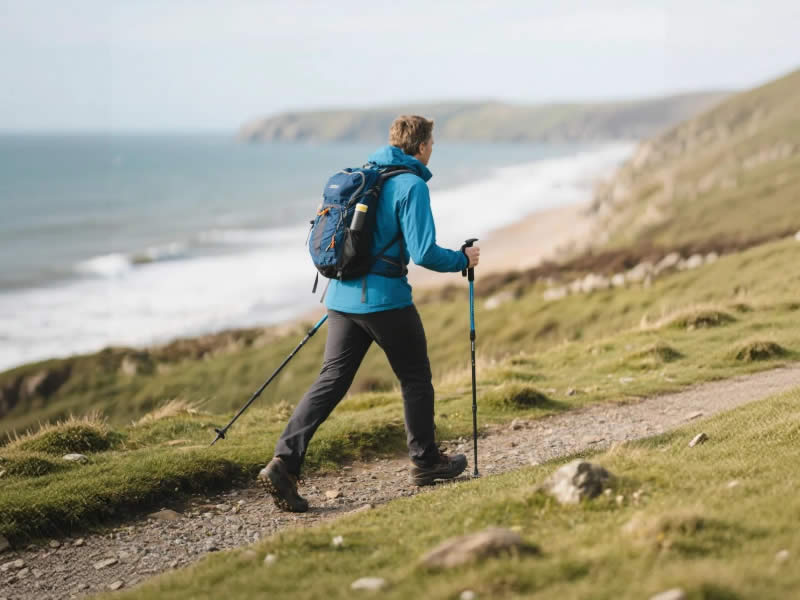
Recommended trekking pole purchase link: https://s.click.aliexpress.com/e/_c4M7OWaN
The secret: transfer work from legs to arms
Walking without poles forces your legs to do all the work. With poles, you can engage your arms, shoulders, and back – spreading the load across more muscles. This reduces the strain on your quadriceps and calves, preserving them for the many hills. To achieve this, you must:
- Use the wrist straps correctly (hand up from below, strap between thumb and index finger). The strap should bear your weight, not your grip.
- Push back with each plant – don’t just tap the ground. Actively drive the pole backward as you step forward, adding a small propulsion boost.
The opposite arm‑leg rhythm
The most energy‑efficient walking motion is the natural diagonal gait: right foot forward, left pole planted; left foot forward, right pole planted. This rhythm uses your body’s natural counter‑rotation, saving energy compared to planting both poles together. On the Coast to Coast’s long, rolling sections – like the Eden Valley or the Yorkshire Moors – stick to this alternating pattern.
Adjust length for each terrain
- Flat sections (e.g., along the River Eden): Elbow at 90° when tip is on the ground. This neutral length allows a relaxed arm swing.
- Uphill (Lake District passes): Shorten poles by 5–10 cm. This keeps your arms low, allowing you to push down effectively. Use double planting on steep climbs to pull yourself up.
- Downhill (from Kidsty Pike or into Swaledale): Lengthen poles by 5–10 cm. Plant ahead of your feet and push down to brake, transferring weight from your knees to your arms.
Keep your poles light
If you’re carrying your poles instead of planting them, you’re wasting energy. Collapse and stow them on your pack when not needed (e.g., long paved sections). Use ultralight foldable poles (300–400g per pair) to reduce arm fatigue over 15‑mile days.
Practical energy‑saving tips for the Coast to Coast
- Eat and drink while walking: Use one pole to balance while you grab a snack with the other hand.
- Pole length markings: Mark your “uphill”, “flat”, and “downhill” lengths with tape or a marker. Reset them without measuring each time.
- Relax your grip: A death grip tires your forearms. Let the strap do the work.
- Shorten your stride on uphills: This reduces energy waste and keeps your cadence high.
Drill to practice before your trip
On any local hill, walk up once without poles, then again with poles shortened correctly and using an active push. You’ll immediately feel the difference in leg burn. The rhythm becomes automatic after a few miles.
Final verdict
To save energy on the Coast to Coast path, use opposite arm‑leg planting, adjust pole length for each terrain, push back actively, and master the wrist strap. Your legs will thank you after the descent from Nine Standards Rigg, and you’ll have more energy for the final dash to Robin Hood’s Bay.




