




Can trekking poles be used to test water depth before crossing?
When you encounter a stream or river on the trail – whether in the Lake District, the Scottish Highlands, or the Alps – one of the most critical steps before crossing is assessing the water depth. Stepping into an unexpectedly deep hole can lead to a fall, wet gear, or even hypothermia in cold conditions. Trekking poles are an excellent tool for this job, but only if used correctly. The short answer is yes, trekking poles can be used to test water depth, but with important limitations and proper technique.
Recommended trekking pole purchase link: https://s.click.aliexpress.com/e/_c4M7OWaN
How to test depth with a trekking pole
- Lengthen your pole fully (or at least to its maximum stable extension). A longer pole gives you greater reach.
- Remove any rubber tip cover – you need the bare carbide tip to feel the bottom.
- Keep small baskets on – they prevent the pole from sinking into mud or soft gravel, but they don’t affect depth measurement.
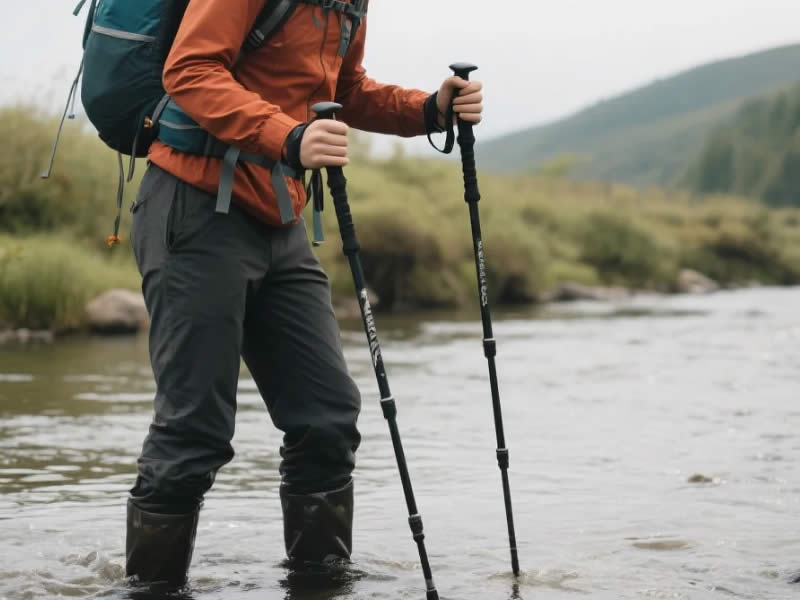
- Probe ahead – before you commit your body, reach forward with one pole and push it vertically down until it hits solid ground. The water level on the shaft tells you the depth.
- Probe in multiple spots – depths can vary rapidly. Use your poles to test a few potential foot placements.
What you can and cannot determine
- Depth: You can accurately measure water depth at the exact point where the pole touches bottom. Mark the shaft with your fingers or note the waterline on the pole.
- Bottom composition: A carbide tip can distinguish between rock, gravel, mud, or sand by feel. Soft mud may require larger baskets or different crossing strategy.
- Hidden holes: By probing ahead, you can detect sudden drop‑offs before stepping into them.
What you cannot determine
- Current speed: Poles don’t measure flow. A shallow stream with fast current can still sweep you off your feet.
- Bottom stability: A pole might hit a rock that later rolls when you step on it.
- Ice or slippery algae: The tip may grip, but your boot may slip.
Limitations of trekking poles for depth testing
- Pole length: Most trekking poles max out at 135 cm (about 4.5 feet). If a stream is deeper, you cannot probe it safely with your pole. For deeper water, you need a different crossing strategy or a longer stick.
- Flooded poles: If you submerge the pole above the locking mechanism, water can enter and degrade the lock. Seal locks with waterproof tape or avoid full submersion.
- Turbid water: In murky water, you can’t see the waterline on the pole. Use the feel of the tip on bottom and an estimated depth based on how far you lowered the pole.
Step‑by‑step for safe crossing using poles to test depth
- Assemble your poles – lengthen them, remove rubber tips, check locks.
- Find a wide, slow section – avoid narrow channels where current is strong.
- Probe from the bank – extend one pole as far as you can; push it vertically down. Note depth. If it’s over mid‑thigh, reconsider crossing.
- Walk slowly – use both poles planted downstream. Probe each step before shifting weight.
- Keep three points of contact – either both poles + one foot, or one pole + both feet.
When poles are not enough
- Water deeper than 1 meter (3 feet) – your poles won’t reach bottom. Turn back or find a bridge.
- Fast current – even shallow water can knock you over. Poles help with balance but cannot overcome strong flow. If the water reaches your knees and the current is strong, do not cross.
- Very cold water – depth becomes less important; hypothermia is a risk. Find a different crossing or wait.
Alternatives and complementary tools
- Use a longer stick – if you’re concerned about depth beyond pole length, find a long branch.
- Throw a rock – to gauge depth by sound (plunk = deep, crack = shallow) – not as accurate.
- GPS or map – may indicate fords or depth information.
Final verdict
Yes, trekking poles are highly effective for testing water depth before crossing, provided the water is shallower than the pole’s length. They allow you to probe for holes, feel the bottom, and measure depth precisely. Always pair depth testing with current assessment and proper crossing technique (downstream bracing, two poles, unbuckled pack). Never rely solely on poles – use your judgment. With careful use, your poles will keep you dry and safe on countless stream crossings.




