




How to use trekking poles for trail running on the South Downs Way?
The South Downs Way – 100 miles (160 km) of rolling chalk hills, steep ascents, and rapid descents – is a classic British trail run. Trekking poles can be a game‑changer, saving energy on climbs, improving stability on slippery downland, and reducing impact on your knees. But running with poles requires a different technique than hiking. Here’s how to use them effectively on the South Downs Way.
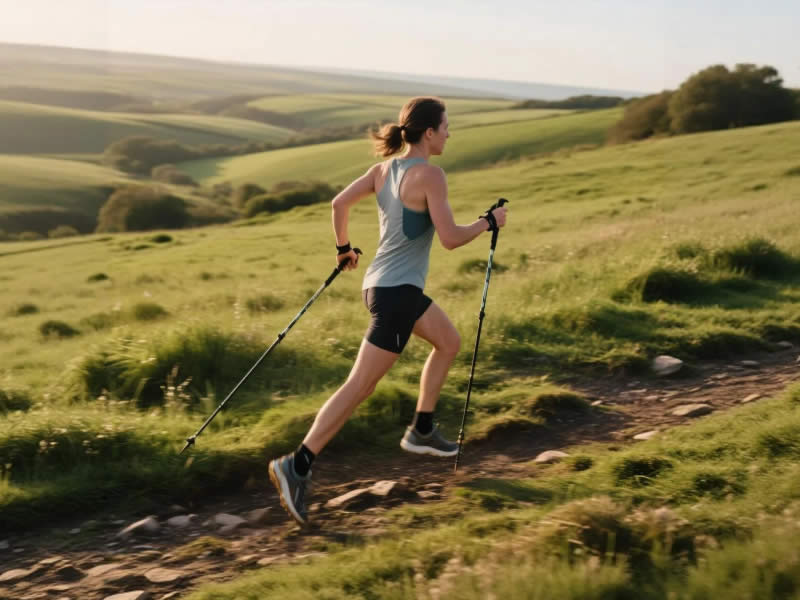
Recommended trekking pole purchase link: https://s.click.aliexpress.com/e/_c4M7OWaN
Choose the right poles for running
Leave your heavy telescopic hiking poles at home. For trail running, you need ultralight foldable (Z‑pole) poles:
- Weight: Under 150 g per pole (300 g per pair).
- Material: Carbon fibre – stiff and light.
- Grip: Foam – lightweight and comfortable.
- Length: Fixed or minimally adjustable. Choose based on your height (e.g., 120 cm for a 175 cm runner). Slightly shorter than hiking poles.
Top models: Black Diamond Distance Carbon Z, Leki Ultratrail FX.One, Komperdell C4 Carbon Pro.
Set the correct length
For running, use a slightly shorter pole than for hiking. Stand with elbows at 90° – the tip should touch the ground. Then shorten by 2–5 cm. A shorter pole promotes a faster cadence and prevents over‑reaching. On the South Downs’ steep climbs, you’ll thank the shorter length.
Master the running pole technique
- Light, quick plants – Unlike hiking, you don’t need to push hard. Plant the pole lightly, just enough to maintain rhythm. Over‑planting slows you down.
- High cadence – Aim for 170–190 steps per minute. Plant opposite pole to forward foot, matching your natural running gait.
- Short stride on climbs – On the South Downs’ notorious steep ascents (e.g., the climb out of Alfriston or up to Ditchling Beacon), shorten your stride and use poles to pull yourself up. Plant both poles together for extra power.
- Relaxed grip – Use wrist straps loosely (or not at all for very short runs). Your hands should be relaxed, holding the poles like eggs.
- Descending the chalk ridges – On smooth, grassy or chalky descents, you can either stow your poles or use them for balance. If using, plant lightly and keep them short to avoid tripping.
Stowing and deploying on the move
The South Downs Way has long sections of gentle ridgeline where poles are unnecessary. Efficient runners stow their poles on their vests:
- Running vest pockets: Most vests have elastic loops or bungees on the front or back. Fold your Z‑poles and slide them diagonally into a front stretch pocket or under a bungee.
- Magnetic clips: Some vests have magnetic toggles – quick and secure.
- Hand carry: For short sections, fold and carry both poles in one hand.
Practice stowing and deploying at home until you can do it in under 10 seconds without stopping.
Energy savings on the South Downs
- On the endless climbs (the Downs are rarely flat), poles reduce leg effort by 15–20%, saving your quads for the next rise.
- On the steep, chalky descents (especially after rain when chalk is slippery), poles provide extra stability, preventing ankle rolls.
- During the long, undulating middle sections, use alternating rhythm with light plants to maintain forward momentum.
Common mistakes to avoid
- Planting too far forward – slows you down; plant just ahead of your forward foot.
- Using hiking‑style heavy plants – running requires a light touch.
- Gripping too tightly – relax your fingers; let the pole pivot.
- Forgetting to stow – carrying unfolded poles on flat sections throws off your balance.
- Poles too long – causes over‑reaching and shoulder strain.
Drills for South Downs running
- Climb rehearsal: On a steep grassy slope (e.g., the climb to Butser Hill), practice double planting with a high cadence. Compare your leg effort with and without poles.
- Stow/deploy drill: Run 100 m, stow poles, run 100 m, deploy. Repeat until fluid.
- Downhill confidence: On a gentle chalk descent, run without poles, then with poles planted lightly. Notice the difference in your knees and confidence.
Final verdict
For trail running on the South Downs Way, lightweight foldable poles are a powerful tool. Use a shorter length, light quick plants, a high cadence, and stow them on long flats. Master the rhythm and the transitions, and you’ll conquer the chalk climbs with less fatigue, protect your knees on the descents, and finish your ultra or long run feeling stronger. The South Downs Way is a classic – run it with poles and experience the difference.




