




How to use trekking poles to increase walking speed on gentle hills?
Most hikers think of trekking poles as tools for stability and knee protection, not speed. But on gentle hills – those undulating slopes that aren’t steep enough to exhaust you but do slow you down – poles can actually help you walk faster with less perceived effort. The key is to convert the poles from passive support into active propulsion. Here’s how to pick up the pace on rolling terrain.
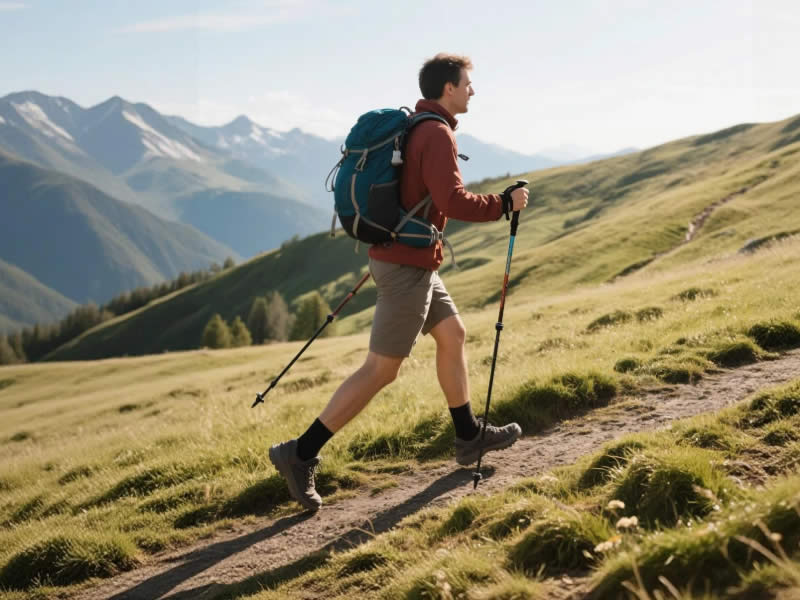
Recommended trekking pole purchase link: https://s.click.aliexpress.com/e/_c4M7OWaN
The biomechanics of faster walking on hills
Walking speed is determined by stride length and cadence (steps per minute). On a gentle uphill, your natural stride shortens, and your cadence often drops. Trekking poles can reverse both effects when used actively. By pushing back with each plant, you add a small amount of forward thrust – like using your arms to help your legs. Over hundreds of steps, this adds up to a noticeable speed increase. Additionally, poles encourage an upright posture and a more rhythmic arm swing, which can increase cadence without extra leg effort.
Step 1: Shorten your poles slightly
On gentle hills (both up and down), use a slightly shorter pole than your standard flat‑ground setting. Reduce the length by 2–3 cm (about one inch). Why? A shorter pole allows you to plant closer to your body, reducing over‑reaching. It also promotes a faster, more compact arm swing, increasing cadence. If your poles are too long, your arm swing will be slow and cumbersome, and you’ll lose the leverage needed for a quick push.
Step 2: Use an active push – don’t just tap
The most common mistake is lightly tapping the pole on the ground. For speed, you must push back with each plant.
- As your foot lands, plant the opposite pole.
- Instead of just letting the pole touch, actively drive the pole backward as you push off with your rear foot.
- Your hand should end up behind your hip, with your arm extended back.
- This backward push adds forward momentum, like a mini rowing stroke.
You’ll feel your triceps and latissimus dorsi engaging. This is good – you’re using your upper body to help your legs.
Step 3: Maintain a high cadence
The opposite arm‑leg rhythm is essential. For speed, you want a quick, crisp rhythm.
- Use a metronome app set to 120–130 beats per minute. Plant a pole on every second beat.
- Keep your plants light and snappy – no heavy stabbing.
- Focus on a smooth, continuous motion. The poles should feel like extensions of your arms.
On a gentle uphill, your cadence will naturally drop – actively using the poles helps you maintain a faster step rate than without poles.
Step 4: Lean slightly forward (uphill) and keep your chest up
On an uphill, lean slightly forward from your ankles (not your waist). This converts the pole push into forward motion. On a gentle downhill, lean back slightly and use the poles to brake – but for speed, you want to maintain momentum, so a neutral to slight forward lean works. Keep your chest open and your eyes ahead.
Step 5: Use wrist straps correctly
A relaxed grip is essential for speed. With your hand inserted up through the strap (from below), the strap should bear the weight. Your fingers can be almost open. This allows a fast, loose swing without death‑gripping the handle.
How much faster can you go?
On a 5% uphill grade, experienced walkers using this active technique can increase their speed by 5–10% for the same perceived effort. That’s the difference between a 5 km/h walk and a 5.5 km/h brisk walk. Over a full day of rolling hills, this adds up to significant time savings and less leg fatigue.
Drills to build speed on gentle hills
- Cadence drill: On a gentle uphill, count your steps for 30 seconds. Then, try to increase your step count by 10% using quick pole plants. Feel the difference.
- Push drill: Walk with poles but deliberately push back as hard as you can for 10 steps. Feel the extra forward thrust. Then try to maintain that feeling at normal effort.
- Interval training: Walk fast with poles for 2 minutes, then recover for 1 minute. Repeat on a rolling section.
Common speed‑killing mistakes
- Planting too far forward – over‑reaching slows you down. Plant when your hand is level with your forward heel.
- Heavy, loud plants – a quiet, light plant is faster.
- Using poles that are too long – short poles = faster cadence.
- Gripping too tightly – tension slows your arm swing.
- Planting both poles together on gentle hills – this kills rhythm and speed. Use alternate planting.
Final verdict
To increase walking speed on gentle hills, shorten your poles by 2–3 cm, use an active push back with each plant, maintain a high cadence, and keep a relaxed grip. This technique turns your poles into propulsion tools, not just balance aids. With a little practice, you’ll glide over rolling terrain faster and with less leg fatigue – perfect for long days on undulating trails. Try it on your next hilly walk and feel the difference.




