




How to use trekking poles for descending steep grassy slopes after rain?
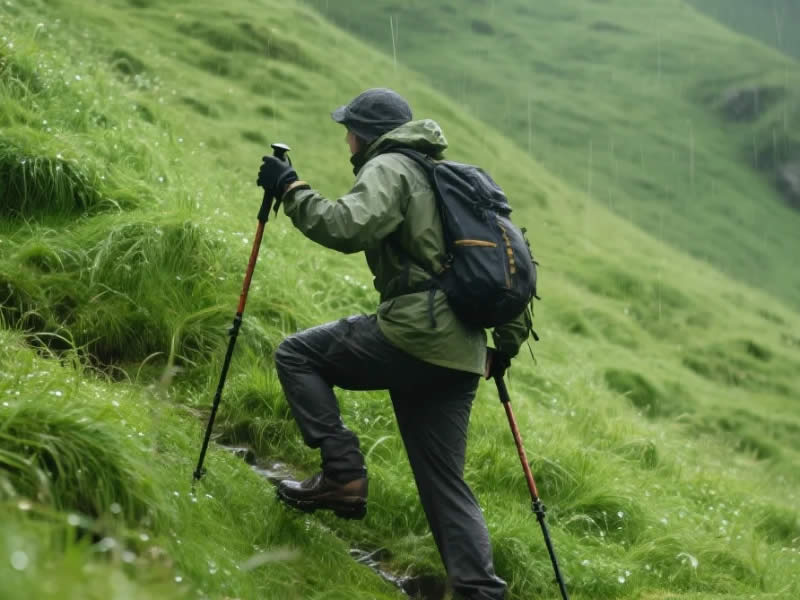
Descending a steep, rain‑soaked grassy slope is one of the most slippery and nerve‑wracking experiences on a hike. Grass becomes like a greased slide; your boots slide even on gentle slopes, and on steep hills, a fall can be inevitable. Trekking poles are essential, but only if you use the correct technique and equipment. Here’s how to stay upright and safe on wet grass.
Recommended trekking pole purchase link: https://s.click.aliexpress.com/e/_c4M7OWaN
The problem with wet grass
Freshly rained‑grass has almost no friction for boot soles. The combination of blade orientation (grass grows downward) and water reduces grip to near zero. Without poles, you might find yourself sliding uncontrollably, trying to self‑arrest with your hands – which can lead to abrasions, sprains, or worse. Poles give you four points of contact, but you must set them up properly.
Step 1: Prepare your poles for wet grass
- Lengthen your poles by 5–10 cm compared to flat terrain. A longer pole allows you to plant ahead of your feet, creating a braking angle.
- Remove any rubber tips – use bare carbide tips. Rubber slides on wet grass; carbide bites through the thatch to find firmer ground below.
- Small baskets are fine – they won’t interfere. Large snow baskets can tilt the tip; remove them if possible.
- If you have ice grips (spiked rubber covers), they can provide extra bite on very slick grass, but carbide usually suffices.
Step 2: The braking technique
- Face the slope (do not turn sideways).
- Plant both poles together about 30–50 cm ahead of your feet, slightly wider than shoulder width.
- Push down firmly – drive the tips through the grass layer until they hit soil or a root.
- Lean back slightly from your ankles – your body should be perpendicular to the slope, not leaning forward. The poles help you resist gravity.
- Take short, shuffling steps – do not lift your feet high. Slide your heel back, place your foot flat, and feel for grip.
- Move one pole at a time after each step, keeping at least one pole planted at all times.
Alternative: sideways traverse
If the slope is extremely steep, turn sideways and descend in a traversing “sidestep”:
- Plant the downhill pole first, pushing it firmly into the grass.
- Step sideways with your downhill foot, then bring your uphill foot down.
- Use the uphill pole for additional balance. This technique reduces the steepness you face and gives you more control.
What to avoid
- Planting poles beside your feet – no braking effect. Plant ahead.
- Leaning forward – this shifts your centre of gravity downhill, increasing the risk of a head‑first slide. Lean back.
- Taking long strides – short, flat steps are safer.
- Using rubber tips – they will skid instantly.
- Relying on one pole – you need two for four‑point stability.
If you start to slide
Release your poles (or let them drag) and try to sit down on your heels – a controlled slide is better than a fall. If you have an ice axe (unlikely on a grassy hill), use it to self‑arrest. Otherwise, dig in your heels and the pole tips to slow yourself.
Additional tips for wet grass descents
- Choose a grassy slope with tufts or tussocks – these provide better footholds than smooth, uniform grass.
- Walk on the edge of the path where grass meets dirt – the dirt may offer more grip.
- Consider descending in a zig‑zag – reduces the effective steepness.
- Keep your poles close to your body – over‑reaching can pull you forward.
Drill to practice
Find a moderate, grassy hill after a rain (or wet it with a hose). Start near the bottom. Practice the two‑pole braking technique for 10 metres, then increase steepness. Learn how much pressure is needed to make the tips bite.
Final verdict
Descending steep, rain‑soaked grassy slopes is safer and more controlled with correctly used trekking poles. Lengthen your poles, remove rubber tips, plant both poles ahead, push down firmly, lean back, and take short, shuffling steps. Use a sidestep traverse on extremely steep sections. With practice, you’ll confidently descend even the slipperiest hills – no more sliding out of control.




