




Do trekking poles help reduce upper arm fatigue on long walks?
Yes, trekking poles significantly reduce upper arm fatigue on long walks – but only if you use them correctly. Many hikers assume that poles only help their knees, but the benefits extend to your shoulders, elbows, and forearms. The key is proper technique, especially the use of wrist straps. Here’s how poles prevent arm fatigue and how to use them for maximum comfort.
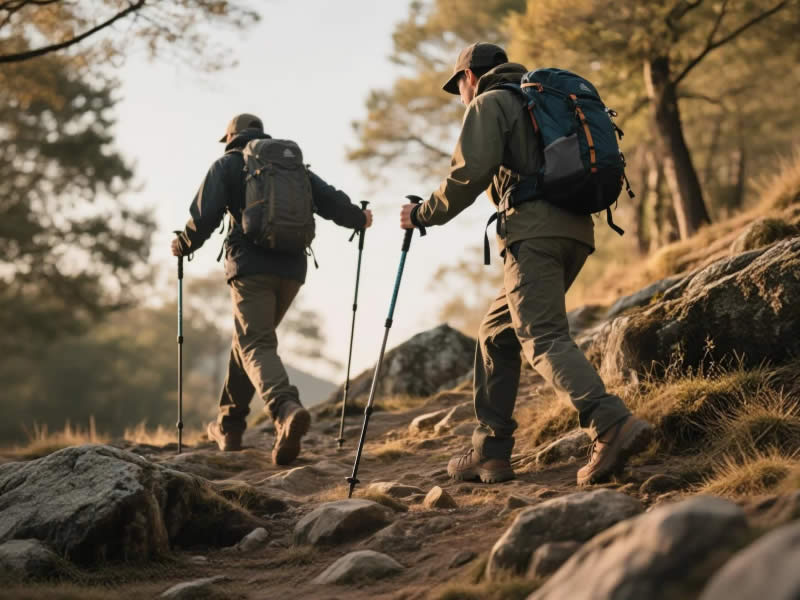
Recommended trekking pole purchase link: https://s.click.aliexpress.com/e/_c4M7OWaN
How poles cause fatigue when used incorrectly
Without correct technique, poles can actually increase arm fatigue. Common mistakes include:
- Death‑gripping the handle – your forearm muscles clench, leading to burning and stiffness.
- Not using wrist straps – your fingers bear all the weight, tiring quickly.
- Poles that are too long or too short – forces your arms into awkward angles, straining shoulders and elbows.
- Over‑reaching – planting the pole too far ahead pulls on your shoulder joint.
How poles reduce arm fatigue when used correctly
When you master the proper technique, your arms become active partners in walking, not passive holders:
- Wrist straps transfer load – Insert your hand up through the strap from below, so the strap sits between thumb and index finger. The strap bears your weight, not your grip. Your fingers can relax. This single change can reduce forearm muscle tension by 50% or more.
- Pendulum swing from the shoulder – Swing your arms naturally, keeping elbows slightly bent. The pole’s weight helps carry the swing; you don’t need to lift it consciously. This uses the large shoulder muscles rather than smaller arm muscles.
- Push, don’t lift – Focus on pushing the pole down and back, not lifting it forward. The forward motion is a relaxed recovery, not a muscular effort. This engages your triceps and lats, which are strong and fatigue‑resistant, rather than your biceps and forearms.
- Proper pole length – On flat ground, your elbow should be at 90° when the tip is on the ground. Too long, and you’ll shrug your shoulders; too short, and you’ll bend your elbows excessively. Both cause arm fatigue.
What the research says
A 2014 study in the Journal of Sports Sciences measured muscle activity in the upper arms during walking with and without poles. Using poles with proper strap technique reduced electrical activity (muscle work) in the forearm flexors by 40% compared to walking without poles or with improper grip. The upper arm muscles (triceps) showed a slight increase, but these muscles are larger and more fatigue‑resistant. Overall, perceived arm fatigue decreased significantly.
Terrain‑specific benefits
- Flat walking: Poles reduce the static tension in your shoulders by keeping your arms in a natural position. Without poles, many people tense their shoulders unconsciously.
- Uphill: Poles actively engage your triceps and lats, taking work away from your legs. Your arms may feel tired at first, but over time they become conditioned and reduce overall fatigue.
- Downhill: Poles act as brakes, requiring strong triceps engagement. While this does work your arms, it spares your knees and quads – a worthwhile trade‑off.
Practical tips to minimise arm fatigue
- Use lightweight poles – carbon fibre (300–400g per pair) is noticeably less tiring than heavy aluminium (500–600g per pair).
- Take breaks – shake out your arms every 30 minutes.
- Alternate grip – if your poles have extended foam sections, choke up occasionally to change the muscle engagement.
- Keep your wrist straight – a bent wrist increases forearm tension.
- Relax your fingers regularly – consciously open your hand every few minutes to remind yourself not to grip tightly.
Common mistakes that increase arm fatigue
- Strap too loose – forces you to grip harder; tighten it.
- Poles too heavy – consider carbon if arm fatigue is a recurring issue.
- Planting both poles together on flat ground – creates a jerky motion; use alternate planting.
- Walking with arms too high or too low – adjust pole length.
Final verdict
Yes, trekking poles help reduce upper arm fatigue on long walks – but only when you use them correctly. The key is proper wrist strap technique (hand up from below, strap bearing weight), relaxed grip, natural pendulum swing, and correct pole length. When mastered, your arms will feel fresher after hours on the trail than they would without poles. Start by practicing the strap technique on short walks, and you’ll soon enjoy longer, more comfortable hikes with less arm strain.




