




How to use trekking poles on technical rocky sections in the Brecon Beacons?
The Brecon Beacons in South Wales are famous for their stunning but challenging rocky terrain – from the jagged limestone pavements of the Black Mountain to the quartzite scree of Pen y Fan and the erosion‑scarred paths of Cribyn. Walking on these technical rocky sections demands a different approach to using trekking poles than on smooth trails. Here’s how to stay safe and efficient on the Beacons’ rockier ground.
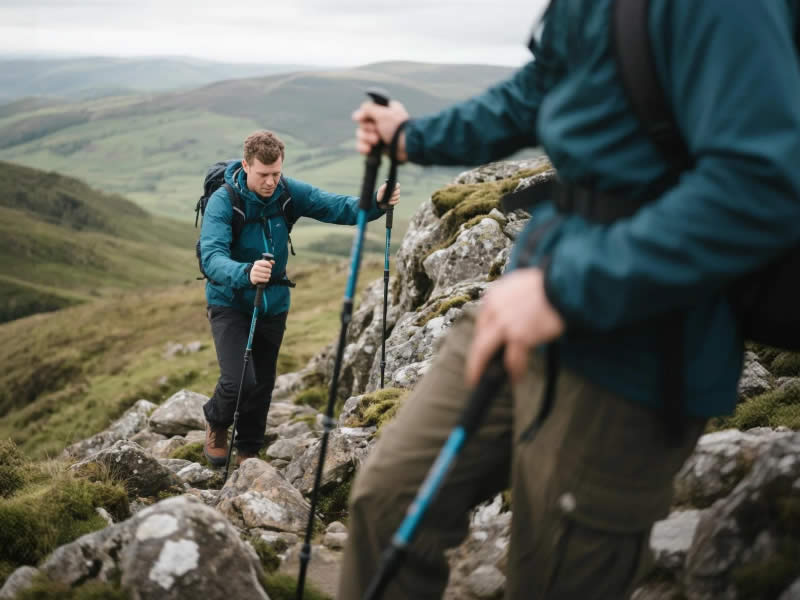
Recommended trekking pole purchase link: https://s.click.aliexpress.com/e/_c4M7OWaN
When to use poles – and when to stow them
- Use poles for: Walking across blocky, uneven rock where you don’t need your hands for balance, descending steep rocky paths, and crossing limestone pavements with wide grippy surfaces.
- Stow poles for: Any section where you need to use your hands to scramble (e.g., the final push to Fan y Big’s rocky summit), narrow gullies, or climbing over stiles.
Prepare your poles for rocky terrain
- Shorten your poles by 5–10 cm compared to flat ground. Shorter poles give you better control, prevent them from hitting your face, and reduce the chance of jamming between rocks.
- Remove rubber tips – use bare carbide tips. They bite into rock even when wet or mossy.
- Remove large snow baskets – they catch on rock edges and can break. Small summer baskets are fine.
- Check lever locks – ensure they are tight. A collapsing pole on rock is dangerous.
Technique for walking on rocky paths
- Plant on flat rock surfaces – avoid planting in crevices or between boulders where the tip can get stuck. If the tip jams, you may fall forward or snap the pole.
- Plant vertically – an angled plant on a sloping rock can skid. Push the tip straight down.
- Test each plant – before committing your weight, press lightly to ensure the tip has traction.
- Use alternate planting – opposite pole to forward foot, the same as on flat ground. This maintains rhythm.
- Keep your eyes ahead, not down – use peripheral vision and the tactile feedback from your poles to feel the ground.
Descending steep rocky sections
- Lengthen poles by 5–10 cm (compared to flat) for descents.
- Use double planting – plant both poles together ahead of your feet, then step down. This gives maximum braking and stability.
- Take short, deliberate steps – avoid bouncing or jumping. Poles help you lower yourself slowly.
Ascending steep rocky slopes
- Keep poles shortened (5–10 cm shorter than flat).
- Use double planting – plant both poles ahead and pull yourself up, engaging your arms.
- Look for flat rock shelves – aim to plant on stable surfaces, not loose flakes.
What to avoid on Brecon Beacons rock
- Planting in cracks – the carbide tip can wedge, and as you move forward, the pole can snap or you can trip.
- Using poles as levers – never pull on a pole to lift yourself up a rock step. It can snap or slip. Use your free hand.
- Keeping long poles – they will hit the rock above you, throwing off your balance.
- Leaving wrist straps tight – if you fall, you don’t want a pole strapped to your wrist. Remove straps or keep them very loose.
Practical tips for specific Beacons locations
- Limestone pavement (e.g., Black Mountain): The grippy, pitted surface is great for carbide tips. Use short poles and plant on the flat tops of clints (the blocks). Avoid planting in grykes (the deep fissures) – the tip can get stuck and you may twist an ankle.
- Pen y Fan’s eroded stone steps: The stone is often smooth and polished. Carbide tips bite well, but rubber tips slide. Use bare carbide. Shorten poles for the steep sections.
- Scree on Cribyn: Use double planting on descents; the poles help you control your slide. Lengthen poles and plant ahead.
When to stow poles
On any section where you need both hands for balance or holds – for example, the short rocky scramble up to the summit of Fan y Big, or crossing a stream with large boulders. Collapse your poles and attach them to your pack. It takes only 30 seconds and prevents a dangerous accident.
Final verdict
On technical rocky sections in the Brecon Beacons, trekking poles are a valuable aid – but you must adapt your technique. Shorten poles, use carbide tips, plant on flat rock surfaces (not crevices), and avoid using poles as levers. On steep descents, double plant and brake. When the terrain requires hands, stow your poles. With the right approach, your poles will improve stability and reduce knee strain, making the Beacons’ rocky paths safer and more enjoyable.




