




Can trekking poles be used as a camera tripod for long exposures?
For landscape and night photographers who also hike, every gram counts. Carrying a full tripod can add 1–2 kg to your pack. Trekking poles are already in your hands – could they double as a camera support for long exposures? The short answer is yes, but not as a monopod. A single pole is unstable for long exposures. However, with a simple adapter, you can convert two trekking poles (plus a third stick or pole) into a surprisingly sturdy tripod. Here’s how.
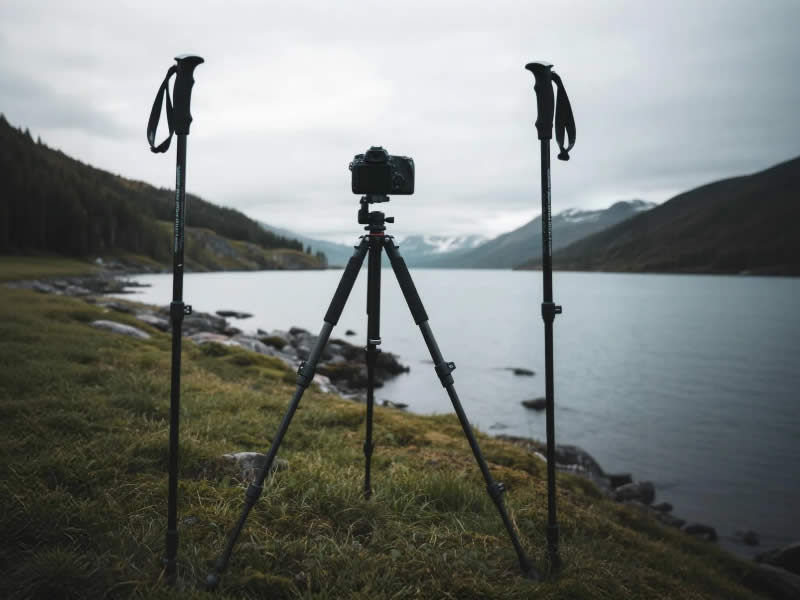
Recommended trekking pole purchase link: https://s.click.aliexpress.com/e/_c4M7OWaN
The monopod problem
Many trekking poles have a removable grip with a ¼‑20 screw thread. You can attach a ball head and use the pole as a monopod. But a monopod has only one leg – it’s stable for handheld shots (reducing camera shake by 2–3 stops) but not for long exposures. Any movement of your body or wind will blur the image. For exposures longer than 1/10 second, a monopod is insufficient.
The solution: two‑pole tripod systems
Several products allow you to turn your trekking poles into a tripod:
- TrailPix (most popular): A small, lightweight hub (about 30 g) that accepts three pole tips. You insert your two trekking poles and a third stick (or a third pole) to create a full tripod. The hub has a standard ¼‑20 screw for your camera. It folds flat and costs about €50.
- DIY methods: Use a small piece of wood with three holes drilled at angles, or a clamp that holds three poles together. Less elegant but functional.
- Using two poles as a bipod: You can mount your camera on a bracket that attaches to two poles, forming an A‑frame. This works for static shots but still requires a third leg for full stability.
How to get stable long exposures with poles
- TrailPix method: Set up your two trekking poles and a third stick (e.g., a stout branch or your partner’s third pole). Adjust the pole lengths so the tips form a stable tripod. Mount your camera on the hub. Use a remote shutter release or 2‑second timer to avoid vibration.
- Two‑pole + ground technique: For very short long exposures (e.g., 1–2 seconds), you can lean your camera on a low ball head attached to one pole, and use the second pole to brace the first. Not recommended.
- Hanging weight: For any pole‑based support, hang your backpack from the centre of the tripod to add stability in wind.
Limitations and practical tips
- Load capacity: The TrailPix and similar adapters are designed for mirrorless cameras or small DSLRs with lightweight lenses (total under 2 kg). A heavy telephoto lens may be too much.
- Pole rigidity: Trekking poles are not as stiff as dedicated tripod legs, especially at full extension. Keep them as short as possible (e.g., use a shorter stick as the third leg).
- Tip grip: Carbide tips can slip on rock. Use rubber tip covers on hard surfaces for better grip.
- Wind: Pole‑based tripods are more susceptible to wind than a solid tripod. Seek sheltered locations or add weight.
What about using a single pole as a tripod with a clamp?
Some photographers carry a small clamp (e.g., Joby GorillaPod Clamp) that attaches to the pole shaft. You then attach your camera to the clamp. This gives you a fixed monopod, but again, not stable for long exposures unless you can brace the pole against something.
Recommendations for camera users
- For long exposures (night, waterfalls, astro): Invest in a lightweight tripod (e.g., Peak Design Travel Tripod, 1.3 kg) or use the TrailPix system. The TrailPix adds only 30 g to your pack and turns your existing poles into a functional tripod.
- For casual, short exposure (1/10 – 1 second): A monopod (single pole) with a ball head is fine.
- For group shots/selfies: Use the TrailPix or simply prop your camera on a rock.
Final verdict
Yes, you can use trekking poles as a camera tripod for long exposures – but not with a single pole. You need a system like the TrailPix hub that converts two poles and a third stick into a stable tripod. This solution is ultralight, packable, and perfectly adequate for mirrorless cameras and small DSLRs. For heavy gear or extreme stability, a dedicated tripod remains superior. But for weight‑conscious hiking photographers, the TrailPix is a game‑changer. Always test your setup at home before relying on it in the field.




