




How to use trekking poles for pulling yourself up on steep steps?
Steep steps – whether on a forest staircase, a mountain trail with rock steps, or the eroded stairs of a coastal path – can be exhausting for your legs. Trekking poles can transform these sections by allowing you to use your strong upper body to pull yourself up. The technique is simple but requires proper pole adjustment and body positioning. Here’s how to do it effectively and safely.
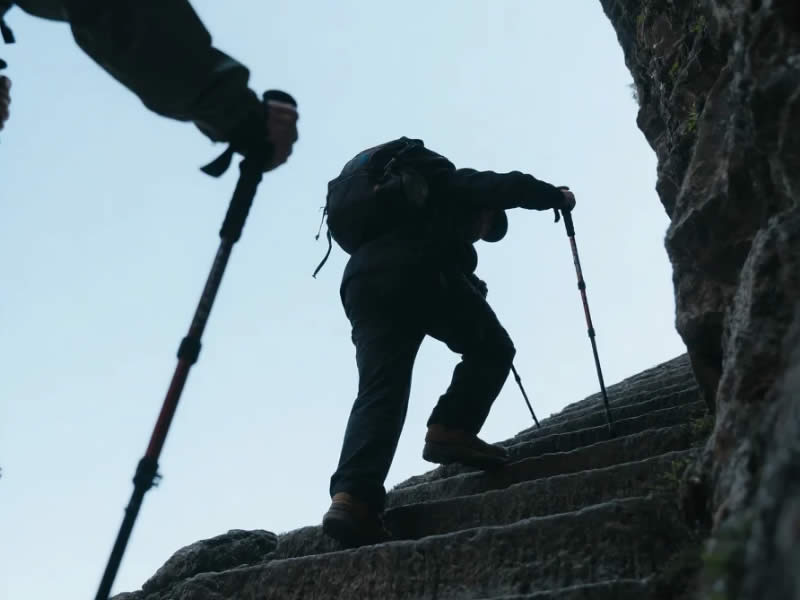
Recommended trekking pole purchase link: https://s.click.aliexpress.com/e/_c4M7OWaN
When to use the “pull‑up” technique
This technique is best for steep, consecutive steps where you need to lift your body weight with each step. It’s not for gentle inclines or uneven scrambling – only for clear, repeating steps (e.g., boardwalks, stone staircases, or compacted dirt steps). On very steep or slippery steps, the pull‑up method reduces leg fatigue and improves stability.
Step 1: Shorten your poles significantly
Before you start climbing the steep steps, shorten your poles by 5–10 cm (or even more, depending on steepness). Your flat‑ground length (elbow at 90°) is too long for this technique. A shorter pole allows you to plant it ahead of you at a comfortable height without raising your arms too high. As a rule, the steeper the steps, the shorter the poles. Mark your “steep step” length on the shaft for quick reference.
Step 2: Plant both poles together ahead
Stand facing the steps. Plant both poles simultaneously on the step you are about to climb (or on the step just above). Space them shoulder‑width apart. Push the carbide tips firmly into the step – on wooden steps, aim for a softer spot; on rock, find a small depression for grip. Avoid planting in gaps between steps where the tip could slip.
Step 3: Engage your arms and pull
With both poles securely planted, pull your body upward using your arms. Your elbows should bend as you pull. Your legs will still step, but the poles will take a significant portion of your weight. Imagine you’re pulling yourself up a ladder. Keep your back straight and your chest open – do not hunch over the poles.
Step 4: Step with the opposite foot rhythm
As you pull, lift your foot and place it on the next step. There’s no strict opposite‑pole rule here because you’re using both poles together. Simply step with whichever foot is comfortable. After you’ve taken one step, reposition the poles to the next step and repeat.
Step 5: Keep your body close to the steps
Avoid leaning too far forward – that shifts your centre of gravity away from your feet. Instead, keep your body close to the steps. Your arms should pull you up and slightly toward the steps, not out and up. This maintains balance and reduces the risk of the poles slipping.
Common mistakes to avoid
- Poles too long: Your arms will be forced too high, reducing pulling power and straining shoulders.
- Planting poles too far ahead: This pulls you away from the steps and unbalances you. Plant on the step you’re about to climb, or the one just above.
- Using one pole only: Two poles provide balanced pulling force. One pole can twist your torso.
- Gripping too tightly: Let the wrist straps help. Insert your hand from below and relax your fingers – the strap will bear much of the load.
- Forgetting to shorten poles: Flat‑length poles make this technique impossible. Always shorten for steep steps.
Additional tips for different step surfaces
- Wet wooden steps: Carbide tips may slip. Use rubber tips (if they have good grip) or find dry spots. Consider stepping around the poles.
- Rock steps: Carbide tips bite well. Look for small cracks or rough patches for a secure plant.
- Muddy or loose steps: The poles may sink. Use small baskets to prevent sinking, but the pull‑up technique may be less effective. Consider an alternative route.
Drill to practice
Find a short set of steep steps (e.g., a staircase in a park). First climb without poles, noting leg effort. Then climb with poles shortened correctly, using the pull‑up technique. You’ll notice an immediate reduction in quadriceps burn. Practice for 5 minutes until the motion feels natural.
Final verdict
Using trekking poles to pull yourself up on steep steps is a powerful energy‑saving technique. Shorten your poles, plant both together ahead, and pull with your arms as you step. This transfers work from your legs to your strong upper body, allowing you to climb steep stairs with less fatigue and more stability. Master it, and even the longest flight of steps will feel manageable.




