




Can trekking poles be used to measure distance by stride counting?
When hiking without a GPS or a map, some walkers use “stride counting” – measuring how many steps they take over a known distance, then multiplying that by their average stride length to estimate the distance traveled. The question arises: can trekking poles help with this process? The short answer is yes, indirectly. While poles themselves are not measuring tools, they can help you maintain a consistent stride length, which is the key to accurate stride counting. Additionally, you can mark your poles to measure short distances directly. Here’s how.
Recommended trekking pole purchase link: https://s.click.aliexpress.com/e/_c4M7OWaN
The problem with stride counting without poles
Stride length varies depending on terrain, fatigue, pack weight, and your natural gait. On uneven ground, you might take shorter steps; on a smooth descent, longer steps. This variability introduces error. Inconsistent stride length can make your distance estimate off by 10–20% or more.
How trekking poles improve stride consistency
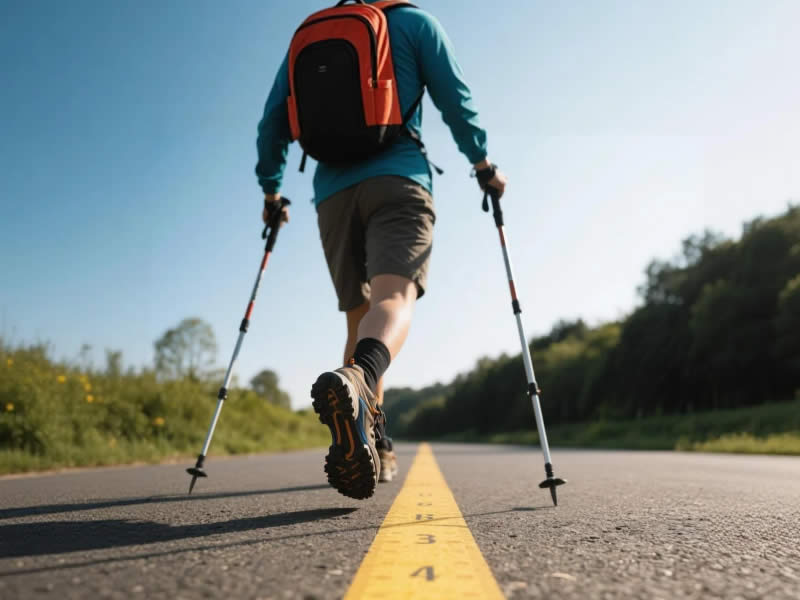
Trekking poles impose a rhythmic, repeating pattern. When you plant your poles in an alternating rhythm (opposite pole to forward foot), each step tends to be more uniform. The poles act as a pacing guide: you naturally adjust your stride length to match the pole plants. This consistency reduces the variation in stride length, making stride counting more accurate.
Using poles as a direct measuring tool
You can also use your poles to measure short distances on the trail – for example, the width of a stream, the height of a step, or the length of a campsite. Here’s how:
- Mark your pole with a known distance. Use a permanent marker or tape to mark 1 metre (or 1 foot) from the tip. You can also mark 50 cm and 20 cm for finer measurements.
- Extend your pole (telescopic) to a standard length, e.g., 120 cm. Note that the length includes the tip and grip. Measure the exact length at home.
- Use the pole as a ruler: Place the pole tip at one end of the feature (e.g., a rock), then count how many pole‑lengths (including fractions) span the distance. Multiply by the pole length.
Step‑by‑step for distance estimation using stride counting with poles
- Calibrate your stride on a known distance (e.g., 100 metres on a flat trail). Walk normally with your poles, using your standard rhythm. Count the number of steps (e.g., 120 steps per 100 m = 0.83 m per step).
- Compute your step length: Known distance ÷ number of steps.
- On the trail, count your steps (or use a step counter). Keep the same pole rhythm.
- Estimate distance: Steps × step length.
- Adjust for terrain: On an uphill, your steps will be shorter (reduce step length by 10–20%). On a downhill, steps may be longer. Use your poles to maintain a consistent effort, not a fixed length.
Practical tips for more accurate measurement
- Use a clicker or step counter – counting steps mentally is distracting. Many watches have step counters.
- Mark your pole length – knowing the exact extended length (e.g., 120 cm) allows you to measure short distances directly.
- Practice – calibrate your stride on both flat and hilly sections, with and without a pack.
- Average multiple counts – for a long distance, count steps over several 100‑m sections and average them.
Limitations to keep in mind
- Terrain variability still introduces error, even with poles. For precise navigation, use a GPS or map.
- Pole‑based stride counting works best on moderate, consistent trails – not on steep, technical scrambling.
- Pole length changes – if you adjust your pole length for different terrain (shorter for uphill, longer for downhill), your stride length changes accordingly. Re‑calibrate for each length setting.
An alternative: use your pole as a measuring stick for short distances
For measuring the width of a stream or the height of a drop, simply extend your pole to its maximum length (e.g., 135 cm). Place it horizontally or vertically against the feature. Compare the distance to your pole length. If your pole is 135 cm long and the stream is about one and a half pole lengths, it’s roughly 2 metres wide.
Final verdict
Trekking poles are not precision distance‑measuring instruments, but they can be used to improve stride counting by promoting a consistent stride length. They also serve as a handy ruler for short distances if you mark the shaft or know the extended length. For rough estimates on well‑defined trails, stride counting with poles is a useful skill. For accurate navigation, supplement with a GPS or a map. With practice, your poles will become a versatile tool – not just for balance, but for understanding the ground you cover.




