




How to use trekking poles in high winds on exposed ridges?
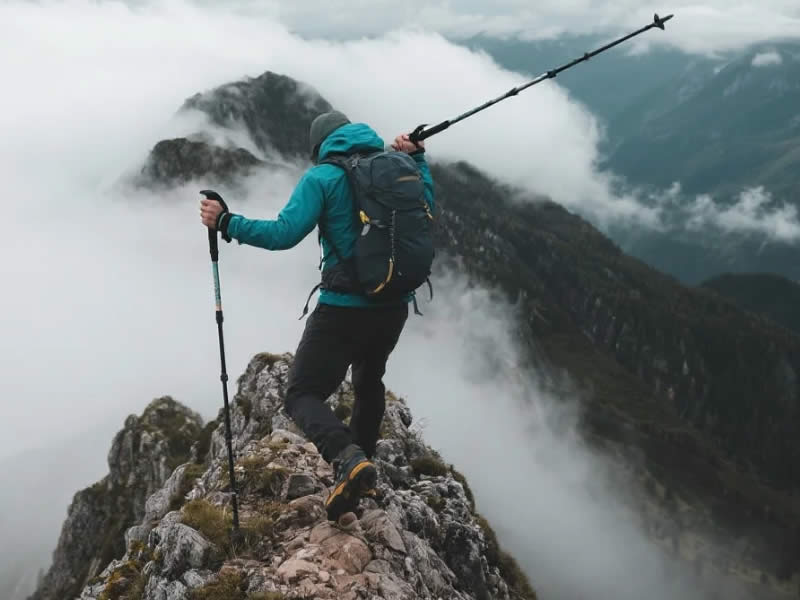
Walking on an exposed ridge in high winds – whether on Crib Goch in Snowdonia, Striding Edge in the Lake District, or a high Alpine pass – is one of the most challenging and dangerous hiking situations. Sudden gusts can throw you off balance, and your trekking poles can either help or become a hazard. Used correctly, poles improve stability and prevent falls. Used incorrectly, they can act like sails, pulling you off balance. Here’s how to use them safely in high winds.
Recommended trekking pole purchase link: https://s.click.aliexpress.com/e/_c4M7OWaN
The danger: poles as sails
In strong winds, holding poles upright turns them into levers. A gust hitting the broad side of a pole can twist your arm and pull you sideways. The higher you raise the pole, the greater the leverage. The solution: keep your poles low and stable.
Step 1: Shorten your poles significantly
On an exposed ridge, shorten your poles by 10–15 cm compared to flat ground. Your arms should be much lower than the standard 90° elbow angle. A shorter pole reduces the lever arm, making it harder for the wind to grab. It also keeps your center of gravity lower, which improves balance.
Step 2: Use a low, wide stance
- Plant both poles widely – about shoulder‑width apart or wider. This creates a wide base of support.
- Keep the poles close to the ground – the tips should be only a few centimetres ahead of your feet.
- Hold the poles at a low angle – nearly vertical, but slightly tilted into the wind. Do not raise them high.
Step 3: Plant firmly and continuously
- Use double planting – plant both poles together with each step, or maintain at least one pole on the ground at all times.
- Push down firmly – the pressure from your arms will help anchor you against gusts.
- Avoid lifting both poles at once – that leaves you with only two feet on the ground, reducing stability.
Step 4: Use wrist straps correctly – or remove them
- Keep straps snug so the pole doesn’t fly away if a gust catches it.
- Consider removing straps for very high winds. If a pole is ripped from your hand, you don’t want it attached to your wrist – it could pull you over. This is a personal decision; test what feels safe.
Step 5: Adjust your body position
- Lean slightly into the wind – from your ankles, not your waist. This counteracts the push of the wind.
- Bend your knees – a lower stance is more stable.
- Keep your torso upright – avoid hunching over the poles.
When to stow your poles
On extremely narrow, exposed ridges where you need both hands for balance (e.g., the final knife‑edge of Crib Goch), stow your poles on your pack. Use your hands to grip the rock. Trying to use poles in such a situation is dangerous – they can get caught, snag, or blow away.
Technique for different wind directions
- Headwind (wind in your face): Shorten poles, lean forward, plant both poles ahead. The wind helps press you into the poles.
- Tailwind (wind at your back): Shorten poles, lean back slightly, plant both poles behind you. The wind tries to push you forward – use poles as brakes.
- Crosswind (wind from the side): This is most dangerous. Lean into the wind, plant the upwind pole firmly, and keep the downwind pole ready to brace. Shorten both poles significantly. Consider crouching.
What to avoid in high winds
- Raising poles above your head – creates a huge sail; you could be knocked over.
- Planting poles far ahead – over‑reaching makes you vulnerable to gusts.
- Using a single pole – two poles provide four points of contact; one pole is insufficient.
- Walking with poles extended to full length – the longer the lever, the more wind force.
Practice on a windy day
Before you need it, practice the low‑pole, wide‑plant technique on a windy hill (not on an exposed ridge). Learn how different stances feel. With experience, the correct response becomes automatic.
Final checklist for windy ridges
- Poles shortened by 10–15 cm
- Both poles planted wide and low
- Leaning slightly into the wind
- Knees bent, torso upright
- Double planting or at least one pole always on ground
- Consider removing straps in extreme gusts
Final verdict
In high winds on exposed ridges, trekking poles are both a blessing and a potential hazard. Shorten them, keep them low, plant widely, and use a firm, continuous push. On extremely narrow or technical sections, stow them and use your hands. With the right technique, your poles will anchor you against the wind, not become a sail. Practice on less exposed terrain first, and always prioritise safety over speed.




