




Are carbon fibre trekking poles safe in sub-zero temperatures?
Winter hiking in the Scottish Highlands, the Alps, or any sub‑zero environment raises a critical question: can you trust your lightweight carbon fibre trekking poles in the extreme cold? The short answer is yes, with significant caveats. Carbon fibre does behave differently in freezing temperatures, but it can be safe if you understand its limitations and adapt your technique. Here’s what you need to know.
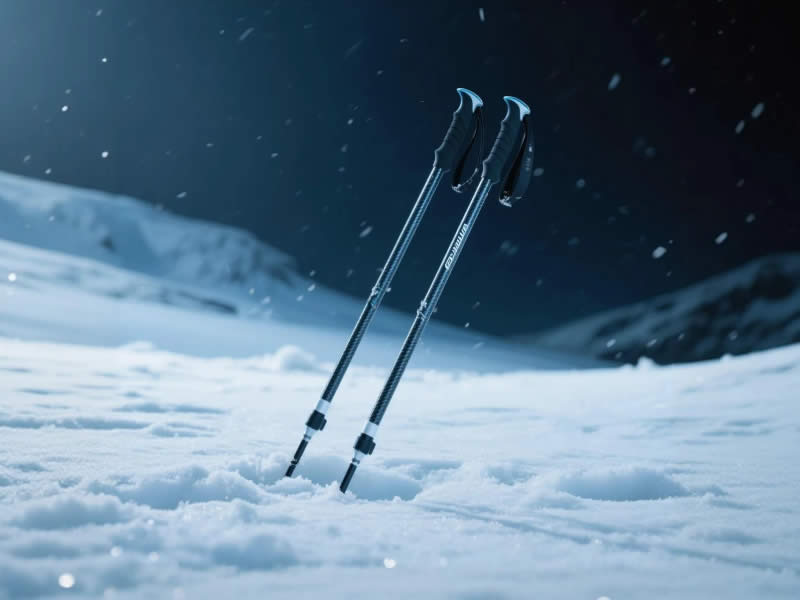
Recommended trekking pole purchase link: https://lightenup.aliexpress.com/store/1101521655
How carbon fibre works – and how cold affects it
Carbon fibre composites consist of carbon strands embedded in an epoxy resin matrix. The resin provides flexibility and impact resistance. At room temperature, carbon poles are extremely strong in compression (planting straight down) but vulnerable to lateral (sideways) forces, which can cause them to snap.
As temperatures drop below freezing, the epoxy resin becomes more brittle. The material loses some of its ability to absorb impact energy. At typical UK winter temperatures (-5°C to -15°C), the change is noticeable but not catastrophic. At extreme cold (e.g., -30°C in northern Scandinavia), carbon becomes significantly more brittle.
What the research and experience show
There are no peer‑reviewed studies specifically on trekking poles, but materials science tells us that most polymer‑based composites have a glass transition temperature (Tg) below which they become rigid and less tough. For high‑quality carbon used in poles (e.g., from Leki, Black Diamond, Komperdell), the Tg is typically well below -20°C. This means that in typical UK sub‑zero conditions (-5°C to -10°C), the change in toughness is minimal. However, impacts that would only cause a small crack at room temperature can propagate into a full break in the cold.
Anecdotally, many winter mountaineers use carbon poles successfully in the Alps and Norway, but they are careful to avoid jamming the pole between rocks or applying sideways leverage. Others have snapped carbon poles on icy Scottish ridges when a tip wedged in a crack and the pole was levered sideways.
When carbon poles are safe in sub‑zero conditions
- Soft, deep snow: Plant vertically, no lateral stress – carbon is fine. The snow also cushions any impact.
- Well‑maintained winter trails: Smooth, hardpacked snow or ice – as long as you plant straight, carbon is acceptable.
- Light loads and careful technique: If you are a light hiker and you are attentive to planting vertically, carbon can be safe.
When carbon poles are risky in the cold
- Rocky, icy terrain with cracks and crevices: The tip can get jammed, and a sideways pull will concentrate stress. In the cold, this is more likely to cause a snap.
- Falls or awkward plants: A stumble where the pole is loaded at an angle can cause sudden failure.
- Heavy packs (15+ kg): The extra force increases the risk of breakage, especially if the pole is at an angle.
- Very low temperatures (below -20°C): Most carbon poles are not rated for extreme cold. Check manufacturer specifications.
Aluminium: the safer winter alternative
7075 aluminium poles are significantly more forgiving in sub‑zero conditions. Aluminium does not become brittle – it remains ductile, meaning it will bend rather than snap. A bent aluminium pole can often be straightened enough to finish your hike. Aluminium is also less expensive and absorbs impact better. The trade‑off is weight: a pair of aluminium poles weighs about 500–600g vs. 300–400g for carbon. For winter safety, many mountaineers choose aluminium.
Best practices for using carbon poles in winter
- Inspect before every trip: Look for any existing cracks or delamination (especially near the joints). Cold can widen micro‑cracks.
- Avoid jamming tips: Plant only on solid, flat surfaces. Never force a pole into a crack.
- Shorten your poles on steep, icy terrain to reduce leverage.
- Use wrist straps loosely or remove them – if the pole snaps, you don’t want it attached to your wrist.
- Carry a spare pole or a repair sleeve (a short aluminium tube that can splint a broken carbon pole). Some brands sell emergency splints.
- Consider hybrid poles – carbon upper sections with aluminium lower sections (e.g., Leki Cressida). The aluminium lower is more impact‑resistant.
- Don’t use carbon as a lever to pull yourself up over rocks or out of a snow hole.
Manufacturer guidance
Leki, Black Diamond, and Komperdell all state that their carbon poles are tested down to -20°C. However, they caution that any impact – such as a fall or a jam – is more likely to cause breakage in cold temperatures than at room temperature. They recommend aluminium for “extreme winter conditions.”
Final verdict
Carbon fibre trekking poles are safe in sub‑zero temperatures for most winter hiking scenarios – i.e., walking on snow, hardpack, or ice with careful vertical planting. However, they become more brittle and are more prone to snapping if subjected to lateral stress or impacts. For icy, rocky terrain (like many Scottish winter routes) or if you tend to be heavy‑handed with your poles, aluminium is a safer and more durable choice. If you do use carbon in the cold, inspect them closely, plant vertically, avoid jams, and carry a repair splint. The weight savings may be worth it to you, but never compromise safety for a few grams.




