




How to use trekking poles for balance on neve (frozen snow)?
Neve – the granular, frozen snow that forms after multiple freeze‑thaw cycles – is a common winter surface in the Scottish Highlands, the Alps, and other cold mountain regions. Unlike soft powder or wet spring snow, neve is hard, sometimes icy, and often slopes at steep angles. Balancing on it without proper technique can lead to slips and falls. Trekking poles are essential, but you must use them correctly. Here’s how.
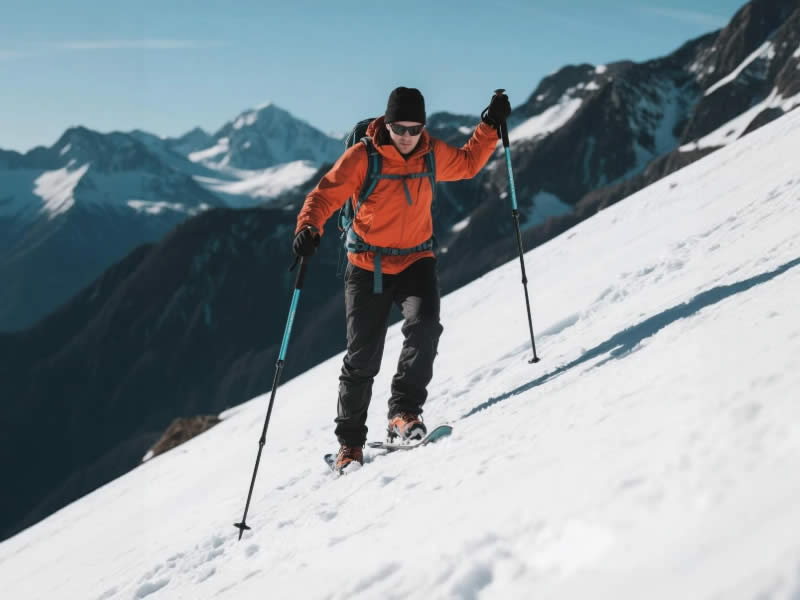
Recommended trekking pole purchase link: https://lightenup.aliexpress.com/store/1101521655
First, prepare your poles for neve
- Tips: Use tungsten carbide tips – they bite into hard snow. For very icy neve, add ice grips (spiked rubber covers). Remove rubber pavement tips – they are dangerously slippery.
- Baskets: You can use small summer baskets or no baskets. Large snow baskets are unnecessary on neve – they may lift the tip off the surface, reducing grip.
- Length: Set your poles 5–10 cm longer than your flat‑ground length. This allows you to plant ahead of your body, improving stability and balance.
Basic technique for flat or gentle neve slopes
- Plant vertically – an angled plant will skid sideways on hard neve. Push the pole straight down until the carbide tip engages.
- Use a firm, deliberate plant – a light tap may not penetrate the frozen crust. Apply steady pressure until you feel the tip bite.
- Maintain an alternating rhythm – plant the opposite pole to your forward foot (right foot forward, left pole down). This provides continuous support.
Descending neve slopes
Descending is where neve is most treacherous. Use this technique:
- Lengthen poles by 5–10 cm (relative to flat ground).
- Plant both poles together about 30–50 cm ahead of your feet.
- Push down firmly – the poles act as brakes, transferring weight from your legs to your arms.
- Keep your knees slightly bent and your torso upright. Do not lean forward.
- Take short, flat‑footed steps – avoid lifting your feet high. Shuffle or slide your feet.
- Move one pole at a time after each step, keeping at least one pole planted.
Ascending neve slopes
- Shorten poles by 5–10 cm (compared to flat length).
- Use double planting – plant both poles ahead and pull yourself up. Engage your triceps and lats.
- Take shorter steps and keep your weight centred.
Traversing across a neve slope
- Adjust each pole individually – shorten the uphill pole, lengthen the downhill pole, so your torso stays level.
- Plant the uphill pole firmly into the neve, using it as a support against sliding downhill.
- Use the downhill pole for additional balance, but keep it light.
Common mistakes to avoid
- Planting at an angle – the pole will skid. Keep it vertical.
- Using rubber tips – they have zero grip on neve.
- Keeping poles too short – you’ll lean forward and lose balance.
- Walking with a normal stride – short, controlled steps are safer.
- Relying only on poles – also wear microspikes or crampons on your boots for foot traction.
When to add ice grips
If the neve is polished ice (e.g., after rain followed by freezing), carbide tips alone may not be enough. Attach ice grips (e.g., Leki Ice Grips, Black Diamond Ice Tip). These have small metal spikes that bite into solid ice. Test on a safe patch before committing to a steep slope.
Practice on a gentle neve slope
Before tackling an exposed ridge, practice on a low‑angle neve slope. Experiment with pole length, planting force, and double planting. Learn how much pressure is needed to make the tip bite. With a few minutes of practice, the correct technique becomes instinctive.
Final checklist for neve travel
- Poles adjusted longer (or shorter for uphill)
- Carbide tips exposed (ice grips added if needed)
- Small baskets or no baskets
- Wrist straps used correctly (hand up from below)
- Double planting on descents
- Short, controlled steps
Final verdict
Walking on neve requires deliberate, vertical pole plants, longer pole length for descents, and double planting for stability. Carbide tips are essential; ice grips add security on polished ice. With the right equipment and technique, your poles will provide excellent balance, allowing you to cross frozen snow slopes safely and confidently. Neve may be hard, but your poles – used correctly – make it manageable.




