




Are trekking poles better than a traditional NHS walking stick?
For many people, the standard NHS walking stick (a single‑point cane) is the first mobility aid they think of. It is simple, cheap, and widely available. However, for walking on uneven ground, for longer distances, or for those with balance issues affecting both sides of the body, a pair of trekking poles is often significantly better. Here’s an honest comparison to help you decide.
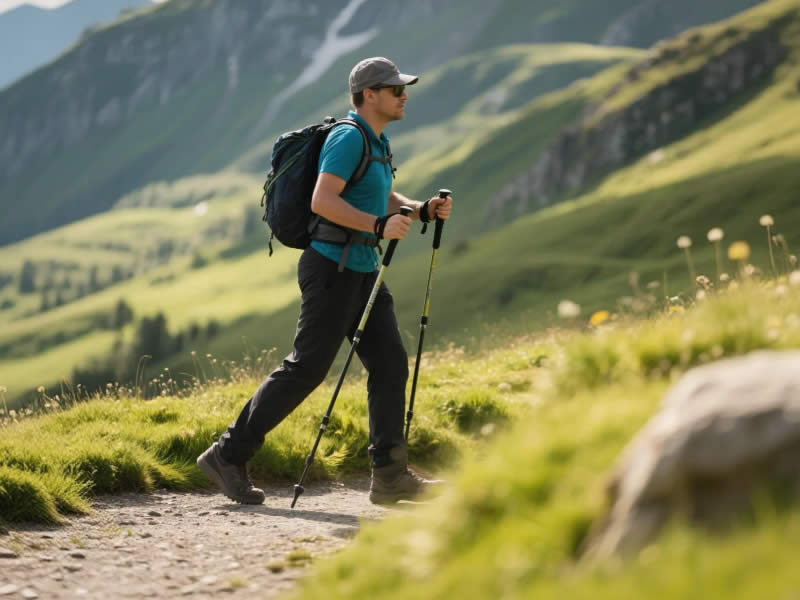
Recommended trekking pole purchase link: https://lightenup.aliexpress.com/store/1101521655
The case for a traditional NHS walking stick
- Simple and lightweight – A standard cane weighs around 250–350g, is easy to fold, and fits in a small bag.
- Familiar – Many people are used to using a single stick; there is little learning curve.
- Cheap / free – Available on the NHS or for a few pounds at a pharmacy.
- Good for minor support – If you have mild pain in one knee or hip, a stick on the opposite side can help offload that joint.
The limitations of a single walking stick
- Asymmetrical support – Using one stick forces you to lean to that side, potentially causing back pain or a limp over time. It also protects only one joint (e.g., one bad knee), leaving the other knee and hip unsupported.
- Poor balance on uneven ground – A single point of contact on a muddy path, gravel, or grass does little to prevent falls. The stick can slip or sink.
- Less upper‑body engagement – A cane is mostly for support; it doesn’t help propel you forward or improve posture.
- Not adjustable for hills – Most NHS sticks have a fixed length. On steep slopes, your wrist angle changes, reducing effectiveness and increasing strain.
Why trekking poles can be better
- Bilateral support – Two poles distribute weight evenly across both arms and both legs. This reduces the risk of developing a limp, protects both knees and hips, and keeps your torso level.
- Superior balance on uneven ground – With two poles, you have four points of contact (feet + poles). On gravel, grass, or trails, this dramatically improves stability and fall prevention.
- Adjustable length – Trekking poles can be shortened for uphill walking and lengthened for downhill. This keeps your wrist in a neutral position and maintains the weight‑bearing benefit on slopes – essential for joint protection.
- Upper‑body workout – Using two rhythmically makes walking a full‑body exercise, improving cardiovascular health and maintaining arm strength.
- Snow and mud performance – Add large baskets to prevent sinking; ice grips for frozen paths. A single NHS stick is useless in snow.
When a single walking stick is still good
- Very short, flat walks indoors or on smooth pavement.
- When you only have pain on one side and need minimal support.
- For someone who cannot coordinate two poles (e.g., some neurological conditions).
- As a temporary aid after a minor injury.
When trekking poles are clearly better
- Walking on uneven ground, grass, gravel, or trails.
- Recovering from hip or knee surgery (once cleared by a physio) – two poles encourage a symmetrical gait.
- For seniors with general balance decline – the four points of contact reduce fall risk.
- For anyone who walks more than a few hundred metres regularly.
- For winter walking or hiking in the countryside.
Choosing the right trekking poles for medical use
- Select lightweight aluminium poles (e.g., Leki Makalu, Decathlon Forclaz MT500) – carbon is fine but more expensive.
- Always use rubber tips (paw covers) on pavement and indoors. Carbide tips are for dirt only.
- Adjust length to elbow at 90° when standing.
- Use two poles – never one.
- Learn the correct gait – opposite arm‑leg rhythm (right foot forward, left pole forward). This is natural once practised.
Final verdict
For most people who walk on a variety of surfaces, for longer distances, or for those with balance concerns, a pair of trekking poles is significantly better than a single NHS walking stick. The bilateral support, adjustability, and extra points of contact make walking safer, more comfortable, and more efficient. The only downsides are the cost (though budget pairs are under £40) and a short learning curve. For indoor or very short flat walks, a single stick remains fine. But if you want to stay active outdoors, trekking poles are a wise investment in your independence and safety.




